seamus dubhghaill

Promoting Irish Culture and History from Little Rock, Arkansas, USA


Leave a comment

General Patrick Cleburne Commands Division in the Battle of Stones River

Irish-born Confederate States Army General Patrick Cleburne commands a division in the Battle of Stones River, also known as the Second Battle of Murfreesboro, one of the fiercest battles of the Western theater of the American Civil War. The battle takes place in Middle Tennessee from December 31, 1862, to January 2, 1863.

In early December 1862, the transfer of Confederate General Simon Bolivar Buckner creates a vacancy for a division command in General Braxton Bragg‘s Army of Tennessee. There is no man in that Army who can breathe a word against the promotion of Patrick Ronayne Cleburne to that post, nor the promotion to major general that goes with it. Usually, the months of December and January are quiet times, with soldiers in winter camps, but Union Major General William S. Rosecrans intends to drive Bragg’s army from Tennessee, winter or not.

Rosecrans’s Army of the Cumberland marches from Nashville, Tennessee, on December 26, 1862, to challenge Bragg’s Army of Tennessee at Murfreesboro. Bragg awaits his advance along Stones River, just west of Murfreesboro.

On December 31, each army commander plans to attack his opponent’s right flank, but Bragg has a shorter distance to go and thus strikes first. Cleburne’s division is on the Confederate left. A massive assault by the corps of Major General William J. Hardee, followed by that of Leonidas Polk, overruns the wing commanded by Major General Alexander M. McCook and drives the corps from the field. Union General Thomas Crittenden, observing from a distance, says it is the first time the Army of the Cumberland has ever seen such panic.

A stout defense by the division of Brigadier General Philip Sheridan in the right center of the line prevents a total collapse, and the Union assumes a tight defensive position backing up to the Nashville Turnpike. Repeated Confederate attacks are repulsed from this concentrated line, most notably in the cedar “Round Forest” salient against the brigade of Colonel William B. Hazen. Bragg attempts to continue the assault with the division of Major General John C. Breckinridge, but the troops are slow in arriving and their multiple piecemeal attacks fail.

Later, Confederate Corps commander William Hardee expresses his belief that had a fresh division followed up Cleburne’s, Rosecrans entire army would have been routed. Night falls, however, and the two armies bring in the New Year sleeping on their arms. Rosecran’s army is badly whipped, but it stays put on January 1st.

Bragg is cautious and only probes to discover if the Union army is still there. The Union army has fortified their position to the west of the river, in front of Cleburne. Bragg decides to attack them east of the river. Fighting resumes on January 2, 1863, when Bragg orders Breckinridge to assault a lightly defended Union position on a hill to the east of the Stones River. Chasing the retreating Union forces, this attack is successful at first, but they are led into a deadly trap. Faced with overwhelming artillery, the Confederates are repulsed with heavy losses. Bragg chooses to withdraw his army on January 3 to Tullahoma, Tennessee. Though his army has abandoned the field, Cleburne’s performance in his first battle as a major general has been outstanding. His eventual rise to corps command seems certain, but factors away from the battlefield prevent that.

The battle ends in a victory for the Union army following the Confederate army’s withdrawal on January 3, largely due to a series of tactical miscalculations by Confederate General Braxton Bragg, but the victory is costly for the Union army. Nevertheless, it is an important victory for the Union because it provides a much-needed boost in morale after the Union’s recent defeat at the Battle of Fredericksburg and also reinforces President Abraham Lincoln‘s foundation for issuing the Emancipation Proclamation, which ultimately discourages European powers from intervening on the Confederacy’s behalf.

Leave a comment

The Battle of Antietam

irish-brigade-at-antietam

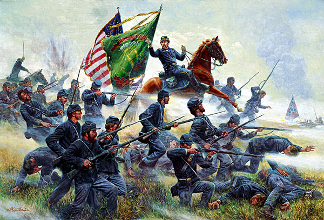
The Irish Brigade of the Union Army fights in the Battle of Antietam, one of the most famous battles of the American Civil War, on September 17, 1862. The battle has the sad distinction of being the bloodiest single day of fighting in America’s bloodiest war. Combined casualties at the Battle of Antietam are 26,134. Few regiments suffered more than the Irish Brigade.

The Irish Brigade is the brainchild of their commanding officer Thomas Francis Meagher. The former Young Ireland rebel, creator of the Irish Tricolor of green, white and orange, escaped political prisoner, lawyer, newspaper editor and politician forms the brigade with the twin objectives of gaining respect for the Irish by their patriotism for their adopted country and developing a nucleus for a future fight for Ireland’s freedom. The Brigade is formed of the almost exclusively Irish American 69th, 63rd and 88th New York and the “honorary Irish” of the 29th Massachusetts. The regiments of the Irish Brigade had already earned a formidable reputation as a crack unit, having distinguished themselves in every battle of the earlier Seven Days Battles. It is small wonder, many in the Brigade’s ranks had already distinguished themselves in the Mexican-American War or in fighting with the Papal forces in Italy against Giuseppe Garibaldi.

The Union Army is already heavily engaged, when the Irish Brigade is ordered to advance through an open field to take an area of high ground. Subjected to accurate Confederate rifle fire as they cross the field, the Brigade marches on in disciplined order, the National and the famed Green Regimental Colors (flags) fluttering overhead. When they encounter a fence across their line of march, eighty volunteers rush forward to knock it down, rather than see the whole Brigade slowed by the obstacle and exposed to fire. Over half of these volunteers are killed. Seeing the Irish continue to press forward, the Confederates fall back as the Irish advance up the hill.

What no one on the Union side knows is that on the other side of the hill is a farmer’s dirt road that years of rain has eroded into a ditch five feet below the surrounding ground level. The sunken road is a perfect rifle pit and is filled with Colonel John Brown Gordon’s Georgians. As the Irish crest the hill, they are met with a volley that decimates the Brigade, including killing or wounding every single standard-bearer. Seeing the flags fall from across the field, an aide to Union General George B. McClellan exclaims, “The battles lost, the Irish are fleeing!” only for McClellan to respond, “No, the flags are raised again, they are advancing.” Eight successive standard-bearers of the 69th New York alone fall that day as men pick up the flags from fallen comrades. Captain Patrick Clooney, though wounded himself, snatches up the colors from the 88th’s fallen standard-bearer only to be killed by multiple shots, the Green Flag wrapping around him like a shroud befitting a hero. Another standard-bearer, the staff of his Irish Brigade flag snapped in two by a rifle shot, drapes the flag over his shoulder like a sash and continues to move forward, personifying the Gaelic phrase on the flag he is carrying “Riamh Nar Dhruid O Spairn lann”, “Who never retreated from the clash of spears.”

The fire of the Confederates is so intense that the Irish Brigade cannot advance, but they do not flee either. Despite the failure of promised reinforcements that never materialize, the Brigade pours “Buck and Ball” (a 69-caliber ball and three 30 caliber buckshot) into the enemy at 300 paces, turning the “Sunken Road” into “Bloody Lane.” When their ammunition is depleted, the remnants of the Brigade, with drill ground precision, form and march back to the Union lines. The Irish Brigade never “ran” from the enemy. Another Union unit takes the “Bloody Lane,” but most credit the punishment that the Irish Brigade inflicted on the enemy, at a terrible cost to themselves, with making it possible. The New York Regiments take over 50% casualties. The Irish Brigade is now no bigger than a single regiment. As the depleted ranks of the 88th march passed, Union Major General Israel Bush Richardson salutes as it passes with the words “Bravo 88th, I shall never forget you!”

During the course of the War, the Irish Brigade suffers over 4,000 casualties, more men than the Brigade ever had at any one time. The Fighting 69th loses more men than any other New York regiment. The Battle of Antietam is remembered as the Union victory that allows President Abraham Lincoln to issue the Emancipation Proclamation, which frees the slaves in the Confederate states. It is all too often forgotten that this emancipation was secured in no small part with the blood of Irish immigrants, immigrants who were denied civil rights in their own country and faced discrimination in their adopted county before and after the Civil War.

In thinking of the Civil War, all Americans should remember the words of a defeated Confederate Officer to his Union counterpart at Appomattox, “You only won as you had more Irish than we did.”

(Credit: “The Irish Brigade at Antietam” by Neil F. Cosgrove, October 17, 2009)