seamus dubhghaill

Promoting Irish Culture and History from Little Rock, Arkansas, USA


Leave a comment

Birth of Thomas Patrick Ashe

thomas-patrick-ashe

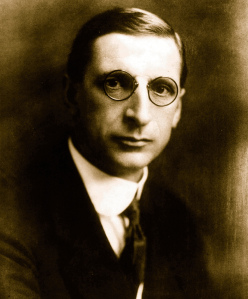
Thomas Patrick Ashe, a member of the Gaelic League, the Irish Republican Brotherhood (IRB), and a founding member of the Irish Volunteers, is born in Lispole, County Kerry, on January 12, 1885. Ashe enters De La Salle Training College, Waterford, in 1905 and begins a teaching career as principal of Corduff National School, Lusk, County Dublin, in 1908.

Ashe plays a major part in the 1916 Easter Rising outside the capital city commanding the Fingal battalion of the Irish Volunteers. Ashe is commandant of the 5th battalion of the Dublin brigade, a force of 60–70 men engaging British forces around north County Dublin during the rising. They are armed only with a few rounds, about a dozen service rifles, a dozen Mausers, and a dozen Martini-Henry carbines. Some of Ashe’s men are armed only with a shotgun against the well-equipped army regulars.

Ashe’s battalion wins a major victory in Ashbourne, County Meath, where they engage a much larger force. They capture a significant quantity of arms and up to twenty Royal Irish Constabulary (RIC) vehicles. Eleven RIC members, including County Inspector Alexander Gray, and two volunteers are killed during the 5-1/2-hour battle. Twenty-four hours after the rising collapses, Ashe’s battalion surrenders on the orders of Patrick Pearse. On May 8, 1916, Ashe and Éamon de Valera are court-martialled and sentenced to death. The sentences are commuted to penal servitude for life. Ashe is imprisoned in Lewes Prison in Lewes, East Sussex, England.

De Valera, Ashe, and Thomas Hunter lead a prisoner hunger strike on May 28, 1917. With accounts of prison mistreatment appearing in the Irish press and mounting protests in Ireland, Ashe and the remaining prisoners are freed on June 18, 1917, by David Lloyd George as part of a general amnesty.

Upon his release, Ashe returns to Ireland and begins a series of speaking engagements. In August 1917, he is arrested and charged with sedition for a speech that he makes in Ballinalee, County Longford, where Michael Collins is also speaking. He is detained at the Curragh but is then transferred to Mountjoy Prison in Dublin. He is convicted and sentenced to two years hard labour. Ashe and other prisoners, including Austin Stack, demand prisoner of war status. On September 20, 1917, Ashe again goes on hunger strike. He dies at the Mater Hospital on September 25, 1917, after being force fed by prison authorities. At the inquest into his death, the jury condemns the staff at the prison for the “inhuman and dangerous operation performed on the prisoner, and other acts of unfeeling and barbaric conduct.” His body lies in state at Dublin City Hall and is buried in Glasnevin Cemetery in Dublin.

Ashe is a relative of Catherine Ashe, the paternal grandmother of American actor Gregory Peck, who emigrates to the United States in the 19th century. The Ashe Memorial Hall built in 1928, housing the Kerry County Museum, in Tralee, County Kerry, is named after him while Nelson Street, also in Tralee, is renamed Ashe Street.

Leave a comment

Éamon de Valera Resigns as President of the Republic

eamon-de-valeraThe Anglo-Irish Treaty is introduced to replace the Republic with a dominion of the British Commonwealth with the King represented by a Governor-General of the Irish Free State. The Treaty is finally signed on December 6, 1921.
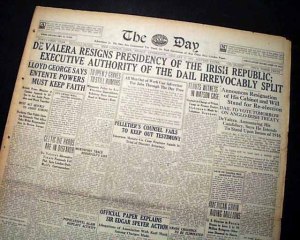
Éamon de Valera does not join in on the negotiations. His opponents say that he does so because he knows that the British will only allow an Irish dominion, not a republic, and does not want to be blamed for giving up the idea of a republic. De Valera says he is angry because the delegates working out the treaty had not asked him before signing the treaty. But at a secret session of the Dáil during the Treaty debates and publicised in January 1922, de Valera’s ideas for a treaty include dominion status, the “Treaty Ports,” a veto by the parliament in Belfast, and the king as head of the Commonwealth. Ireland would pay a share of the imperial debt.

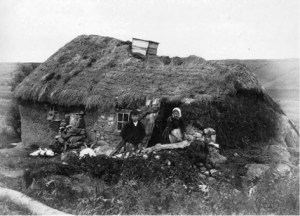
On January 9, 1922, when the Treaty is accepted by a vote of 64 to 57, de Valera resigns as President of the Republic and a large minority of Sinn Féin Teachta Dálas (TDs) leave Dáil Éireann. De Valera  states, “In view of the vote that was taken here on Saturday and which I had definitely to oppose as one that was tending to subvert the Republic which I was elected to my present position to defend and maintain; and as it appeared to me also to be a vote which would tend to subvert the independence of the country, I could no longer continue— as I was beaten in that — I could no longer continue in my present office feeling I did not have the confidence of the House. I therefore wish to place my resignation in the hands of the Assembly.”the-day-01-09-1922

A motion to re-elect De Valera as President is defeated along pro and anti-treaty lines by 60 votes to 58. Arthur Griffith, de Valera opponent and former colleague, is elected President of Dáil Éireann in his place.

Following the vote, Griffith says, “Before another word is spoken I want to say: I want the Deputies here to know, and all Ireland to know, that this vote is not to be taken as against President de Valera. It is a vote to help the Treaty, and I want to say now that there is scarcely a man I have ever met in my life that I have more love and respect for than President de Valera. I am thoroughly sorry to see him placed in such a position. We want him with us.”


Leave a comment

The Night of the Big Wind

night-of-the-big-windThe Night of the Big Wind (Irish: Oíche na Gaoithe Móire), a powerful European windstorm sweeps without warning across Ireland beginning in the afternoon of January 6, 1839, causing severe damage to property and several hundred deaths. As many as one quarter of the houses in north Dublin are damaged or destroyed and 42 ships are wrecked. The storm tracks eastward to the north of Ireland bringing winds gusts of over 100 knots to the south before moving across the north of England and onto the European continent where it eventually dies out. At the time, it is the most damaging Irish storm in 300 years.
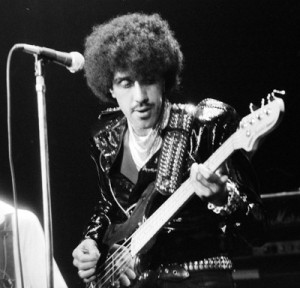
The storm develops after a period of unusual weather. Heavy snow, which is rare in Ireland, falls across the country on the night of January 5, and is replaced on the morning of January 6 by an Atlantic warm front, which brings a period of complete calm with dense, motionless, cloud cover. Through the day, temperatures rise well above their seasonal average, resulting in rapid melting of the snow.

Later in the day, a deep Atlantic depression begins to move towards Ireland, forming a cold front bringing strong winds and heavy rain when it collides with the warm air over land. First reports of stormy weather come from western County Mayo around noon and the storm moves very slowly across the island through the remainder of the day, gathering strength as it progresses.

By midnight the winds reach hurricane force. It is estimated that between 250 and 300 people lose their lives in the storm. Severe property damage is caused, particularly in Connacht, but also in Ulster and northern Leinster. Much of the inland damage is caused by a storm surge that draws large quantities of sea water inland, resulting in widespread flooding.

The Night of the Big Wind has become part of Irish folk tradition. Irish folklore held that Judgement Day would occur on the Feast of the Epiphany, January 6. Such a severe storm led many to believe that the end of the world was at hand.


Leave a comment

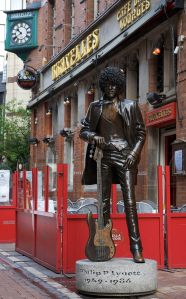
Death of Phil Lynott

phil-lynott

Philip Parris “Phil” Lynott, Irish musician, singer, songwriter, and a founding member, principal songwriter, lead vocalist, and bassist of Thin Lizzy, dies on January 4, 1986, in Salisbury, Wiltshire, England.

Born in West Bromwich, Staffordshire, England on August 20, 1949, Lynott goes to live with his grandmother, Sarah Lynott, in Crumlin, Dublin, when he is four years old. He is introduced to music through his uncle Timothy’s record collection and becomes influenced by Motown and The Mamas and the Papas.

Growing up in Dublin in the 1960s, Lynott fronts several bands as a lead vocalist, most notably teaming up with bassist Brendan ‘Brush’ Shiels to form Skid Row in early 1968. It is during this period that Lynott learns to play the bass guitar.

Toward the end of 1969, Lynott, now confident enough to play bass himself in a band, teams with Brian Downey, Eric Bell, and Eric Wrixon to form Thin Lizzy. The band’s first top ten hit comes in 1973 with a rock version of the well-known Irish traditional song “Whiskey in the Jar.” With the release of the Jailbreak album in 1976, Lynott and Thin Lizzy become international superstars on the strength of the album’s biggest hit, “The Boys Are Back in Town.” The song reaches the Top 10 in the United Kingdom, No. 1 in Ireland, and is a hit in the United States and Canada.

Having finally achieved mainstream success, Thin Lizzy embarks on several consecutive world tours. However, the band suffers from personnel changes. By the early 1980s, Thin Lizzy is starting to struggle commercially and Lynott starts showing symptoms of drug abuse, including regular asthma attacks. After the resignation of longtime manager Chris O’Donnell, Lynott decides to disband Thin Lizzy in 1983.

phil-lynott-statue

In 1984, Lynott forms a new band, Grand Slam, with Doish Nagle, Laurence Archer, Robbie Brennan, and Mark Stanway. The band tours various clubs but suffers from being labeled a poor version of Thin Lizzy due to the inclusion of two lead guitarists. Grand Slam disbands at the end of the year due to a lack of money and Lynott’s increasing addiction to heroin.

Lynott’s last years are dogged by drug and alcohol dependency leading to his collapse on December 25, 1985, at his home in Kew. He is taken to Salisbury Infirmary where he is diagnosed as suffering from septicemia. His condition worsens by the start of the new year, and he is put on a respirator. He dies of pneumonia and heart failure due to septicemia in the hospital’s intensive care unit on January 4, 1986, at the age of 36.

Lynott’s funeral is held at St. Elizabeth of Portugal Church, Richmond, London, on January 9, 1986, with most of Thin Lizzy’s ex-members in attendance, followed by a second service at Church of the Assumption, Howth, on January 11. He is buried in St. Fintan’s Cemetery, Sutton, Dublin.


Leave a comment

The Acts of Union 1800

On January 1, 1801, the Acts of Union 1800 goes into effect uniting the Kingdom of Great Britain and the Kingdom of Ireland to create the United Kingdom of Great Britain and Ireland. The Acts of Union 1800 consists of two acts with the same long title, An Act for the Union of Great Britain and Ireland. Both are passed in 1800.

Before these Acts, Ireland had been in personal union with England since 1541, when the Parliament of Ireland had passed the Crown of Ireland Act 1542 proclaiming King Henry VIII of England to be King of Ireland. Both Ireland and England had come in personal union with Scotland with the Union of the Crowns in 1603.

In 1707, the Kingdom of England and the Kingdom of Scotland were united into a single kingdom named the Kingdom of Great Britain. The Irish parliament at that time was subject to a number of restrictions that placed it subservient to the Parliament of England and, following the union of England and Scotland, the Parliament of Great Britain.

In the century that followed the union of England and Scotland, Ireland gained effective legislative independence from Great Britain through the Constitution of 1782. However, access to institutional power in Ireland was restricted to a small minority, the so-called Anglo-Irish of the Protestant Ascendancy. Frustration at the lack of reform eventually led to a rebellion in 1798, involving a French invasion of Ireland and seeking complete independence from Great Britain. The rebellion was crushed with much bloodshed and the subsequent drive for union between Great Britain and Ireland that passed in 1800 was motivated at least in part by the belief that the rebellion was caused as much by loyalist brutality as by the United Irishmen.

Each Act had to be passed in the Parliament of Great Britain and the Parliament of Ireland. The final passage of the Act in the Irish Parliament was achieved with substantial majorities, achieved in part according to contemporary documents through bribery, namely the awarding of peerages and honours to critics to get their votes.

Both Acts, though since amended, still remain in force in the United Kingdom but have been repealed in the Republic of Ireland.