Thomas Dermody, classical scholar and poet, is born in Ennis, County Clare, on January 15, 1775. He writes under several pseudonyms including Mauritius Moonshine and Marmaduke Myrtle.
Dermody is scholarly but lives hard and makes little of his life. At the age of nine he is employed as a classical teacher in his father’s school, and has already acquired from his father a love for literature and the bottle.
Dermody has the genius of a poet, and writes fairly good poetry, but his genius is not enough. He lives for 27 years, half his life a promising boy and half a ne’er-do-well. His promise brings him generous patrons in his early days in Ireland, but he scorns the hand that feeds him, denies the friends who could nurse his genius, and runs away to England to keep bad company.
At the age of nineteen, he enlists in the army and behaves uncommonly well under military discipline. He becomes corporal, sergeant, and eventually second lieutenant, serving with distinction. He is wounded in France, and upon his return to England, is retired on half-pay.
He gains and loses friend after friend and abuses patron after patron. They clothe and clean him and make him presentable, but he then drinks himself to nakedness and rags and behaves like a brute. Such from day to day and year to year is his life, and in the end he drinks himself to death and perishes in a miserable cottage near Lewisham on July 15, 1802. He is filled with conceit and a slave to his desires, but the lines that are fading away on the stone above his grave show that he was a poet. Dermody is buried in the churchyard of St. Mary’s Church Lewisham.
Dermody publishes two books of poems which, after his death, are collected as The Harp of Erin. Some 56 of his sonnets have been published in various works, from his first 1789 collection Poems to those published in 1792, with a few posthumously published verses in the biography by James Grant Raymond. Samuel Taylor Coleridge takes an interest in some of his verse which has been included in the literary magazine The Anthologia Hibernica.
The first aircraft, an Irish Air Corps Aero Anson A43, lands at the newly opened Rineanna Airfield, which is later to become known as Shannon International Airport, on May 18, 1939.
Transatlantic aviation in the Shannon Estuary first commences with a seaplane base at Foynes. In October 1935, the Irish Government makes a decision to initiate a survey to find suitable bases for the operation of seaplanes and land planes on a transatlantic service. The Department of Defence, which provides technical advice on aviation to the Civil Aviation Section of the Department of Industry, is given the task.
On November 21, 1935, a survey party sets out and surveys sites as far north as Athlone and south to Askeaton. Among the sites for a seaplane base to be considered are the Shannon just below Limerick, Lough Derg, Lough Corrib, Tralee Bay, Kenmare Bay, Lough Ree, and Valentia. Foynes, near the mouth of the Fergus River, is finally selected due to its sheltered anchorage and its proximity to long open stretches of water.
The first priority is drainage to remove surface water from the site and to construct embankments to prevent flooding of the airfield due to its proximity to the tidal River Shannon. Several hundred men are employed to dig narrow lateral drains for the approximately 135 miles of pipes which are laid in parallel lines 50 feet apart over almost the entire area of the airfield site. They also excavate catchment drains to collect water from the surface of the site.
At this time all indications are that regular aerial travel between Europe and the United States will be initially by flying boat and accordingly, the base at Rineanna is designed to cater to both land planes and flying boats. Construction work commences to build embankments and a breakwater to provide for a seaplane base and to protect the airfield site from flooding from the River Shannon.
Developments in aviation during World War I ensure land planes and not flying boats are to be the future of aviation, therefore the mooring basin and the east breakwater which are being constructed for flying boats at Rineanna are never quite finished. Construction of the embankments continue to protect the site from the River Shannon and to form a drainage lagoon for surface water from the western headland of the airport site.
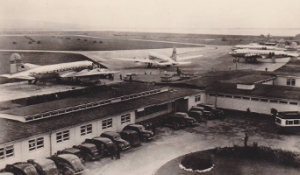
When World War II ends, the airport is ready to be used by the many new post-war commercial airlines of Europe and North America. On September 16, 1945, the first transatlantic proving flight, a Pan AmDC-4, lands at Shannon from New York City. On October 24, the first scheduled commercial flight, an American Overseas Airlines DC-4, passes through Shannon Airport. An accident involving President Airlines on September 10, 1961 results in the loss of 83 lives. The Douglas DC-6 aircraft crashes into the River Shannon while leaving Shannon Airport for Chicago.
The number of international carriers rises sharply in succeeding years as Shannon becomes well known as the gateway between Europe and the Americas as limited aircraft range necessitates refueling stops on many journeys. Shannon becomes the most convenient stopping point before and after a trip across the Atlantic. Additionally, during the Cold War, many transatlantic flights from the Soviet Union stop here for refueling, because Shannon is the westernmost non-NATO airport.
Shannon Airport is one of Ireland’s three primary airports, along with Dublin Airport and Cork Airport, and includes the longest runway in Ireland at 10,495 feet. It is a designated emergency landing site for the Space Shuttle during the U.S. shuttle program. In 2015, 1.715 million passengers pass through the airport, making it the third busiest airport in the country after Dublin and Cork. Shannon Airport is in Shannon, County Clare, and mainly serves Limerick, Ennis, Galway, and the south-west of Ireland.