
seamus dubhghaill

Promoting Irish Culture and History from Little Rock, Arkansas, USA


Leave a comment

Archbishop Giovanni Battista Rinuccini Arrives in Ireland

Archbishop Giovanni Battista Rinuccini arrives in Ireland on October 21, 1645. He is sent by Pope Innocent X to help the Irish Confederate Catholics in their war against English Protestant rule, succeeding the papal envoy there, Pierfrancesco Scarampi.

In the mid-17th century, Ireland is embroiled in the Irish Confederate Wars (1641–1653), a conflict between Irish Catholics, English and Scottish Protestants, and Royalist forces loyal to Charles I. Irish Catholics, through the Confederation of Kilkenny, seek the free exercise of their religion, recovery of church lands, and greater political autonomy. Their movement is internally divided between moderate “Old English” landowners advocating compromise with the Royalists, and hardline Gaelic-Irish factions demanding full Catholic control.

On September 15, 1644, Pope Innocent X seeks to bolster the Irish Catholic cause amid the English Civil War. He appoints Giovanni Battista Rinuccini, Archbishop of Fermo, as Papal Nuncio to Ireland, giving him authority to deliver arms, ammunition, and financial support directly to the Confederates. Rinuccini’s mission aligns with the wider Catholic Counter-Reformation strategy, aiming to strengthen Catholic influence politically and militarily.

Rinuccini lands at Kenmare Bay, County Kerry, on October 21, 1645, with a retinue of Italians and Irish officers, as well as a substantial shipment of weapons and funds:

Rinuccini’s entry symbolizes direct papal intervention in Irish affairs, demonstrating both spiritual and temporal support for Catholic aspirations. Rinuccini proceeds to Kilkenny, the Confederate capital, where he is officially received by the Confederate president, Richard Butler, 3rd Viscount Mountgarret, and addresses the Assembly in Latin.

Rinuccini influences Confederate politics by controlling the distribution of arms and money, strengthening the hardline clerical and militant factions, who oppose compromise with the Royalists. He insists on the full restoration of Catholic churches and lands, and opposes treaties offering only religious toleration without Catholic political power. His arrival intensifies divisions between moderates (Old English) and radicals (Gaelic Irish and clergy). This factionalism undermines Confederate unity and contributes to eventual defeats in 1647-1648.

Rinuccini’s arrival marks a turning point in the Irish Confederate Wars. It exemplifies foreign papal support in local conflicts during the Counter-Reformation. Militarily, it temporarily enhances the Confederates’ capacity, exemplified later at the Battle of Benburb (1646). Politically, it deepens internal divisions, which ultimately hinders successful negotiations with Royalist and Parliamentarian forces, leading to the collapse of Confederate resistance.

In summary, Archbishop Giovanni Battista Rinuccini lands in Ireland on October 21, 1645, delivering arms and funds. The significance of his visit is symbolic and practical papal support for Irish Catholics, strengthening of hardline factions, direct influence of military campaigns and political negotiations and the highlighting of the entanglement of religion, diplomacy, and civil war in mid-17th-century Ireland.

The event demonstrates the intersection of international Catholic interests and Irish nationalist-religious aspirations, shaping the course of the Irish Confederate Wars and influencing the fate of the Catholic Church in Ireland for decades.

Leave a comment

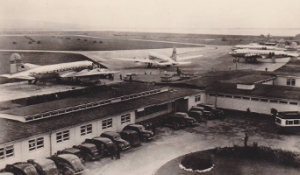
First Aircraft Lands at Rineanna Airfield (Shannon Airport)

rineanna-airport

The first aircraft, an Irish Air Corps Aero Anson A43, lands at the newly opened Rineanna Airfield, which is later to become known as Shannon International Airport, on May 18, 1939.

Transatlantic aviation in the Shannon Estuary first commences with a seaplane base at Foynes. In October 1935, the Irish Government makes a decision to initiate a survey to find suitable bases for the operation of seaplanes and land planes on a transatlantic service. The Department of Defence, which provides technical advice on aviation to the Civil Aviation Section of the Department of Industry, is given the task.

On November 21, 1935, a survey party sets out and surveys sites as far north as Athlone and south to Askeaton. Among the sites for a seaplane base to be considered are the Shannon just below Limerick, Lough Derg, Lough Corrib, Tralee Bay, Kenmare Bay, Lough Ree, and Valentia. Foynes, near the mouth of the Fergus River, is finally selected due to its sheltered anchorage and its proximity to long open stretches of water.

The first priority is drainage to remove surface water from the site and to construct embankments to prevent flooding of the airfield due to its proximity to the tidal River Shannon. Several hundred men are employed to dig narrow lateral drains for the approximately 135 miles of pipes which are laid in parallel lines 50 feet apart over almost the entire area of the airfield site. They also excavate catchment drains to collect water from the surface of the site.

At this time all indications are that regular aerial travel between Europe and the United States will be initially by flying boat and accordingly, the base at Rineanna is designed to cater to both land planes and flying boats.  Construction work commences to build embankments and a breakwater to provide for a seaplane base and to protect the airfield site from flooding from the River Shannon.

Developments in aviation during World War I ensure land planes and not flying boats are to be the future of aviation, therefore the mooring basin and the east breakwater which are being constructed for flying boats at Rineanna are never quite finished.  Construction of the embankments continue to protect the site from the River Shannon and to form a drainage lagoon for surface water from the western headland of the airport site.

When World War II ends, the airport is ready to be used by the many new post-war commercial airlines of Europe and North America. On September 16, 1945, the first transatlantic proving flight, a Pan Am DC-4, lands at Shannon from New York City. On October 24, the first scheduled commercial flight, an American Overseas Airlines DC-4, passes through Shannon Airport. An accident involving President Airlines on September 10, 1961 results in the loss of 83 lives. The Douglas DC-6 aircraft crashes into the River Shannon while leaving Shannon Airport for Chicago.

The number of international carriers rises sharply in succeeding years as Shannon becomes well known as the gateway between Europe and the Americas as limited aircraft range necessitates refueling stops on many journeys. Shannon becomes the most convenient stopping point before and after a trip across the Atlantic. Additionally, during the Cold War, many transatlantic flights from the Soviet Union stop here for refueling, because Shannon is the westernmost non-NATO airport.

Shannon Airport is one of Ireland’s three primary airports, along with Dublin Airport and Cork Airport, and includes the longest runway in Ireland at 10,495 feet. It is a designated emergency landing site for the Space Shuttle during the U.S. shuttle program. In 2015, 1.715 million passengers pass through the airport, making it the third busiest airport in the country after Dublin and Cork. Shannon Airport is in Shannon, County Clare, and mainly serves Limerick, Ennis, Galway, and the south-west of Ireland.