seamus dubhghaill

Promoting Irish Culture and History from Little Rock, Arkansas, USA


Leave a comment

Death of Countess Constance Georgine Markievicz

markievicz-funeral-procession

Countess Constance Georgine Markievicz, née Gore-Booth, Irish politician, revolutionary nationalist, and suffragette, dies on July 15, 1927, in Sir Patrick Dun’s Hospital, Dublin, of complications related to appendicitis.

Constance Gore-Booth is born into the Anglo-Irish aristocracy and grows up at her family’s estate, Lissadell House, in County Sligo. Constance enrolls at London’s Slade School of Fine Art in 1893. In the late 1890s she travels to Paris, where she meets Count Casimir Dunin-Markievicz of Poland. They are married in 1900.

In 1903 the Markieviczes move to Dublin, where Constance’s interests soon turn from art to Irish politics. At age 40, in 1908, she embraces Irish nationalism, joining the revolutionary women’s group Inghinidhe na hÉireann (Daughters of Ireland) and the Sinn Féin political party. The following year she forms Na Fianna Éireann (Soldiers of Ireland), a republican organization loosely based on the Boy Scouts, in which young boys are trained to be nationalist soldiers.

In 1911 she is arrested for demonstrating against King George V’s visit to Ireland. This is just the first of several arrests and imprisonments for Markievicz, whose political activism results in jail time intermittently for the remainder of her life. In 1913–14 she provides food for workers and their families during a labour dispute in which thousands of people are locked out of their workplaces for refusing to reject union membership.

In April 1916 Markievicz takes part in the Easter Rising, the republican insurrection in Dublin against British government in Ireland. After the general surrender, she is arrested and imprisoned. Though many women participate in the uprising, Markievicz is the only one to be court-martialed. She is sentenced to death, but the sentence is commuted to a lifetime of penal servitude on account of her gender. The following year, under a general amnesty, Markievicz is released, but soon finds herself back in jail for supposed participation in a plot against the British government. In December 1918, while still carrying out a prison sentence, Markievicz is elected to the House of Commons as the representative for Dublin’s St. Patrick’s division. Along with the other members of Sinn Féin, she refuses to swear an oath of allegiance to the king and, thus, does not take her seat. Instead, under the leadership of Éamon de Valera, the Irish republicans set up their own provisional government, Dáil Éireann.

After her release from prison, Markievicz serves in the first Dáil Éireann as the minister of labour, a post she holds from 1919 until she is defeated in the 1922 elections. That same year the Irish Free State is established, and Dáil Éireann is incorporated as the lower house of the Oireachtas (Irish parliament). Markievicz is elected to the Dáil in the 1923 general election but, along with the other members of Sinn Féin, she again refuses to swear allegiance to the king and does not take her seat. Instead, she devotes herself to charity work. Markievicz joins de Valera’s Fianna Fáil party on its founding in 1926 and is again elected to the Dáil in 1927 but dies a month later without having taken her seat.

Refused a state funeral by the Free State government, Markievicz is buried at Glasnevin Cemetery, Dublin, and de Valera gives the funeral oration.

Leave a comment

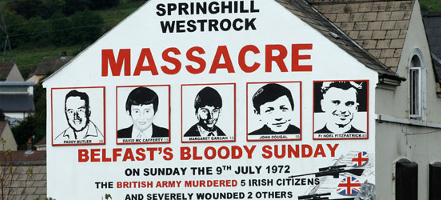
The Springhill Massacre

springhill-massacre

The Springhill Massacre, a shooting incident which claims five lives in the Springhill estate in west Belfast, takes place on July 9, 1972. Three civilians, including a Catholic priest, and two members of Fianna Éireann are shot dead by British Army snipers firing from a timber yard.

The Northern Ireland Troubles have been raging for three years and hundreds have already been killed by the two warring factions in Northern Ireland, unionists, including Ulster loyalists and the British Army, and Irish republicans wanting unification with the Republic of Ireland. Violence has been taking place all day and the five dead are part of ten people killed on that day.

According to a Provisional Irish Republican Army (IRA) statement on July 10, British Army snipers take up sniping positions in Corry’s timber yard and reinforced them with sandbags. Two cars pull into Springhill and the snipers fire two shots at them. One of the cars flees while the other drives a short distance and stops. The occupants get out and the snipers open fire again, seriously wounding one with a shot in the back of the head. A resident rushes to help the injured man but is immediately shot in the arm. This man’s brother and a friend run to the downed occupant, but both are shot by the snipers. At some point during this time a 13-year-old girl is fatally shot by the snipers. The parish priest, waving a white cloth, and a passer-by rush to her but a sniper kills both with a single bullet that passes through both their heads. All of the victims are unarmed.

The British Army disputes the IRA’s version of events and claims its troops were fired on first by the IRA, ending a temporary IRA ceasefire. A British Army spokesman states, “There has been a heavy exchange of fire between the IRA and troops. Some of the dead and wounded were undoubtedly caught in the crossfire.” On July 10, the British Army claims that it has killed terrorists. An open verdict is recorded at the inquest into the events.

No British soldier has been held accountable for these murders.


Leave a comment

Executions of Èamonn Ceannt, Michael Mallin, Seán Heuston, & Con Colbert

colbert-ceannt-mallin-heuston

Irish patriots Èamonn Ceannt, Michael Mallin, Seán Heuston, and Cornelius “Con” Colbert are executed by firing squad in the Stonebreakers Yard at Kilmainham Gaol on May 8, 1916, as the executions following the 1916 Easter Rising continue.

Éamonn Ceannt, one of the seven signatories of the Proclamation of the Irish Republic, is born in Ballymoe, Glenamaddy in County Galway in 1881. Prior to the Rising, Ceannt is an employee of the Dublin Corporation. He is a co-founder of the Irish Volunteers, partaking in the successful Howth gun-running operation of 1914. His involvement in republican activities is complemented by his interest in Irish culture, specifically Irish language and history, although he is also an accomplished uilleann piper. Ceannt is appointed Director of Communications of the Provisional Government and is Commandant of the Fourth Battalion of the Irish Volunteers, who are stationed at the South Dublin Union, now the site of St. James’s Hospital. Ceannt has about 100 men with him, including his second-in-command Cathal Brugha, and W.T. Cosgrave who goes on later to become Taoiseach. Ceannt and his men at the South Dublin Union take part in some of the fiercest fighting in the rebellion and hold out against far superior numbers of British troops.

Michael Mallin, a silk weaver by trade, is born in Dublin on December 1, 1874. Mallin is the Chief of Staff of the Irish Citizen Army (ICA), second in command only to James Connolly. He trains and drills the ICA and is the Commandant of the St. Stephen’s Green Royal College of Surgeons garrison during the Rising. Countess Markievicz is his second in command. This location sees less action than some of the other sites chosen by the rebels because the British concentrate their efforts on the most strategically important targets such as the General Post Office (GPO) and Four Courts. Mallin surrenders on April 30.

Seán Heuston, born in Dublin on February 21, 1891, is responsible for the organisation of Fianna Éireann in Limerick. Along with Con Colbert, Heuston is involved in the education of the schoolboys at Scoil Éanna, organising drill and musketry exercises. Heuston is the Officer Commanding of the Volunteers in the Mendicity Institution on the south side of Dublin. With 26 Volunteers under his command, they hold their position for two days. With his position becoming untenable against considerable numbers, and the building almost completely surrounded, Heuston sends a dispatch to Connolly informing him of their position. It is soon after sending this dispatch that Heuston decides to surrender. Heuston Railway Station in Dublin is named after him.

Con Colbert is born on October 19, 1888, at Monalena in Limerick, and is one of the younger generations of Irish republicans who take part in the Easter Rising. Prior to the Easter Rising he is an active member of the republican movement. He is one of the founding members of Fianna Éireann. A dedicated pioneer, Colbert is known not to drink or smoke. During the Rising, Colbert is the commander of a group of Volunteers stationed at Watkin’s Brewery on Ardee Street, and later at Jameson’s Distillery on Marrowbone Lane. They hold their position until receiving the order to surrender from Patrick Pearse.


Leave a comment

Birth of Paddy Devlin, Founder of the SDLP

paddy-devlin

Paddy Devlin, Irish social democrat and Labour activist, former Stormont Member of Parliament (MP), founder of the Social Democratic and Labour Party (SDLP), and member of the 1974 Power Sharing Executive, is born in West Belfast on March 8, 1925.

Devlin lives almost all his life in Belfast and grows up in a highly political household. His early activism is confined to Fianna Éireann and later the Irish Republican Army (IRA). As a result, he is interned in Crumlin Road Gaol during World War II. He leaves the republican movement upon his release.

After the war he spends some time in Portsmouth and Coventry, where he becomes interested in Labour and trade union politics and briefly joins the British Labour Party. Devlin returns to Belfast in 1948 and helps establish the Irish Labour Party after the split of the Northern Ireland Labour Party (NILP). He later defeats Gerry Fitt to win a seat on the city council. Later Catholic Action claims the Irish Labour Party is infested with communists which effectively wipes out the party and Devlin loses his seat.

In the mid 1960s, Devlin joins the revived NILP and beats Harry Diamond for the Falls seat in Stormont. Devlin then joins Fitt, John Hume, Austin Currie, and others to found the SDLP in 1970. At the request of Secretary of State for Northern Ireland William Whitelaw in 1973, he becomes involved in ensuring safe passage for Gerry Adams to talks with the British government.

Devlin is a member of the Northern Ireland Assembly in 1973 and Minister of Health and Social Services in the power-sharing Executive from January 1, 1974, to May 28, 1974.

In 1978, Devlin establishes the United Labour Party, which aims to be a broad-based Labour formation in Northern Ireland. He stands under its label for the European Parliament in 1979 but polls just 6,122 first preferences and thereby loses his deposit.

In 1987, Devlin and remnants of the NILP and others, establish Labour ’87 as another attempt at building a Labour Party in Northern Ireland by uniting the disparate groups supporting labour and socialist policies but it is met with little or no success. In 1985 he loses his seat on the Belfast City council.

Devlin suffers from severe diabetes and throughout the 1990s suffers a series of ailments as his health and sight collapse. Devlin dies at the age of 74 on August 15, 1999.


Leave a comment

Birth of Constance Georgine Gore-Booth (Countess Markievicz)

countess-markievicz

Constance Georgine Gore-Booth is born on February 4, 1868, at Buckingham Gate, London, the eldest daughter of Arctic explorer and philanthropist Sir Henry Gore-Booth and Georgina May Hill.

The Gore-Booths are known as model landlords in County Sligo as they provide free food for the tenants on their estate. Perhaps being raised in this atmosphere of concern for the common man has something to do with the way Constance and her younger sister, Eva, conduct their later lives.

Gore-Booth decides to train as a painter and, in 1892, she enters the Slade School of Art in London because, at the time, only one art school in Dublin accepts female students. While in school in London Gore-Booth first becomes politically active and joins the National Union of Women’s Suffrage Societies.

She later moves to Paris and enrolls at the prestigious Académie Julian where she meets her future husband, Count Casimir Markievicz. They are married in London on September 29, 1900, making her Countess Markievicz. The Markieviczes relocate to Dublin in 1903 and move in artistic and literary circles, with Constance being instrumental in founding the United Artists Club.

In 1908, Markievicz becomes actively involved in nationalist politics in Ireland and joins Sinn Féin and Inghinidhe na hÉireann (Daughters of Ireland), a revolutionary women’s movement founded by Maud Gonne. In the same year, Markievicz plays a dramatic role in the women’s suffrage campaigners’ tactic of opposing Winston Churchill‘s election to Parliament during the Manchester North West by-election. Churchill ultimately loses the election to Conservative candidate William Joynson-Hicks.

In 1909, Markievicz founds Fianna Éireann, a para-military nationalist scouts organisation that instructs teenage boys and girls in the use of firearms. Patrick Pearse says that the creation of Fianna Éireann is as important as the creation of the Irish Volunteers in 1913. She is jailed for the first time in 1911 for speaking at an Irish Republican Brotherhood demonstration organised to protest against George V’s visit to Ireland.

Markievicz joins James Connolly‘s socialist Irish Citizen Army, a small volunteer force formed in response to the lock-out of 1913, to defend the demonstrating workers from the police. During the Howth gun-running on July 26, 1914, Irish Citizen Army members led by Markievicz, and including Thomas MacDonagh, Bulmer Hobson, Douglas Hyde and Darrell Figgis, unload arms from Erskine Childers‘ yacht Asgard in Howth harbour with hand carts and wheelbarrows.

As a member of the Irish Citizen Army, Markievicz takes part in the 1916 Easter Rising. Under Michael Mallin and Christopher Poole, she supervises the erection of barricades as the Rising begins and is in the middle of the fighting all around Stephen’s Green. Mallin and Poole and their men and women, including Markievicz, hold out for six days, ending the engagement when the British bring them a copy of Patrick Pearse’s surrender order.

They are taken to Dublin Castle and Markievicz is transported to Kilmainham Gaol, where she is the only one of 70 women prisoners who is put into solitary confinement. At her court martial on May 4, 1916, Markievicz is sentenced to death, but General Maxwell commutes this to life in prison on “account of the prisoner’s sex.” It is widely reported that she tells the court, “I do wish your lot had the decency to shoot me.” Markievicz is transferred to Mountjoy Prison and then to Aylesbury Prison in England in July 1916. She is released from prison in 1917, along with others involved in the Rising.

In the 1918 general election, Markievicz is elected for the constituency of Dublin St Patrick’s, making her the first woman elected to the British House of Commons. However, in line with Sinn Féin abstentionist policy, she does not take her seat in the House of Commons. She is re-elected to the Second Dáil in the elections of 1921. Markievicz serves as Minister for Labour from April 1919 to January 1922, holding cabinet rank from April to August 1919, becoming both the first Irish female Cabinet Minister and only the second female government minister in Europe.

Markievicz leaves government in January 1922 along with Éamon de Valera and others in opposition to the Anglo-Irish Treaty. She fights actively for the Republican cause in the Irish Civil War. She is returned in the 1923 general election for the Dublin South constituency but again, in common with other Republican candidates, she does not take her seat.

She joins Fianna Fáil on its foundation in 1926, chairing the inaugural meeting of the new party in La Scala Theatre. In the June 1927 general election, she is re-elected to the 5th Dáil as a candidate for the new Fianna Fáil party, which is pledged to return to Dáil Éireann.

Before she can take up her seat, Markievicz dies at the age of 59 on July 15, 1927, in a public ward “among the poor where she wanted to be” of complications related to appendicitis. One of the doctors attending her is her revolutionary colleague, Kathleen Lynn. Also at her bedside are Casimir and Stanislas Markievicz, Éamon de Valera, and Hanna Sheehy-Skeffington. Refused a state funeral by the Free State government, Markievicz is buried at Glasnevin Cemetery, Dublin, and de Valera gives the funeral oration.


1 Comment

Tomás MacCurtain Elected Sinn Féin Lord Mayor of Cork

tomas-maccurtain

Tomás MacCurtain is elected Sinn Féin Lord Mayor of Cork on January 31, 1920.

MacCurtain is born at Ballyknockane in the Parish of Mourne Abbey on March 20, 1884. He attends Burnfort National School until the family moves to Blackpool on the north side of Cork city in 1897, where he attends The North Monastery School. He becomes active in numerous cultural and political movements and joins the Blackpool branch of the Gaelic League, becoming its secretary in 1902. He works in his early career as a clerk and in his free time teaches the Irish language. He joins the Fianna Éireann in 1911 and is a founding member of the Irish Volunteers.

At the outset of the Easter Rising in April 1916, MacCurtain commands a force of up to 1,000 men of the Irish Volunteers who assemble at various locations around County Cork. MacCurtain and his officers await orders from the volunteer leadership in Dublin, but conflicting instructions and confusion prevail, and the Cork volunteers never entered the fray. A tense week-long stand-off develops when British forces surround the volunteer hall. A negotiated agreement leads to the surrender of the volunteers’ arms to then Lord Mayor of Cork Thomas Butterfield on the understanding that they will be returned. The weapons are not returned and MacCurtain is jailed in the Frongoch Prisoner of War camp in Wales. Eighteen months later, after the general amnesty of participants in the Rising, MacCurtain returns to active duty as a Commandant of what is now the Irish Republican Army (IRA).

By 1918, MacCurtain is a brigade commander in the IRA. During the Conscription Crisis in the autumn 1918, he actively encourages the hiring of the women of Cumann na mBan to cater for Volunteers. MacCurtain is personally involved with Michael Collins‘ Squad that attempts to assassinate Lord John French, whose car is missed as the convoy passes through the ambush positions. Despite the setback he remains brigadier of No.1 Cork when he is elected the Sinn Féin councillor for NW Ward No. 3 of Cork in the January 1920 council elections and is chosen by his fellow councillors to be the Lord Mayor. He begins a process of political reform within the city.

On his 36th birthday, March 20, 1920, MacCurtain is shot dead in front of his wife and son by a group of men with blackened faces in retaliation for the shooting of a policeman. MacCurtain’s house in the city’s Blackpool area is also ransacked. The assassins are found to be members of the Royal Irish Constabulary (RIC) by the official inquest into the event.

The killing causes widespread public outrage. The coroner’s inquest passes a verdict of wilful murder against British Prime Minister Lloyd George and against certain members of the RIC. Michael Collins later orders his personal assassination squad to hunt down and kill the police officers involved in the attack. RIC District Inspector Oswald Swanzy, who had ordered the attack, is fatally shot with MacCurtain’s own revolver while leaving a Protestant church in Lisburn, County Antrim on August 22, 1920, sparking a “pogrom” against the Catholic residents of the town. MacCurtain is buried in St. Finbarr’s Cemetery, Cork.