
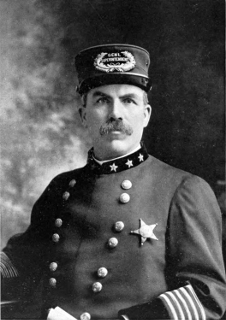
Francis O’Neill, Irish-born American police officer and collector of Irish traditional music, is born in Tralibane, near Bantry, County Cork on August 28, 1848. His biographer Nicholas Carolan refers to him as “the greatest individual influence on the evolution of Irish traditional dance music in the twentieth century.”
At an early age O’Neill hears the music of local musicians, among them Peter Hagarty, Cormac Murphy and Timothy Dowling. At the age of 16, he becomes a cabin boy on an English merchant vessel. On a voyage to New York, he meets Anna Rogers, a young emigrant whom he later marries in Bloomington, Illinois. The O’Neills move to Chicago, and in 1873 he becomes a policeman with the Chicago Police Department. He rises through the ranks quickly, eventually serving as the Chief of Police from 1901 to 1905. He has the rare distinction, in a time when political “pull” counts for more than competence, of being re-appointed twice to the position by two different mayors.
O’Neill is a flautist, fiddler and piper and is part of the vibrant Irish community in Chicago at the time. During his time as chief, he recruits many traditional Irish musicians into the police force, including Patrick O’Mahony, James O’Neill, Bernard Delaney, John McFadden and James Early. He also collects tunes from some of the major performers of the time including Patsy Touhey, who regularly sends him wax cylinders and visits him in Chicago. He also collects tunes from a wide variety of printed sources.
O’Neill retires from the police force in 1905. After that, he devotes much of his energy to publishing the music he has collected. He dies in Chicago, at the age of 87, on January 28, 1936.
In 2000, a life-size monument of Francis O’Neill playing a flute is unveiled next to the O’Neill family homestead in Tralibane, County Cork. The monument, and a commemorative wall are erected through the efforts of the Captain Francis O’Neill Memorial Company.
In 2008, Northwestern University Press issues Captain O’Neill’s Sketchy Recollections of an Eventful Life in Chicago, a non-musical memoir edited by Ellen Skerrett and Mary Lesch, O’Neill’s great-granddaughter, with a foreword by Nicholas Carolan of the Irish Traditional Music Archive. Carolan himself writes a musical biography of O’Neill, A Harvest Saved: Francis O’Neill and Irish Music in Chicago, which is published in Ireland by Ossian in 1997.
In August 2013, the inaugural Chief O’Neill Traditional Music Festival takes place in Bantry, County Cork, just a few miles from Tralibane. The 2013 event marks the centenary of the publication of O’Neill’s Irish Minstrels and Musicians. The event has taken place annually since.


 seamus dubhghaill