seamus dubhghaill

Promoting Irish Culture and History from Little Rock, Arkansas, USA


Leave a comment

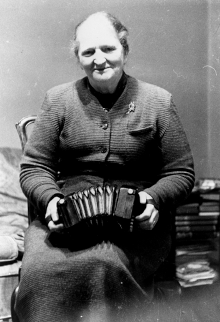
Death of Concertina Player Elizabeth “Lizzie” Crotty

Elizabeth “Lizzie” Crotty (née Markham), concertina player better known as Mrs. Crotty, dies in Kilrush, County Clare, from angina pectoris on December 27, 1960.

Markham is born on January 8, 1886, at Gower, Cooraclare, County Clare, the youngest in the large family of Michael Markham, farmer, and Margaret Markham (née Keane). She attends national school in Cooraclare from 1893 to 1899. Although she does not speak or understand the Irish language, as do her father and likely her mother, the Rosary is recited in Irish at home. She and a sister are the only siblings not to emigrate. Her mother plays the fiddle, while her older sister Margaret (Maggie) plays the concertina and probably influences her to do likewise. She has no single teacher and acquires tunes and her style of playing from neighbours and family friends. She begins to play a two-row German-type concertina at house dances throughout west Clare and becomes very much in demand.

In 1914, Markham marries Michael (Miko) Crotty from Gowerhass, the townland next to Gower. Miko had been in the United States for a couple of years and uses the money earned there to buy a public house on the Market Square in Kilrush, now known as “Crotty’s Pub.” They live in the Square in Kilrush and Miko bottles his own whiskey. The pub is an important venue for Irish traditional music, especially for those who wish to hear Crotty play. She remains relatively unknown outside of Clare until the early 1950s, and there are a relatively small number of recordings of her playing the concertina. The broadcaster Ciarán Mac Mathúna conducts recording sessions in her house in 1955 and she is to be heard on A Job of Journeywork, his programme on Radio Éireann. She possesses a number of concertinas, but the Lachenal that she purchases in the 1950s is her favourite and the one with which she is most closely identified. In 1954, she is a founder member and the first president of the Clare branch of Comhaltas Ceoltóirí Éireann. During her time as president, the All Ireland Fleadh is held in Ennis in 1956.

Crotty often sings the traditional song “An draighneán donn,” which is one of her favourites. Among tunes she enjoys playing are the “Ewe reel,” the “Dublin reel,” and “The maid of Mount Cisco,” along with “The wind that shakes the barley.” Her straight style of playing for dancing and dancers increases her popularity. Seán Ó Riada regards her as one of the finest concertina players he ever heard. Although she does not read or write staff notation, she creates a written code for herself by giving the concertina keys a number and by using a symbol for the press or draw movement on the concertina keys.

Crotty suffers from severe angina which necessitates visits for medical treatment to Dublin, where she becomes friends with fiddle player Kathleen Harrington (née Gardiner). They attend the Pipers’ Club in Thomas Street, play together on Radio Éireann, and travel together to fleadhanna.

Crotty dies on December 27, 1960, of an anginal attack while at her home. She is buried in (old) Shanakyle cemetery. She loses her first three children, and a son drowns in the River Shannon in 1945. Another son, Thomas, becomes a priest. A festival, ‘Éigse Mrs Crotty’, is held in her memory each summer in Kilrush. Her son Paddy gives three perpetual trophies for presentation at the All-Ireland Fleadh Cheoil.

(From: “Crotty, Elizabeth (‘Lizzie’)” by Ríonach uí Ógáin, Dictionary of Irish Biography, http://www.dib.ie, October 2009)


Leave a comment

Death of Sarah Makem, Traditional Irish Singer

Sarah Boyle Makem, traditional Irish singer, dies on April 20, 1983, in County Armagh, Northern Ireland. Born on October 18, 1900, in Keady, County Armagh, in what is now Northern Ireland, she is the wife of fiddler Peter Makem, mother of musicians Tommy Makem and Jack Makem, and grandmother of musicians Tom Sweeney, Jimmy Sweeney (of Northern Irish Canadian group Barley Bree), Shane Makem, Conor Makem and Rory Makem. She and her cousin, Annie Jane Kelly, are members of the Singing Greenes of Keady.

Makem lives in Keady her entire life. Living in the border region of Ulster and in a market town, she is influenced by Irish, Scottish, and English traditions. She learns songs from her mother while she is doing household chores such as cooking. She often picks up these songs while sitting with her mother after just one repetition. She also learns some of her repertoire from songs the children sing in school.

Makem leaves school early to work as a factory weaver as do many of the girls in her town. She works from 7:00 a.m. to 6:30 p.m. then comes home to have sessions with many of the other musicians living in the same area. She marries Peter Makem in 1919.

In the 1950s, song collectors from the United States tour Ireland recording its musical heritage. Makem is visited and recorded by, among others, Diane Guggenheim Hamilton, Jean Ritchie, Peter Kennedy and Sean O’Boyle.

Makem does not consider herself a musician; however, she has an extensive musical career. She is a ballad singer who has over five hundred songs in memory. These songs she describes as life stories of murder and love and emigration songs. She records many of her songs, mostly for collection purposes. In the 1950s, one of these songs, her rendition of “As I Roved Out,” is used to open a BBC Radio program named after her ballad and featuring Irish folk music. She does not intend to use this recording as such and is very embarrassed to know her voice will be heard everyday across Ireland.

Makem dies at the age of 82 on April 20, 1983, in County Armagh, Northern Ireland. She is buried in St. Patrick’s Roman Catholic Graveyard in Keady.


Leave a comment

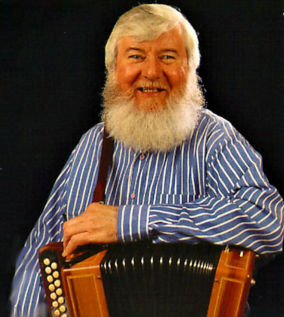
Birth of Joe Burke, Button Accordion Player

Joseph Burke, Irish musician noted for being a pre-eminent button accordion player, is born in Kilnadeema, south of Loughrea, County Galway, on April 11, 1939. He records and performs traditional Irish music for over half a century.

Burke starts playing traditional at age four and purchases his first accordion in the 1950s. He wins the All-Ireland Senior Accordion Championship in Thurles in 1959 and again in Boyle the following year. Together with fiddler Aggie Whyte, he wins the All-Ireland duet championship in 1962 in Gorey, County Wexford.

Burke co-founds the Leitrim Ceili Band with Padden Downey in 1956. Other members of the east Galway-based band, which wins All-Ireland Championships in 1959 and 1962, includes Irish flute players Paddy Carty, Ambrose Moloney and Tony Molloy, button accordionists Mick Darcy and Sean McGlynn, fiddlers Michael Joe Dooley, Paddy Doorhy, Aggie Whyte and Séamus Connolly, drummer Sean Curley and pianist Anne-Marie Courtney. The band tours in England and releases an LP on the New York-based Dublin label.

Burke first tours in the United States in 1961, and lives mainly in New York from 1962 to 1965, during which period he forms a musical partnership with fiddler Andy McGann. With McGann and pianist Felix Dolan, he records an LP, A Tribute to Michael Coleman, first released in 1966 on his own Shaskeen label. He records again with this trio, issuing The Funny Reel LP on the Shanachie Records label in 1979. Other musical collaborators over the years include Belfast fiddle great Sean McGuire, piper Michael Cooney, harpist Máire Ní Chathasaigh, fiddler Kevin Burke, pianist Charlie Lennon and his wife Anne Conroy Burke, whom he marries in 1990, on guitar and button accordion.

Burke’s first solo LP, Galway’s Own, is released in 1971. He also tours extensively for the next two decades, including with groups sponsored by Comhaltas Ceoltóirí Éireann. From 1988 to 1991, he lives in St. Louis, Missouri, where he has a musical residency at John D. McGurk’s Pub and hosts radio programmes at two stations, one of them the “Ireland in America” programme on KDHX. He represents Ireland in 1989 and 1992 at the International Accordion Festivals, in Montmagny, Quebec, along with accordion greats who include Cajun accordion player Marc Savoy and jazz accordionist Art Van Damme.

After residing in the United States from 1988 until 1991, Burke returns to Kilnadeema in 1992. There, he carries on teaching and performing music. He dies at the age of 81 on February 20, 2021, at Galway Hospice.

Burke is named RTɑs Traditional Musician of the Year in 1970. He goes on to win both the AIB Traditional Musician of the Year and the Lifetime Achievement Award from The Irish World in 1997. A Joe Burke Tribute Concert is held in April 1997 at the Town Hall Theatre in Galway, on his reception of the AIB award. Three years later, he receives an award in Musical Mastery from Boston College. He is later conferred Gradam an Chomhaltais in 2003.


Leave a comment

Birth of Bill Whelan, Musician & Composer of “Riverdance”

Bill Whelan, composer and musician, is born in Limerick, County Limerick, on May 22, 1950. He is best known for composing a piece for the interval of the 1994 Eurovision Song Contest. The result, Riverdance, is a seven-minute display of traditional Irish dancing that becomes a full-length stage production and spawns a worldwide craze for Irish dancing and Celtic music. It also wins him a Grammy. Riverdance is released as a single in the UK in 1994, credited to “Bill Whelan and Anúna featuring the RTÉ Concert Orchestra.” It reaches number 9 and stays on the charts for 16 weeks. The album of the same title reaches number 31 in the album charts in 1995.

Whelan also composes a symphonic suite version of Riverdance, with its premiere performed by the Ulster Orchestra on BBC Radio 3 in August 2014.

Whelan is educated at Crescent College, University College Dublin and the King’s Inns. While he is best known for his Riverdance composition, he has been involved in many ground-breaking projects in Ireland since the 1970s. As a producer he works with U2 on their War album, Van Morrison, Kate Bush, The Dubliners, Planxty, Andy Irvine & Davy Spillane, Patrick Street, Stockton’s Wing and fellow Limerickman Richard Harris.

As an arranger and composer, Whelan’s credits include:

  • The Spirit of Mayo, performed by an 85-piece orchestra in Dublin‘s National Concert Hall and featuring a powerful Celtic drum corps and a 200 strong choir and choral group Anúna.

In theatre, Whelan receives a Laurence Olivier Awards nomination for his adaption of Gilbert and Sullivan‘s H.M.S. Pinafore. He writes original music for fifteen of W. B. Yeats‘s plays for Dublin’s Abbey Theatre and his film credits include Dancing at Lughnasa (starring Meryl Streep), Some Mother’s Son, Lamb (starring Liam Neeson) and the award-winning At the Cinema Palace.


Leave a comment

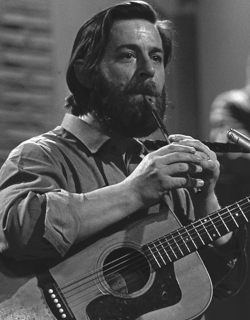
Death of Irish Folk Musician Tommy Makem

Thomas “Tommy” Makem, internationally celebrated Irish folk musician, artist, poet and storyteller, dies in Dover, New Hampshire, on August 1, 2007, following a lengthy battle with lung cancer.

Makem is born in Keady, County Armagh, on November 4, 1932. He is best known as a member of The Clancy Brothers and Tommy Makem. He plays the long-necked 5-string banjo, tin whistle, low whistle, guitar, bodhrán and bagpipes, and sings in a distinctive baritone. He is sometimes known as “The Bard of Armagh,” taken from a traditional song of the same name, and “The Godfather of Irish Music.”

Makem’s mother, Sarah Makem, is an important source of traditional Irish music, who is visited and recorded by, among others, Diane Guggenheim Hamilton, Jean Ritchie, Peter Kennedy and Sean O’Boyle. His father, Peter Makem, is a fiddler who also plays the bass drum in a local pipe band named “Oliver Plunkett,” after a Roman Catholic martyr of the reign of Charles II of England. His brother and sister are folk musicians as well. Makem, from the age of eight, is member of the St. Patrick’s church choir for 15 years where he sings Gregorian chant and motets. He does not learn to read music but he makes it in his “own way.”

Makem starts to work at 14 as a clerk in a garage and later he works for a while as a barman at Mone’s Bar, a local pub, and as a local correspondent for The Armagh Observer.

Makem emigrates to the United States in 1955, carrying his few possessions and a set of bagpipes from his time in a pipe band. Arriving in Dover, New Hampshire, he works at Kidder Press, where his hand was accidentally crushed by a press in 1956. With his arm in a sling, he leaves Dover for New York City to pursue an acting career.

The Clancys and Makem are signed to Columbia Records in 1961. The same year, at the Newport Folk Festival, Makem and Joan Baez are named the most promising newcomers on the American folk scene. During the 1960s, the Clancy Brothers and Tommy Makem perform sellout concerts at such venues as Carnegie Hall, and make television appearances on shows like The Ed Sullivan Show and The Tonight Show. The group performs for President John F. Kennedy. They also play in smaller venues such as the Gate of Horn in Chicago. They appear jointly in the UK Albums Chart in April 1966, when Isn’t It Grand Boys reaches number 22.

Makem leaves the group in 1969 to pursue a solo career. In 1975, he and Liam Clancy are both booked to play a folk festival in Cleveland, Ohio, and are persuaded to do a set together. Thereafter they often perform as Makem and Clancy, recording several albums together. He once again goes solo in 1988. Throughout the 1970s and 1980s he performs both solo and with Liam Clancy on The Irish Rovers‘ various television shows, which are filming in Canada and Ireland.

In the 1980s and 1990s, Makem is a principal in a well-known Irish music venue in New York, “Tommy Makem’s Irish Pavilion.” This East 57th Street club is a prominent and well-loved performance spot for a wide range of musicians. Among the performers and visitors are Paddy Reilly, Joe Burke, and Ronnie Gilbert. Makem is a regular performer, often solo and often as part of Makem and Clancy, particularly in the late fall and holiday season. The club is also used for warm-up performances in the weeks before the 1984 reunion concert of The Clancy Brothers and Tommy Makem at Lincoln Center for the Performing Arts. In addition, the after-party for Bob Dylan‘s legendary 30th Anniversary Concert Celebration at Madison Square Garden in 1992 is held at the Irish Pavilion.

In 1997 Makem writes a book, Tommy Makem’s Secret Ireland, and in 1999 premiers a one-man theatre show, Invasions and Legacies, in New York. His career includes various other acting, video, composition, and writing credits. He also establishes the Tommy Makem International Festival of Song in South Armagh in 2000.

Tommy Makem dies in Dover, New Hampshire, on August 1, 2007, following a lengthy battle with lung cancer. He continues to record and perform until very close to the end. Paying tribute to him after his death, Liam Clancy says, “He was my brother in every way.” He is buried next to his wife at New Saint Mary Cemetery in Dover.


Leave a comment

Birth of Cara Dillon, Irish Folk Singer

Cara Elizabeth Dillon, Irish folk singer, is born in Dungiven, County Londonderry, Northern Ireland on July 21, 1975.

Dillon comes from an area steeped in Irish traditional music. Since she was a schoolgirl she has sung and performed. She learns local folk songs from teachers and workshops held in the town. She can also play the fiddle and whistles. At the age of 14 she wins the All-Ireland Singing Trophy at Fleadh Cheoil.

In 1991 Dillon forms a band called Óige (an Irish word meaning ‘youth’) with school friends Murrough and Ruadhrai O’Kane, bringing her take on Irish traditional songs to Ireland, Scotland and further afield. During this time she also performs with big names such as De Dannan and Phil Coulter. Óige records two albums with Dillon, a studio and a live album. Inspiration is recorded in 1992 to sell at concerts in Europe. The live album, simply called Live, is recorded at a concert in Glasgow on August 15, 1993.

Dillon leaves Óige in 1995 and joins the folk supergroup Equation, replacing Kate Rusby, and signs a record deal with Warner Music Group. She leaves Equation with original band member Sam Lakeman because of musical differences and together they immediately signed a separate deal with the same label as a duo named Polar Star. In 2001, she releases her first solo album, Cara Dillon, which features traditional songs and two original Dillon/Lakeman compositions. The album is an unexpected hit in the folk world, with Dillon receiving four nominations at the 2002 BBC Radio 2 Folk Awards. Lakeman and Dillon marry in December 2002.

Dillon’s second album, Sweet Liberty (2003), enters the Irish Albums Chart and UK Independent Albums Chart. In 2004, she receives the Meteor Irish Music Award for Best Irish Female. Her third album, After the Morning, is released in 2006. The album’s opening track “Never in a Million Years” gains BBC Radio 2 airplay, while other tracks feature the Czech Philharmonic orchestra and Paul Brady. Also in 2006, she sings at the opening of the Ryder Cup in Ireland.

In 2009, Dillon releases her fourth album, the award-winning Hill of Thieves. The record marks a return to Dillon’s traditional roots with a purer production and arrangement style. The titular track “Hill of Thieves,” a Dillon\Lakeman original, is voted by BBC listeners as one of the “Top 10” original songs to have come out of Northern Ireland. In 2012, she performs two concerts with the Ulster Orchestra.

Dillon’s fifth solo album, A Thousand Hearts, is released in 2014. Prior to the album’s release, she discovers that her music enjoys a dedicated following in China, where her first album is featured in English curriculums. She has since embarked on several popular Chinese tours. As of 2017, she continues to tour regularly and work with her husband, who backs her on piano and guitar. Her most recent release is the album, Wanderer (2017).

Dillon is the sister of fellow folk singer Mary Dillon, formerly of Déanta. Dillon and Lakeman live in Frome, Somerset, England with their three children, twin sons born in 2006 and a daughter born in 2010.


Leave a comment

Death of Francis McPeake II, Uilleann Piper & Singer

Francis ‘Francie’ McPeake II, uilleann piper and singer, dies in Belfast on July 7, 1986. He is a crucial figure in preserving the great Ulster piping tradition.

McPeake is born on January 20, 1917 at 43 Malcolmson Street, Belfast, the son of Francis J. McPeake (1885–1971), piper and tram conductor, and Mary McPeake (née Loney). His father, a staunch nationalist, wins the Feis piping competition in Belfast in 1909 and represents Ireland together with a Welsh harper, John Page, at the Pan-Celtic Congress in Brussels in 1911. In July 1912 he wins first prize in the learners’ class when he attends the foundation of the Pipers’ Club in Dublin. He represents Ireland in many instances as one of relatively few pipers from Northern Ireland at the time.

McPeake continues the strong musical tradition in the family. He also plays the pipes and father and son are recorded by Peter Kennedy in 1952. They appear at the Royal Albert Hall in 1956 and later form the McPeake Trio along with his brother James, who plays the fiddle, the piano accordion, and later a harp made by McFall in Belfast. The trio comes to be known as The McPeakes. They sing in Irish and in English and are closely identified with particular songs, such as “The Jug of Punch,” “The Lament of Aughrim,” and “The Verdant Braes of Skreen,” though the one most associated with them is “Will You Go, Lassie, Go?”

The McPeakes win first prize at the international Eisteddfod in Wales in the late 1950s and acquire a strong international reputation with Bob Dylan being among their fans. The trio is later augmented by members of the next generation, recorded by Peter Kennedy again, and make several recordings, including Irish Folk (1964) and Welcome Home (1967), which is a cassette reissue of a 1962 album for the Topic Records label. Some of Kennedy’s recordings of the McPeake family are released on the compact disc Traditional Songs of Ireland (CD-SDL 411) in 1995. A fourth-generation family group follows, Clan McPeake, inheriting the commitment, much of the repertoire, and the verve of the earlier generations.

McPeakes’s gift for teaching is employed at the Francis McPeake School of Music, which is established in 1977, and he writes a well-reviewed tin whistle tutor entitled Smash the Windows, published by Appletree Press in 1981. He also forms the Clonard Traditional Music Society.

McPeake dies on July 7, 1986. The McPeake family remains closely associated with traditional music and with Belfast. The Francis McPeake International Summer School is established in 2004.

(From: “McPeake, Francis (‘Francie’)” by Ríonach uí Ógáin, Dictionary of Irish Biography, content licensed under a Creative Commons Attribution Non Commercial 4.0 International license)


Leave a comment

Birth of Ciarán Bourke, Founding Member of The Dubliners

Ciarán Bourke, Irish musician and one of the founding members of the Irish folk band The Dubliners, is born in Dublin on February 18, 1935.

Although born in Dublin, Bourke lives most of his life in Tibradden, County Dublin. His father, a doctor, is in practice in the city. The children have an Irish-speaking nanny. His early exposure to Irish continues throughout his education, attending Colaiste Mhuire, Parnell Square, Dublin. He later attends University College Dublin for a course in Agricultural Science. He does not take his degree but always retains an interest in farming.

After leaving university Bourke meets two of his future bandmates in The Dubliners, Ronnie Drew and Barney McKenna, who invite him to join their sessions in O’Donoghue’s Pub where he plays tin whistle, mouth organ and guitar, and sings. Luke Kelly, who had been singing around the clubs in England, returns to Dublin and joins them, with the four gaining local popularity. Taking the name The Dubliners, the group puts together the first folk concert of its kind in Dublin. The concert is a success, then a theatrical production called “A Ballad Tour of Ireland” is staged at the Gate Theatre shortly afterwards. In 1964 fiddle player John Sheahan joins the band and this becomes known as the original Dubliners line-up.

Bourke is responsible for bringing a Gaelic element to The Dubliners’ music with songs such as “Peggy Lettermore” and “Sé Fáth Mo Bhuartha” being performed in the Irish language. He also sings a number of the group’s more lighthearted and humorous numbers such as “Jar of Porter,” “The Dublin Fusiliers,” “The Limerick Rake,” “Mrs. McGrath,” “Darby O’Leary,” “All For Me Grog” and “The Ballad of Ronnie’s Mare,” as well as patriotic songs such as “Roddy McCorley,” “The Enniskillen Dragoons,” “Take It Down From The Mast” and “Henry Joy.”

On April 5, 1974 The Dubliners travel to Eastbourne where they are to appear in concert. Kelly is worried by the way Bourke keeps moving his head about, as if trying to alleviate increasing pain. Four minutes into the second half, it is decided he cannot continue with the show. Kelly insists that a doctor should be phoned and instructs to await their return to the Irish Club at Eaton Square. The roadie for the trip, John Corry, thinks that it is better to drive straight to St. George’s Hospital in London, where the doctors diagnose a brain aneurysm. He is transferred to the Atkinson Morley Hospital in Wimbledon, while doctors wait for his wife to return from a trip to Ghana, to get her signature before operating. She is told that there is danger of further haemorrhaging. He is operated on at the earliest opportunity. The bleeding begins again while he is on the table which means that they cannot repair the damage, only staunch the bleeding. This leaves him paralysed down his left side and confused as to where he is and what has happened.

Bourke receives intensive therapy, attending a clinic in Dún Laoghaire, County Dublin. He is heartened by his progress and insists on rejoining The Dubliners on their next tour of the Continent in November that year.

Bourke’s continued insistence that he is fit enough to join them on the forthcoming German tour causes them considerable disquiet. They prefer he ease himself back to work, with a few small shows in Ireland. The tour gradually begins to take its toll on him, and it is decided that for the sake of his health he should return home. He flies from Brussels to Dublin.

Bourke makes his last public appearance on Ireland’s RTÉ One during The Late Late Show‘s tribute to The Dubliners in 1987. Despite his lingering paralysis he recites “The Lament for Brendan Behan” after which everyone in the studio, led by Ronnie Drew, sing “The Auld Triangle.”

Bourke dies on May 10, 1988, after a long illness. From 1974 until his death, he is continued to be paid by the band. A fifth member of the group is not recruited until after his death.


Leave a comment

Birth of Mairéad Ní Mhaonaigh, Irish Fiddler & Vocalist

Compressed by jpeg-recompress

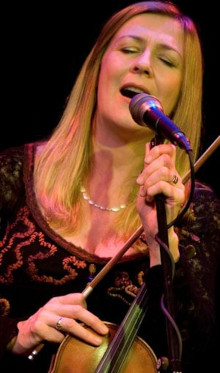
Mairéad Ní Mhaonaigh, Irish fiddler and lead vocalist for the Irish traditional music band Altan, is born on July 26, 1959 in Gweedore, County Donegal, where Gaeilge is her primary language and she learns her songs and tunes from her family and neighbours.

Ní Mhaonaigh’s father, Proinsias Ó Maonaigh, is a noted fiddler, song writer and school teacher and is her first main influence. Her mother, Kitty Rua is also raised in a musical house that holds frequent house dances. It is no surprise that she and her siblings, Gearóid and Anna, all play music together.

In the early 1980s, Ní Mhaonaigh qualifies as a Primary school teacher and teaches in Saint Oliver Plunkett National School in Malahide, County Dublin. She and her husband, Frankie Kennedy, record Ceol Aduaidh (Music from the North) for Irish label Gael Linn in 1983. This timeless recording is the genesis of what later becomes Altan. The recording features her brother Gearóid Ó Maonaigh on guitar, Fintan Mc Manus on bouzouki, Ciaran Curran on bouzouki and Eithne Ní Bhraonáin (now known as Enya) on keyboards. The album quietly gains praise among enthusiasts of traditional Irish music worldwide, which leads the way for a career in music.

Ní Mhaonigh’s teaching career comes to a halt after she and her husband take a career break in 1987 and formed Altan. The band goes on to become one of the most acclaimed Irish traditional bands touring the world. They record for Green Linnet Records in the United States and tour North America extensively.

In 1994, Frankie Kennedy passes away to cancer, which is a tremendous loss to Ní Mhaonigh. She continues with the band at her late husband’s request and signs to multinational record label Virgin Records London in late 1994. This marks the first traditional Irish band to be signed to a major record label and propels Altan and Ní Mhaonigh into a wider audience of followers.

Altan travels all over the world headlining shows from Tokyo, the Sydney Opera House, the Hollywood Bowl to the National Concert Hall, Dublin.

Ní Mhaonaigh, along with fronting Altan, remains close her roots between touring and returns to her native County Donegal to play, sing and teach her music to a new generation. She helps set up Cairdeas na bhFidléirí (The Fellowship / Friendship of Fiddlers) in the early 1980s to promote and preserve the fiddle music of County Donegal.

In 2009, Ní Mhaonaigh releases her first solo album, Imeall (Edge/Theshold), as a limited edition. After many years of playing with the band and numerous requests for a solo recording she finally gets time to record the album after parting with her second husband Dermot Byrne, with whom she has her daughter Nia. She tours the album between Altan commitments with her co-producer and recording engineer Manus Lunny.

The album prompts one reviewer, Paul O’Connor, to remark, “Her identified success as the leader of Altan has dominated our sense of her to the point that we aren’t cognisant of how good she is as an artist, musician, composer in her own right.”

This new focus on Ní Mhaonaigh as an artist in her own right, prompts The Donegal Association in Dublin to grant her “Donegal Person of the Year 2009” at a gala dinner in Dublin’s prestigious Burlington Hotel.

Ní Mhaonaigh is awarded the top recognition in traditional Irish music by her fellow peers in 2018, when she is awarded TG4 Gradam Ceoil’s Traditional Musician of the Year. The following year, she is honoured in her own county at the now world famous “Cup o’Tae Festival” which is held annually in Ardara, County Donegal.

Ní Mhaonaigh is also a member of String Sisters, which is a Grammy listed folk supergroup of six of the world’s leading female fiddlers. Together they have released two albums – the Grammy-longlisted Live and Between Wind and Water. She is a member of T with the Maggies, which is a vocal supergroup of Donegal singers comprised of Maighread and Tríona Ní Dhomhnaill and Moya Brennan of Clannad fame.

Recently Ní Mhaonaigh has recorded with a group of thirteen County Donegal-based female fiddlers which is called ‘SíFiddlers.’

(From: Mairéad Ní Mhaonaigh’s website, http://www.mairead.ie)


Leave a comment

Birth of Martin Fay of The Chieftains

martin-fay-1

Martin Joseph Fay, Irish fiddler and bones player and co-founder of the Irish traditional music ensemble The Chieftains, is born in Cabra, Dublin on September 19, 1936.

The Chieftains are credited with reviving worldwide interest in traditional Celtic music. Fay performs as the group’s fiddler and bones player for some 40 years.

Fay develops an early interest in the violin and takes music lessons at the Municipal School of Music in Dublin. He joins the orchestra of the Abbey Theatre during his teen years and is introduced to Irish folk music by the theatre’s musical director Sean O’Riada.

It was through O’Riada’s folk band, Ceoltóirí Chualann, that Fay meets the other original Chieftains members, Paddy Moloney, Seán Potts, and Michael Tubridy. The foursome releases their first album, Chieftains 1, in 1964. The Chieftains perform on local radio and television programs and in pubs throughout the British Isles, but it is not until the 1970s that they begin touring overseas.

The Chieftains gain international acclaim when their music is used in the Academy Award-winning soundtrack for the film Barry Lyndon (1975). In 1989, The Chieftains are officially designated Ireland’s musical ambassadors. Although the quartet’s membership changes over the years, Fay records more than 30 albums with The Chieftains.

In 2001, Fay decides to stop touring with The Chieftains, limiting his appearances with the group to events in Ireland. He subsequently retires in 2002. After a lengthy illness, he dies at the age of 76 in Cabra on November 14, 2012.