seamus dubhghaill

Promoting Irish Culture and History from Little Rock, Arkansas, USA


Leave a comment

Death of Michael O’Riordan, Founder of the Communist Party of Ireland

Michael O’Riordan, founder of the Communist Party of Ireland, dies at St. Mary’s Hospital in the Phoenix Park on May 18, 2006.

O’Riordan is born at 37 Pope’s Quay, Cork, County Cork, on November 11, 1917, the youngest of five children. His parents come from the West Cork Gaeltacht of BallingearyGougane Barra. Despite his parents being native speakers of the Irish language, it is not until he is interned during World War II that he learns Irish.

As a teenager, O’Riordan joins the republican youth movement, Fianna Éireann, and then the Irish Republican Army (IRA). Much of the IRA at the time is inclined toward left-wing politics. A lot of its activity at the time involves street fighting with the quasi-fascist Blueshirt movement, and he fights the Blueshirts on the streets of Cork in 1933–34. He Is friends with left-wing inclined republicans such as Peadar O’Donnell and Frank Ryan, and in 1934, he follows them into the Republican Congress – a short-lived socialist republican party.

O’Riordan joins the Communist Party of Ireland (1933) in 1935 while still in the IRA and works on the communist newspaper The Irish Workers’ Voice. In 1937, following the urgings of Peadar O’Donnell, several hundred Irishmen, mostly IRA or ex-IRA men, go to fight for the Spanish Republic in the Spanish Civil War with the XVth International Brigade. They are motivated in part by enmity towards the 800 or so Blueshirts, led by Eoin O’Duffy who went to Spain to fight on the “nationalist” side in the Irish Brigade. He accompanies a party led by Frank Ryan. In the Republic’s final offensive of July 25, 1938, he carries the flag of Catalonia across the River Ebro. On August 1 he is severely injured by shrapnel on the Ebro front. He is repatriated to Ireland the following month, after the International Brigades are disbanded.

In 1938, O’Riordan is offered an Irish Army commission by the Irish Free State but chooses instead to train IRA units in Cork. As a result of his IRA activities during World War II, he is interned in the Curragh Camp from 1939 until 1943 where he is Officer Commanding of the Cork Hut and partakes in Máirtín Ó Cadhain‘s Gaelic League classes as well as publishes Splannc (Irish for “Spark”, named after Vladimir Lenin‘s newspaper). He is secretary of the “Connolly group,” composed of leftist internees. Following his release from internment, he terminates his IRA membership.

In 1944, O’Riordan is founding secretary of the Liam Mellows Branch of the Labour Party. This branch becomes infamous for what is regarded during the period as its controversial nature and becomes an intractable enemy of Branch Chair Timothy Quill. The branch is initially established by former members of the Curragh Camp’s Communist Group, including Bill Nagle and Jim Savage. During this time, the Irish Transport and General Workers’ Union (ITGWU) disaffiliates from the Labour Party and the National Labour Party is established on the basis that communists have infiltrated the party. Quill, who is made branch chair by the Labour Party, allegedly has O’Riordan and his fellow members expelled, with the branch being dissolved. O’Riordan later accuses Quill of antisemitism and both Quill and Timothy J. Murphy of “red-baiting.” In 2001, he claims that any attempt to raise the issue of defence of communist Spain “was shouted down at Labour Party Conferences.” In 1945, he is a founding secretary of the Cork Socialist Party.

O’Riordan subsequently works as a bus conductor in Cork and is active in the ITGWU. He stands as a Cork Socialist Party candidate in the 1946 Cork Borough by-election, placing third behind Fianna Fáil‘s Patrick McGrath and Fine Gael‘s Michael O’Driscoll with 3,184 votes. Afterward, he moves to Dublin where he lives in Victoria Street with his wife Kay, and continues to work as a bus conductor and remains active in the ITGWU.

In 1948, O’Riordan is a founding secretary of the Irish Workers’ League and general secretary thereafter, and of its successor organisation the Irish Workers’ Party from 1962 to 1970.

In the 1960s, O’Riordan is a pivotal figure in the Dublin Housing Action Committee which agitates for clearances of Dublin’s slums and for the building of social housing. There, he befriends Fr. Austin Flannery, leading the then Finance Minister and future Taoiseach Charles Haughey to dismiss Flannery as “a gullible cleric” while the Minister for Local GovernmentKevin Boland, describes him as a “so-called cleric” for sharing a platform with O’Riordan. The Catholic Church states that anyone who votes for him has committed mortal sin.

O’Riordan meets and befriends folk musician Luke Kelly, and the two develop a “personal-political friendship.” Kelly endorses him for election, and holds a rally in his name during campaigning in 1965.

In all O’Riordan runs for election five times, campaigning throughout for the establishment of a socialist republic in Ireland but given Ireland’s Catholic conservatism and fear of communism, he does so without success. He does, however, receive playwright Seán O’Casey‘s endorsement in 1951. O’Casey writes: “Mr. O’Riordan is his own message. He has nothing to sell but his soul. But he hasn’t done that, though he will be told he’ll lose it by holding on to it.”

O’Riordan’s participation in the Spanish Civil War is always an important part of his political identity. In 1966, he attends the International Brigades’ Reunion in Berlin and is instrumental in having Frank Ryan’s remains repatriated from Germany to Ireland in 1979.

O’Riordan is a member of the Irish Chile Solidarity Committee and attends the 1st Party Congress of the Communist Party of Cuba in 1984. He also campaigns on behalf of the Birmingham Six and attends their appeal trial in 1990. He serves between 1970 and 1983 as General Secretary of the Communist Party of Ireland (CPI) and from 1983 to 1988 as National Chairman of the party publishing many articles under the auspices of the CPI. Hus staunchly pro-Soviet direction of the party leads to a number of members leaving to form the Eurocommunist Irish Marxist Society.

At the February 1982 Irish general election, O’Riordan and his party are described as “traitors to the working class” by the Communist Party of Ireland (Marxist–Leninist).

O’Riordan’s last major public outing is in 2005 at the re-dedication of the memorial outside Dublin’s Liberty Hall to the Irish veterans of the Spanish Civil War. With other veterans, he Is received by President of Ireland Mary McAleese. He is also presented with Cuba’s Medal of Friendship by the Cuban Consul Teresita Trujillo to Ireland on behalf of Cuban President Fidel Castro.

In 1969, according to Soviet dissident Vasili Mitrokhin, O’Riordan is approached by IRA leaders Cathal Goulding and Seamus Costello with a view to obtaining guns from the Soviet KGB to defend Irish republican areas of Belfast during the communal violence that marked the outbreak of the Troubles. Mitrokhin alleges that O’Riordan then contacts the Kremlin, but the consignment of arms does not reach Ireland until 1972. The operation is known as Operation Splash.

In the meantime, the IRA has split into the Provisional IRA and the Official IRA and it is the latter faction who receives the Soviet arms. Mitrokhin’s allegations are repeated in Boris Yeltsin‘s autobiography. After the split in the Republican movement, O’Riordan unsuccessfully attempts to bring about a reunification of the two sides.

O’Riordan’s book, Connolly Column: The Story of the Irishmen who fought for the Spanish Republic, 1936–1939, published in 1979, deals with the Irish volunteers of the International Brigade who fought in support of the Spanish Republic against Francisco Franco in the Spanish Civil War (1936–39). An updated version of the book is reprinted in 2005 and is launched by the Lord Mayor of Dublin, Cllr. Michael Conaghan at a book launch at SIPTU headquarters, Liberty Hall. The book is the inspiration for Irish singer-songwriter Christy Moore‘s famous song Viva la Quinta Brigada.

In 1991, O’Riordan’s wife, Kay Keohane of Clonakilty, County Cork dies at their home at the age of 81. He continues to live in their family home before moving to Glasnevin in 2000 to be close to his son Manus who lives nearby. In 1999, he describes himself as an atheist and believes that communism will rise again. He lives there until falling ill in November 2005 and is taken to the Mater Hospital. His health rapidly deteriorates and he quickly develops Alzheimer’s disease. Soon afterward he is moved to St. Mary’s Hospital in the Phoenix Park where he spends the final few months of his life, before his death at the age of 88 on May 18, 2006. Then Labour Party leader Ruairi Quinn praises O’Riordan after his death, saying, “As leader of the Labour Party I had the honour of ensuring he received a special citation at our 2001 national conference. Michael O’Riordan stood out against the tide of Irish conservatism and clerical domination that kept Ireland backward and isolated in the 1930s, 1940s and 1950s.”

O’Riordan’s funeral at Glasnevin Crematorium is attended by over a thousand mourners. Following a wake the previous night at Finglas Road, hundreds turn up outside the house of his son and traffic grinds to a halt as family, friends and comrades – many of whom are waving the red flag of the Communist Party of Ireland – escort O’Riordan to Glasnevin Cemetery. A secular ceremony takes place led by Manus O’Riordan (Head of Research at SIPTU) with contributions from O’Riordan’s family, Communist Party general secretary Eugene McCartan and IBMT representative Pauline Frasier.

The funeral congregation includes politicians such as Labour Party leader Pat Rabbitte, his predecessor Ruairi Quinn, party front-bencher Joan BurtonSinn Féin TD Seán Crowe and councillor Larry O’Toole; former Workers’ Party leader Tomás Mac Giolla and former Fianna Fáil MEP Niall Andrews. Also in attendance are union leaders Jack O’Connor (SIPTU), Mick O’Reilly (ITGWU) and David Begg (ICTU). Actors Patrick Bergin, Jer O’Leary; singer Ronnie Drew; artist Robert Ballagh; newsreader Anne Doyle are also among the mourners. Tributes are paid by President of Ireland Mary McAleese, Taoiseach Bertie Ahern, Sinn Féin leader Gerry Adams and Labour Party TDs Ruairi Quinn and Michael D. Higgins.

Leave a comment

The Bachelor’s Walk Massacre

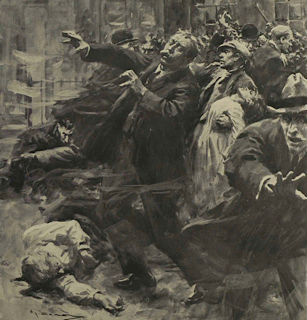
The Bachelor’s Walk massacre occurs in Dublin on July 26, 1914, when a column of troops of the King’s Own Scottish Borderers is accosted by a crowd on Bachelor’s Walk following the Howth gun-running operation. After some verbal baiting, the troops attack “hostile but unarmed” protesters with rifle fire and bayonets, resulting in the deaths of four civilians and injuries to in excess of 30 more. The four killed are Mary Duffy (50), Patrick Quinn (50), James Brennan (18) and Sylvester Pidgeon (40) who succumbs to his wounds on September 24. One of those shot is Luke Kelly, the father of folk singer Luke Kelly.

The events follow the landing of 1,500 rifles and ammunition, purchased for the Irish Volunteers in Hamburg, Germany, in May 1914. In a counter operation to the Unionists running guns into UlsterErskine Childers lands the cargo in Howth, County Dublin, and a thousand rifle-carrying Irish Volunteers marched into Dublin. The quantity is negligible when compared to the far greater numbers of weapons landed and distributed by the Ulster Volunteers, completely without hindrance, but the reaction this time is severe from the British ruling authorities.

The incident proves a moment of political opportunity for Irish nationalists as it sharply brings out the different treatment for the Unionists and for unarmed Dublin civilians. Patrick Pearse declares, “The army is an object of odium, and the Volunteers are the heroes of the hour. The whole movement, the whole country, has been re-baptised by bloodshed for Ireland.”


Leave a comment

Birth of Irish Folk Singer Patsy Watchorn

Patsy Watchorn, Irish folk singer notable for being a member of the Dublin City Ramblers and later The Dubliners, is born in Crumlin, Dublin, on October 16, 1944.

Watchorn first comes to prominence in 1969 as the lead singer of The Quare Fellas, a Dublin-based ballad group. They evolve into the Dublin City Ramblers in the early 1970s and with Watchorn as their lead singer they have hits with songs such as “The Rare Ould Times” and “The Ferryman,” both of which are written by Pete St. John.

Watchorn also writes and sings the Irish Football Team anthem, “We are the Boys in Green” (Home & Away album), with The Dublin City Ramblers for the teams European Championship campaign in Germany and again for the 1990 FIFA World Cup in Italy. The lyrics change slightly in both releases in 1988 and 1990.

In 1995, Watchorn leaves The Dublin City Ramblers and makes a number of solo albums. He joins The Dubliners in 2005, taking Paddy Reilly‘s place. He is well received throughout Ireland, the United Kingdom, Europe, Australia and the United States. He appears on their Tour Sampler EP in 2005, as well as the double album Live at Vicar Street (2006). He plays the banjo, bodhrán and spoons. He cites Luke Kelly, former lead singer with The Dubliners, as his favourite singer.

When The Dubliners announce their retirement in 2012 after finishing their 50 Years Anniversary Tour, Watchorn decides to keep on touring with former band members Seán Cannon and Eamonn Campbell and banjo player Gerry O’Connor under the name of “The Dublin Legends.”

On April 28, 2014, Watchorn posts a message on his website, stating that he has “decided to take a break from the music business for a while” and will not be touring the rest of 2014 with The Dublin Legends. He later admits this is due to ill health and that doctors had advised him that touring would do further damage to his health.

Watchorn’s distinctive and passionate vocals have made him a huge rock on the Irish folk scene. In his solo projects in the mid- and late-1990s, after his departure from The Dublin City Ramblers, he has session men who used to play alongside him and he uses the stage name “Patsy Watchorn, agus a Cháirde” (which means “and his Friends” in Irish).


Leave a comment

Birth of Ciarán Bourke, Founding Member of The Dubliners

Ciarán Bourke, Irish musician and one of the founding members of the Irish folk band The Dubliners, is born in Dublin on February 18, 1935.

Although born in Dublin, Bourke lives most of his life in Tibradden, County Dublin. His father, a doctor, is in practice in the city. The children have an Irish-speaking nanny. His early exposure to Irish continues throughout his education, attending Colaiste Mhuire, Parnell Square, Dublin. He later attends University College Dublin for a course in Agricultural Science. He does not take his degree but always retains an interest in farming.

After leaving university Bourke meets two of his future bandmates in The Dubliners, Ronnie Drew and Barney McKenna, who invite him to join their sessions in O’Donoghue’s Pub where he plays tin whistle, mouth organ and guitar, and sings. Luke Kelly, who had been singing around the clubs in England, returns to Dublin and joins them, with the four gaining local popularity. Taking the name The Dubliners, the group puts together the first folk concert of its kind in Dublin. The concert is a success, then a theatrical production called “A Ballad Tour of Ireland” is staged at the Gate Theatre shortly afterwards. In 1964 fiddle player John Sheahan joins the band and this becomes known as the original Dubliners line-up.

Bourke is responsible for bringing a Gaelic element to The Dubliners’ music with songs such as “Peggy Lettermore” and “Sé Fáth Mo Bhuartha” being performed in the Irish language. He also sings a number of the group’s more lighthearted and humorous numbers such as “Jar of Porter,” “The Dublin Fusiliers,” “The Limerick Rake,” “Mrs. McGrath,” “Darby O’Leary,” “All For Me Grog” and “The Ballad of Ronnie’s Mare,” as well as patriotic songs such as “Roddy McCorley,” “The Enniskillen Dragoons,” “Take It Down From The Mast” and “Henry Joy.”

On April 5, 1974 The Dubliners travel to Eastbourne where they are to appear in concert. Kelly is worried by the way Bourke keeps moving his head about, as if trying to alleviate increasing pain. Four minutes into the second half, it is decided he cannot continue with the show. Kelly insists that a doctor should be phoned and instructs to await their return to the Irish Club at Eaton Square. The roadie for the trip, John Corry, thinks that it is better to drive straight to St. George’s Hospital in London, where the doctors diagnose a brain aneurysm. He is transferred to the Atkinson Morley Hospital in Wimbledon, while doctors wait for his wife to return from a trip to Ghana, to get her signature before operating. She is told that there is danger of further haemorrhaging. He is operated on at the earliest opportunity. The bleeding begins again while he is on the table which means that they cannot repair the damage, only staunch the bleeding. This leaves him paralysed down his left side and confused as to where he is and what has happened.

Bourke receives intensive therapy, attending a clinic in Dún Laoghaire, County Dublin. He is heartened by his progress and insists on rejoining The Dubliners on their next tour of the Continent in November that year.

Bourke’s continued insistence that he is fit enough to join them on the forthcoming German tour causes them considerable disquiet. They prefer he ease himself back to work, with a few small shows in Ireland. The tour gradually begins to take its toll on him, and it is decided that for the sake of his health he should return home. He flies from Brussels to Dublin.

Bourke makes his last public appearance on Ireland’s RTÉ One during The Late Late Show‘s tribute to The Dubliners in 1987. Despite his lingering paralysis he recites “The Lament for Brendan Behan” after which everyone in the studio, led by Ronnie Drew, sing “The Auld Triangle.”

Bourke dies on May 10, 1988, after a long illness. From 1974 until his death, he is continued to be paid by the band. A fifth member of the group is not recruited until after his death.


Leave a comment

Birth of Luke Kelly, Founding Member of The Dubliners

luke-kelly

Luke Kelly, singer, folk musician and actor, is born into a working-class family in Lattimore Cottages at 1 Sheriff Street, Dublin on November 17, 1940. He is noted as a founding member of the band The Dubliners.

After Dublin Corporation demolished Lattimore Cottages in 1942, the Kellys become the first family to move into the St. Laurence O’Toole flats, where Luke spends the bulk of his childhood, although the family is forced to move by a fire in 1953 and settles in the Whitehall area.

Kelly is interested in music during his teenage years and regularly attends cèilidh with his sister Mona and listens to American vocalists including Fats Domino, Al Jolson, Frank Sinatra and Perry Como. He also has an interest in theatre and musicals, being involved with the staging of plays by Dublin’s Marian Arts Society. The first folk club he comes across is in the Bridge Hotel, Newcastle upon Tyne in early 1960. Having already acquired the use of a banjo, he starts memorising songs.

Kelly befriends Sean Mulready in Birmingham and lives in his home for a period. Mulready is a teacher who is forced from his job in Dublin because of his communist beliefs. Mulready’s brother-in-law, Ned Stapleton, teaches Kelly “Rocky Road to Dublin.” During this period he studies literature and politics under the tutelage of Mulready, his wife Mollie, and Marxist classicist George Derwent Thomson.

In 1961 there is a folk music revival or “ballad boom,” as it is later termed, in waiting in Ireland. Kelly returns to Dublin in 1962. A concert John Molloy organises in the Hibernian Hotel leads to his “Ballad Tour of Ireland” with the Ronnie Drew Ballad Group. This tour leads to the Abbey Tavern and the Royal Marine Hotel and then to jam-packed sessions in the Embankment, Tallaght. Ciarán Bourke joins the group, followed later by John Sheahan. They rename themselves The Dubliners at Kelly’s suggestion, as he is reading James Joyce‘s book of short stories, entitled Dubliners, at the time. Kelly is the leading vocalist for the group’s eponymous debut album in 1964, which includes his rendition of “Rocky Road to Dublin.”

In 1964 Kelly leaves the group for nearly two years and is replaced by Bob Lynch and John Sheahan. Kelly goes with Deirdre O’Connell, founder of the Focus Theatre, to whom he marries the following year, back to London and becomes involved in Ewan MacColl‘s “gathering.”

When Bob Lynch leaves The Dubliners, John Sheahan and Kelly rejoin. The ballad boom in Ireland is becoming increasingly commercialised with bar and pub owners building ever larger venues for pay-in performances. Ewan MacColl and Peggy Seeger on a visit to Dublin express concern to Kelly about his drinking.

The arrival of a new manager for The Dubliners, Derry composer Phil Coulter, results in a collaboration that produces three of Kelly’s most notable performances: “The Town I Loved So Well”, “Hand Me Down My Bible“, and “Scorn Not His Simplicity”, a song about Phil’s son who had Down Syndrome. Kelly remains a politically engaged musician, becoming a supporter of the movement against South African apartheid and performing at benefit concerts for the Irish Travellers community.

Kelly’s health deteriorates in the 1970s. During a concert in the Cork Opera House on June 30, 1980 he collapses on the stage. He had already suffered for some time from migraines and forgetfulness which had been ascribed to his intense schedule, alcohol consumption, and “party lifestyle.” A brain tumor is diagnosed. Although he tours with the Dubliners after enduring an operation, his health deteriorates further. He forgets lyrics, has to take longer breaks in concerts due to weakness and becomes more withdrawn. In the autumn of 1983 he has to leave the stage in Traun, Austria and again in Mannheim, Germany. Shortly after this, he has to cancel the tour of southern Germany and, after a short stay in hospital in Heidelberg, he is flown back to Dublin.

After another operation Kelly spends Christmas with his family but is taken to hospital again in the New Year, where he dies on January 30, 1984. His funeral in Whitehall attracts thousands of mourners from across Ireland. His gravestone in Glasnevin Cemetery, Dublin, bears the inscription: Luke Kelly – Dubliner.


Leave a comment

Death of Ronnie Drew, Folk Musician & Singer

ronnie-drew-1

Joseph Ronald “Ronnie” Drew, singer, folk musician and actor who achieves international fame during a fifty-year career recording with The Dubliners, dies on August 16, 2008, in Dublin, County Dublin.

Drew is most recognised for his lead vocals on the singles “Seven Drunken Nights” and “The Irish Rover,” both charting in the UK top 10 and then performed on Top of the Pops. He is recognisable for his long beard and his voice, which was once described by Nathan Joseph as being “like the sound of coke being crushed under a door.”

Drew is born in Dún Laoghaire, County Dublin on September 16, 1934, and is educated at CBS Eblana. Despite his aversion to education, he is considered the most intelligent in his class by schoolfriend and future Irish film censor, Sheamus Smith. Drew also sings as a boy soprano before his voice breaks.

In the 1950s, Drew moves to Spain to teach English and learn Spanish and flamenco guitar. His interest in folk music begins at the age of nineteen. When he returns to Ireland, he performs in the Gate Theatre with John Molloy and soon goes into the music business full-time, after holding a number of short-term jobs.

In 1962, he founds the Ronnie Drew Group with Luke Kelly, Barney McKenna and Ciarán Bourke. They soon change their name to The Dubliners, with John Sheahan joining shortly afterwards to form the definitive line-up and quickly become one of the best-known Irish folk groups. They play at first in O’Donoghue’s Pub in Merrion Row, Dublin where they are often accompanied by Mary Jordan on the spoons and vocalist Ann Mulqueen, a friend of McKenna’s. Mary Jordan’s mother, Peggy Jordan, introduces them to the Abbey Tavern in Howth, which becomes a regular Monday night venue for the emerging group. They also play across the road in the Royal Hotel, at all-night parties in Peggy’s large house in Kenilworth Square in Rathgar, and in John Molloy’s flat at Ely Place.

Drew leaves the Dubliners in 1974, goes to Norway in 1978 and records two songs with the Norwegian group Bergeners. He rejoins The Dubliners in 1979 and leaves for good in 1995, though he does reunite with the group in 2002 for a 40th anniversary celebration. He makes several television appearances with the group between 2002 and 2005.

From 1995 onwards, Drew pursues a solo career. He records with many artists, including Christy Moore, The Pogues, Antonio Breschi, Dropkick Murphys, Eleanor Shanley and others. He does a number of “one-man shows” consisting of stories about people such as Brendan Behan, Patrick Kavanagh and Seán O’Casey, as well as Drew singing their songs.

He fronts a campaign to encourage the use of Dublin’s light-rail infrastructure (the DART) and, before that, the “My Dublin” ads for radio stations 98FM and FM104. He narrates a retelling of the great Irish Myths and Legends over a six CD set in 2006. He also narrates the stories of Oscar Wilde in his distinctive voice for a series released on CD by the News of the World newspaper. Both were re-released as CD box sets in 2010.

On August 22, 2006, Drew is honoured in a ceremony where his handprints are added to the “Walk of Fame” outside Dublin‘s Gaiety Theatre.

In September 2006, Drew is reported to be in ill-health after being admitted to St. Vincent’s University Hospital, Dublin, to undergo tests for suspected throat cancer. On October 25, 2007, Drew, now bald and beardless, appears on Ryan Confidential on RTÉ One to give an interview about his role in The Dubliners, his life since leaving the band and being diagnosed with throat cancer. Later in 2007, he appears on The Late Late Show, where he speaks about the death of his wife and his ongoing treatment for cancer.

Ronnie Drew dies in St. Vincent’s University Hospital, Dublin, on August 16, 2008, following his long illness. He is buried three days later in Redford Cemetery in Greystones.


Leave a comment

Birth of Ronnie Drew, Singer & Folk Musician

Joseph Ronald “Ronnie” Drew, singer, folk musician and actor who achieves international fame during a fifty-year career recording with The Dubliners, is born in Dún Laoghaire, County Dublin, on September 16, 1934. He is most recognised for his lead vocals on the single “Seven Drunken Nights” and “The Irish Rover” both charting in the U.K. top 10. He is recognisable for his long beard and his voice, which is once described by Nathan Joseph as being “like the sound of coal being crushed under a door.”

Drew is educated at CBS Eblana. Despite his aversion to education, he is considered the most intelligent in his class by schoolfriend and future Irish film censor, Sheamus Smith. Drew also sings as a boy soprano before his voice breaks.

In the 1950s, Drew moves to Spain to teach English and learn Spanish and flamenco guitar. His interest in folk music begins at the age of nineteen. When he returns to Ireland, he performs in the Gate Theatre with John Molloy and soon goes into the music business full-time, after holding a number of short-term jobs.

In 1962, he founds the Ronnie Drew Group with Luke Kelly, Barney McKenna and Ciarán Bourke. They soon change their name to The Dubliners, with John Sheahan joining shortly afterwards to form the definitive line-up and quickly become one of the best-known Irish folk groups. They play at first in O’Donoghue’s Pub in Merrion Row, Dublin where they are often accompanied by Mary Jordan on the spoons and vocalist Ann Mulqueen, a friend of McKenna’s. Mary Jordan’s mother, Peggy Jordan, introduces them to the Abbey Tavern in Howth, which becomes a regular Monday night venue for the emerging group. They also play across the road in the Royal Hotel, at all-night parties in Peggy’s large house in Kenilworth Square in Rathgar, and in John Molloy’s flat at Ely Place.

Drew leaves the Dubliners in 1974, goes to Norway in 1978 and records two songs with the Norwegian group Bergeners. He rejoins The Dubliners in 1979 and leaves for good in 1995, though he does reunite with the group in 2002 for a 40th anniversary celebration. He makes several television appearances with the group between 2002 and 2005.

From 1995 onwards, Drew pursues a solo career. He records with many artists, including Christy Moore, The Pogues, Antonio Breschi, Dropkick Murphys, Eleanor Shanley and others. He does a number of “one-man shows” consisting of stories about people such as Brendan Behan, Patrick Kavanagh and Seán O’Casey, as well as Drew singing their songs.

He fronts a campaign to encourage the use of Dublin’s light-rail infrastructure and, before that, the “My Dublin” ads for radio stations 98FM and FM104. He narrates a retelling of the great Irish Myths and Legends over a six CD set in 2006. He also narrates the stories of Oscar Wilde in his distinctive voice for a series released on CD by the News of the World newspaper. Both were re-released as CD box sets in 2010.

On August 22, 2006, Drew is honoured in a ceremony where his handprints are added to the “Walk of Fame” outside Dublin‘s Gaiety Theatre.

In September 2006, Drew is reported to be in ill-health after being admitted to St. Vincent’s Hospital, Dublin, to undergo tests for suspected throat cancer. On October 25, 2007, Drew, now bald and beardless, appears on Ryan Confidential on RTÉ 1 to give an interview about his role in The Dubliners, his life since leaving the band and being diagnosed with throat cancer. Later in 2007, he appears on The Late Late Show, where he speaks about the death of his wife and his ongoing treatment for cancer.

Ronnie Drew dies in St. Vincent’s Hospital, Dublin, on August 16, 2008, following his long illness. He is buried three days later in Redford Cemetery in Greystones.


Leave a comment

Birth of John Sheahan, Musician & Composer

John Sheahan, musician and composer and the last surviving member of the definitive five-member line-up of The Dubliners, is born in Dublin on May 19, 1939. He joins The Dubliners in 1964 and plays with them until 2012 when The Dubliners’ name is retired following the death of founding member Barney McKenna.

Sheahan goes to school at the local Christian Brothers in Marino, Dublin, where he receives his first musical education, learning the tin whistle. When he is about twelve years old he begins to take an active interest in music and soon he transfers the musical knowledge gained on the whistle to a fiddle he finds lying around at home. Enthusiastically supported and encouraged by his parents, he attends the Municipal School of Music in Dublin where he studies classical violin for more than five years.

During this time he continues to maintain his interest in Irish traditional music, which sometimes leads him to improvise on the classics by putting in a few embellishments. His improvisions ultimately lead to the development of his unique style, gaining him a number of awards at various féiseanna. His interest in American bluegrass fiddle music must also have influenced his style, as can be heard in tunes like Flop Eared Mule, recorded with The Dubliners in 1968, 1969 and 1983.

Sheahan plays with a number of bands around the country until he meets The Dubliners in the early 1960s. At that time, the group is formed by Ronnie Drew, Barney McKenna, Ciarán Bourke and Luke Kelly. He joins the band in 1964, together with Bobby Lynch. Both musicians have been playing during the interval at concerts and usually stay on stage for the second half of the show. When Luke Kelly moves to England in 1964, Lynch is taken on as his temporary replacement. When Kelly returns in 1965, Lynch leaves the band and Sheahan stays. He is the only member of the Dubliners to have had a formal musical education.

After 50 years of playing and after the death of founding member Barney McKenna, in the fall of 2012 Sheahan announces the retirement of The Dubliners by the end of the 50th anniversary tour. The last formation of the band features Sheahan, Seán Cannon, Eamonn Campbell, Patsy Watchorn and Gerry O’Connor. He is a steady member of the band for 48 years and the high standards of his playing strongly contribute to forge the Dubliners’ sound.


2 Comments

Birth of Flogging Molly Vocalist Dave King

dave-king

Dave King, Irish vocalist and primary writer and lyricist for the band Flogging Molly, is born at Beggars Bush, Dublin, on December 11, 1961. He is previously well known as the lead singer for the 1980s hard rock band Fastway.

King grows up in a small two-room flat in a Beggars Bush, Dublin tenement that has once been a British military barracks. When he is around the age of six or seven his parents buy him a guitar. King remembers being called inside by his mother to watch David Bowie perform “Starman” on television, which he cites as one of many influences along with Luke Kelly, Joe Strummer, Johnny Cash, and Freddie Mercury to name a few. King’s father dies when King is 10 years old. He leaves Dublin in his twenties, briefly residing in London and then on to Los Angeles where he first joins hard rock band Fastway.

King starts out as the vocalist for Fastway, featuring guitarist “Fast” Eddie Clarke of the metal band Motörhead, Pete Way, former bassist of UFO, and Jerry Shirley, former drummer of Humble Pie, although Way leaves the band before the release of the first album, and does not appear on the album cover. They record their first four records with King on vocals, as well as a live record.

When Fastway is ostensibly disbanded and Eddie Clarke carries on the name with all new members, King forms Katmandu with Mandy Meyer, former member of the band Krokus, who release one self-titled album. The band has a couple of minor hits but later disbands.

King retains a record deal with Epic Records, who want him to sing for Jeff Beck, but he declines. He starts work forming the band Flogging Molly, along with Ted Hutt, Jeff Peters, and Bridget Regan. King and Flogging Molly introduce new material that has a distinct Irish sound, but retains the hard driving, loud and fast musical style. He asks to be let out of his Epic contract because “they wouldn’t know what to do with the new music anyways.” Since then, Flogging Molly has reached position No. 4 on the Billboard charts top 200 and a No. 1 on the Billboard Indie Chart.

After emigrating to the United States, King is without a “green card” for eight years. King is not able to visit his home or family in Ireland during this time for fear that immigration laws will prevent his return to the United States. This separation from his homeland and his mother is thought to be a contributing factor in many of Flogging Molly’s early song lyrics, with many of the songs alluding to King’s time in “exile.”

King is married to fellow musician and band mate Bridget Regan. After years together, the two marry in a private ceremony in Tokyo, Japan while on tour in 2008.


Leave a comment

Birth of Irish Folk Singer Christy Moore

Christopher Andrew “Christy” Moore, Irish folk singer, songwriter, and guitarist, is born in Newbridge, County Kildare, on May 7, 1945.

After attending Newbridge College, Moore works as a bank employee and has a desire to express himself using traditional music. During a twelve-week bank strike in 1966, he goes to England, as do many striking officials, but he does not return when the strike is settled. Doing general labouring work, he frequents the folk clubs and the Irish music pubs where he meets Séamus Ennis, Margaret Barry, Luke Kelly, Martin Byrnes, and many other traditional musicians.

Moore’s first album, Paddy on the Road, a minor release of 500 copies, is recorded with Dominic Behan in 1969. In 1972, his first major release, Prosperous, brings him together with three musicians, Liam O’Flynn, Andy Irvine, and Dónal Lunny, who shortly thereafter form the Irish folk music band Planxty. For a short time, they called themselves “CLAD,” an acronym of their names, but soon decide on Planxty.

After leaving Planxty in 1975, Moore continues his solo career, reforming his old band on occasion. He also forms the band Moving Hearts with Lunny and five other musicians in 1980. In 1987, he appears on Gay Byrne‘s The Late Late Show performing with The Dubliners for their 25th anniversary. In 2000, he publishes his autobiography, One Voice.

Moore’s earlier years of heavy drinking, sleeping dysfunctional hours, continual traveling, and often eating takeout foods results in a decline in health and several operations. Moore’s battle with alcohol and subsequent heart operations takes their toll. At the end of the 1990s, Moore reduces his workload for medical reasons.

Moore releases his first new studio album in four years on April 17, 2009, entitled Listen, and promotes it through a series of live gigs. In December 2011, he releases the album, Folk Tale. His most recent album, Where I Come From, is released in November 2013 and features a new protest song called Arthur’s Day. The album peaks at No. 3 on the Irish album charts.

Moore is best known for his political and social commentary which reflects a left-wing, Irish republican perspective, despite the fact that his mother was a Fine Gael county councillor and parliamentary candidate in Kildare. He supports the republican H-Block protestors with the albums H-Block in 1978, the launch of which is raided by the police, and The Spirit of Freedom. He also records songs by hunger striker Bobby Sands, including Back Home in Derry. Moore ceases support of the military activities of the Irish Republican Army (IRA) in 1987 as a result of the Enniskillen bombing.

Political songs Moore has performed throughout his career include Mick Hanly’s On the Blanket about the protests of republican prisoners, Viva la Quinta Brigada about Irish volunteers who fought against the Fascists in the Spanish Civil War, and Minds Locked Shut about Bloody Sunday in Derry.

In 2007, Moore is named Ireland’s greatest living musician in RTÉ‘s People of the Year Awards.