seamus dubhghaill

Promoting Irish Culture and History from Little Rock, Arkansas, USA


Leave a comment

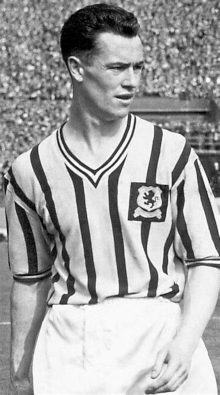
Birth of Peter McParland, Former Northern Irish Footballer

Peter James McParland MBE, former Northern Irish professional footballer who plays as an outside left, is born in Newry, County Down, Northern Ireland, on April 25, 1934.

McParland is spotted playing for Dundalk in the League of Ireland First Division by Aston Villa manager George Martin. Martin signs him for a fee of £3,880.

McParland holds a unique place in English football history as the first player in the game to score in and win both English major domestic knockout Finals. One of the finest headers and strikers of the ball of the past fifty years, he is regarded as one of the greatest players to represent both Aston Villa and Northern Ireland.

During his time with Aston Villa, McParland is influenced by Jimmy Hogan. He later wins the FA Cup in 1957, scoring twice in the final against Manchester United but also becoming involved in a controversial incident in which he shoulder-charges (at the time a legitimate form of challenge) the Manchester United keeper after only six minutes. This leaves United’s goalkeeper, Ray Wood, unconscious with a broken cheekbone. McParland’s two-goal haul is remembered fondly as an example of his all-round abilities as a player showcasing his diving header and volleying techniques.

McParland also wins the Second Division title in 1960 and the League Cup in 1961 while with Aston Villa. He is on the scoresheet for the second leg of the 1961 League Cup final, when Aston Villa overturns a 2–0 deficit against Rotherham United to win the second leg 3–0 at Villa Park, becoming the winners of the first Football League Cup.

Following Aston Villa, McParland joins local rivals Wolverhampton Wanderers for a brief period in 1962. Although he is only there for one season, he manages to score 10 goals in 21 games. The following season he moves on to Plymouth Argyle, his final English league club before hanging up his boots. In 1965, he is recruited to play for Toronto Inter-Roma FC of the Eastern Canada Professional Soccer League. He scores many memorable goals, especially one against the Hamilton Steelers to give his side the victory.

McParland plays for the Atlanta Chiefs of the North American Soccer League (NASL) in 1967 and 1968. He ends his career as player-manager of Glentoran.

McParland represents Northern Ireland 34 times and scores twice in his debut against Wales in the 1953–54 season. He also stars for Northern Ireland in the 1958 FIFA World Cup in which he scores five goals and helps his team to the quarterfinals. France defeats Northern Ireland 4–0 in their quarterfinal match.

McParland holds the record for being the highest-scoring Northern Irish player in World Cup finals history.

In April 2015, the feature-length documentary Spirit of ’58 is screened as part of the Belfast Film Festival. It features McParland prominently alongside Billy Bingham, Billy Simpson, Jimmy McIlroy and Harry Gregg, the other surviving players at the time, as it tells the story of Northern Ireland’s journey throughout the 1950s under the managership of Peter Doherty, culminating in the 1958 World Cup.

McParland is the last surviving player from the 1957 FA Cup Final following the death of Bobby Charlton on October 21, 2023. Following the death of Billy Bingham on June 9, 2022, McParland is the last surviving member of the Northern Ireland squad from the 1958 World Cup campaign. He is one of the last surviving members of the 1958 FIFA World Cup.

Leave a comment

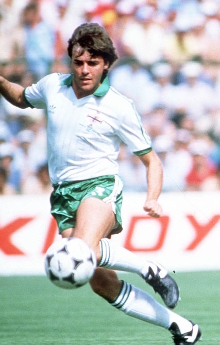
Birth of Mal Donaghy, Former Northern Ireland Footballer

Malachy Martin Donaghy, former Northern Ireland international footballer who also plays for Luton Town F.C. and Manchester United F.C., is born in Belfast, Northern Ireland, on September 13, 1957. He is the manager of the Northern Ireland national under-19 football team from 2000-2008.

Originally from west Belfast, Donaghy begins his football career as a goalkeeper with little-known Down and Connor League side team St. Agnes before moving on to play as an outfield player for works team Post Office Social Club. After barely six months, he is on the move again, this time joining Amateur League side Cromac Albion, where his blossoming talent is spotted by then Larne F.C. boss Brian Halliday.

Donaghy’s rapid rise in the game continues when, after just 20 matches with the Inver Park club, he is transferred to Luton Town F.C. in June 1978 for a fee of £20,000.

Donaghy spends ten years at Luton Town F.C., overseeing the most successful era of their history to date. He collects a Second Division title winner’s medal in 1982, enabling him to experience First Division football for the first time. He helps Luton Town F.C. retain their First Division status and is a key part of the team that finishes a club record high of seventh in the 1986–87 season. In 1987–88, he helps Luton Town F.C. win their first major trophy as they achieve a shocking 3–2 win over Arsenal F.C. in the 1988 Football League Cup Final.

In October 1988, Donaghy departs from Kenilworth Road in a £650,000 move to his boyhood heroes Manchester United F.C. It is at the time a big risk for Alex Ferguson to pay out a large sum of money for a 31-year-old, but Donaghy repays the United manager’s faith in him with some consistent performances in not only his favoured central defensive position but also as a full-back.

Immediately after joining United, Donaghy is the club’s first choice left-back for the 1988–89 season, missing only the League Cup game for which he is cup-tied. However, his opportunities are limited in the 1989–90 season, and he is unable to make even the substitutes bench for the 1990 FA Cup final triumph over Crystal Palace F.C. However, he does make the substitutes bench for the 1991 European Cup Winners’ Cup final triumph.

United are First Division runners-up in 1991–92 and win their first-ever League Cup, but Donaghy’s first-team chances continue to be restricted, and he is also left out of the side that beats Nottingham Forest F.C. in the League Cup final.

Donaghy’s next move is in August 1992 when, just a month short of his 35th birthday, Chelsea F.C. manager Ian Porterfield pays £100,000 for his services. He helps Chelsea finish 11th in the inaugural Premier League season and helps them reach the 1994 FA Cup final, although he does not make the squad for the team that loses 4–0 to double-winners Manchester United F.C. At the end of the season, he announces his retirement from club football.

Donaghy makes his final appearance for Northern Ireland against the Mexico national football team in Miami in June 1994, three months before his 37th birthday.

Shortly after his playing career ends, Donaghy returns to the province with his family and after a brief spell as manager at Newry City F.C., he has stints as a coach with Cliftonville F.C. and as a Youth Development Officer back on his home pitch with Donegal Celtic F.C. In 2000, he is appointed manager for the Northern Ireland national under-19 team. He serves in this capacity until 2008.

The first of Donaghy’s 91 international caps comes in May 1980 at Windsor Park in the 1–0 British Home Championship victory over Scotland. He further enhances his reputation during the 1982 and 1986 World Cup finals. In the former tournament, he plays in four of Northern Ireland’s five games. He is sent off after 60 minutes of the famous 1–0 win over Spain in Valencia, for the offence of shoving Spain’s José Antonio Camacho, but returns for Northern Ireland’s final match, a 4–1 defeat by France in Madrid.


Leave a comment

Birth of Frank Stapleton, Association Footballer & Manager

Francis Anthony Stapleton, Irish former professional association football player and manager, is born in Dublin on July 10, 1956. He is best remembered for his time at Arsenal, Manchester United and as a pivotal player for the Republic of Ireland national football team. He has also been manager at Bradford City and Major League Soccer (MLS) club New England Revolution.

Stapleton is a distinguished centre-forward, once touted as being among the best in the world in his position, and an exceptionally strong header of the ball. He starts his career with Arsenal, joining them in 1972 as an apprentice, after being turned down by Manchester United. He makes his first-team debut in March 1975, at home to Stoke City, and goes on to form a potent striking partnership with Malcolm Macdonald. The two score 46 goals between them in 1976–77. He is Arsenal’s top scorer for the three following seasons and helps the Gunners reach a trio of FA Cup finals. He scores one of the goals in Arsenal’s 1979 FA Cup Final 3–2 win over Manchester United, and scores 108 goals in 300 appearances in total for the Gunners.

Stapleton moves on to Manchester United in the summer of 1981 for £900,000 as new manager Ron Atkinson begins building a team capable of challenging for silverware after a disappointing 1980–81 season under Dave Sexton. He helps United win the 1983 and 1985 FA Cups. It is in the first of those finals, when he scores against Brighton & Hove Albion, in which he makes history by becoming the first man to score for two different clubs in FA Cup Finals. United finishes in the top four of the league in each of Stapleton’s first five seasons at Old Trafford, and comes close to winning a league title medal in the 1985–86 season after United wins their first ten league games of the season before their form slumps and they finished fourth. Atkinson is sacked and replaced by Alex Ferguson in November 1986, and Stapleton remains a regular member of the first team under the new manager, but he leaves at the end of the season to sign for Ajax. There, he makes just six appearances and scores one goal before quickly being moved to Belgian side Anderlecht at the end of 1987, followed by a three-month loan back to England with Derby County. He then plays for French club Le Havre for a season, before returning to England with Blackburn Rovers in 1989, followed by moves to Aldershot, Huddersfield Town (as player-coach) and Bradford City.

After three seasons as player-manager at Bradford, Stapleton is sacked following their narrow failure to qualify for the Division Two playoffs at the end of the 1993-94 season. He then has a brief spell at Brighton & Hove Albion in the 1994–95 season, playing two games before finally announcing his retirement as a player.

Stapleton also wins 71 caps for the Republic of Ireland national team, scoring a then record 20 goals. He makes his international debut under then player-manager Johnny Giles in a friendly against Turkey in Ankara in 1976 at 20 years of age. He scores after only three minutes of his debut when he heads home a Giles free-kick at the near post. That friendly international finishes 3–3 and marks the start of a magnificent international career for the quiet and reserved Stapleton.

Stapleton is committed to international football insisting that an “international release clause” be inserted to all of his contracts so that he can be released to play in international games for Ireland.

Stapleton plays a significant role in Ireland’s attempt to qualify for the 1982 FIFA World Cup in Spain in 1982. Goals against Cyprus, the Netherlands and France by him in the qualifying matches are not enough as Ireland is denied a place at the World Cup by a superior French goal difference. He is made captain of the national team for the qualifying campaign for the 1986 FIFA World Cup though Ireland fails to emulate their fine performance in the 1982 qualifiers.

Jack Charlton takes over as the Irish manager in 1986 and he keeps Stapleton as captain despite a sometimes uneasy relationship between the two men. Stapleton scores a magnificent diving header in the opening UEFA Euro 1988 qualifier against Belgium in the 2–2 draw at the Heysel Stadium, Brussels, that September. He also scores in the 2–1 defeat by Bulgaria in Sofia on April 1, 1987, with another goal against Luxembourg in the 2–1 victory at Lansdowne Road the following September.

Stapleton captains the Irish team to the 1988 Euro finals and plays in all of their matches during the competition including Ireland’s famous victory against England.

After the 1988 European Championships Stapleton remains on the fringe of the national team during qualification for 1990 FIFA World Cup in Italy making just two appearances late in the campaign. By then, his 20 goals for the Republic had made him the national side’s all-time leading goalscorer, a record which is broken ten years later by Niall Quinn, who is in the early stages of his own international career when Stapleton bows out of the international scene. He does, however, score an 87th-minute goal against Malta in a 3–0 friendly in Valletta just prior to those finals in Italy.

Stapleton moves to the United States to manage Major League Soccer side New England Revolution in 1996. In the 2003–04 season he briefly returns to English football as a specialist coach of Bolton Wanderers. The Bolton manager, Sam Allardyce, wants Stapleton to enhance the skills of the strikers at the club and sees the Irishman as an ideal candidate, given his successful playing career.

Stapleton is appointed assistant manager to former teammate Ray Wilkins with Jordan on September 3, 2014.


4 Comments

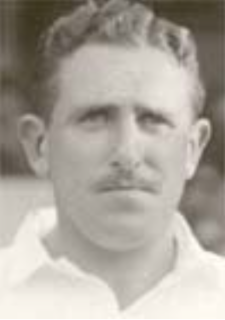
Death of Tom Aherne, Irish Footballer & Hurler

Thomas Aherne, Irish footballer and hurler also referred to as Bud Aherne, dies on December 30, 1999. He plays football for Belfast Celtic F.C. and Luton Town F.C. and is a dual internationalist, playing for both Ireland teams – the IFA XI and the FAI XI. In 1949 he is a member of the FAI XI that defeats England 2–0 at Goodison Park, becoming the first non-UK team to beat England at home. As a hurler he also plays one game for Limerick.

Aherne is born in Limerick, County Limerick, on January 26, 1919. As a youth, he initially emerges as a prominent hurler with Treaty Sarsfields and also plays one game for Limerick. However, he subsequently decides to concentrate on football and begins his senior career with Limerick United where his teammates include Davy Walsh. During World War II, he serves in the Irish Army and is stationed at Crosshaven. His impressive performances in the League of Ireland attract attention and in 1946 he is signed by Belfast Celtic.

While at Belfast Celtic, Aherne plays alongside Jackie Vernon, Billy McMillan, Robin Lawler and Johnny Campbell and helps them win the Irish Cup in 1947 and an Irish League title in 1948. He is also at Celtic during the infamous Boxing Day riot which breaks out during a game against local rivals Linfield F.C. In March 1949, he leaves Celtic and signs for Luton Town. However, in May 1949, he temporarily rejoins Celtic for their final tour before the club disbands. Together with McMillan, Campbell, Lawlor, guest player Mick O’Flanagan and manager Elisha Scott, he goes on the Celtic tour of North America. The highlight of the 10-game tour comes on May 29 when Celtic beats the reigning British champions, Scotland, 2–0.

Aherne signed for Luton Town for a fee of £6,000 and makes his English Football League debut on March 19 in a 2–1 away defeat to Tottenham Hotspur. Despite the fact he is over 30 when he joins Luton, he quickly establishes himself as a regular. He plays competitive football into his late thirties and is ever-present during the 1954–55 season when Luton wins promotion to Division One. After playing 288 games for Luton, including 267 in the league, he retires after a hairline fracture of the ankle ends his career. Even then he continues to play for a local league team, Luton Celtic, into his forties.

When Aherne begins his international career in 1946 there are in effect, two Ireland teams, chosen by two rival associations. Both associations, the Belfast-based Irish Football Association and the Dublin-based Football Association of Ireland, claim jurisdiction over the whole of Ireland and select players from the whole island. As a result, several notable Irish players from this era, including Aherne play for both teams.

Between 1946 and 1953 Aherne makes 16 appearances for the FAI XI. He makes his FAI debut in June 1946 during an Iberian tour, playing in both the 3–1 defeat to Portugal on June 16 and then helping the FAI XI gain a surprise 1–0 victory against Spain on June 23. He remains a regular in the FAI XI throughout the late 1940s and early 1950s and is featured prominently in the qualifying rounds for the 1950 FIFA World Cup. He is also a member of the FAI XI team that defeats England 2–0 at Goodison Park, becoming the first non-UK team to beat England at home.

On November 16, 1953, during a 1–1 draw with France, Aherne briefly becomes involved in controversy. Although only a friendly, the game quickly becomes heated and at one point, with Aherne chasing Raymond Kopa down the tunnel after play had been stopped for a foul. Kopa allegedly runs for his life after upsetting Aherne once too often. The FAI selectors are not impressed, and Aherne is told a repeat will end his international career. As it turns out, he makes only one more appearance for the FAI XI. That comes on October 4, 1953, in 5–3 defeat against France during a qualifier for the 1954 FIFA World Cup.

Between 1946 and 1950, Aherne also makes six appearances for the IFA XI. These include two Victory Internationals played in early 1946. On February 2 at Windsor Park, he makes his debut for the IFA XI in a 3–2 defeat to Scotland. Then on May 4 he helps the IFA XI defeat Wales 1–0 at Ninian Park. On September 28, 1946, he also plays for the IFA XI in a heavy defeat to England. The highlight of his career with the IFA XI comes on October 4, 1947, when he helps them gain a 2–0 win against Scotland.

Ahern makes his last appearance for the IFA XI in a 0–0 draw with Wales on March 8, 1950. As well as being part of the 1950 British Home Championship, the game also doubles up as a qualifier for the 1950 FIFA World Cup. Aherne, together with Con Martin, Reg Ryan and Davy Walsh, is one of four players from the Republic, included in the IFA XI that day and as a result he plays for two different associations in the same FIFA World Cup tournament. This situation eventually leads to intervention by FIFA and as a result Aherne becomes one of the last four Republic-born players to play for the IFA XI.

After retiring as a player Aherne settles in Luton where he coaches the Luton Town youth team, works in the local car industry and runs a very successful licensed premises. He also continues to visit Limerick regularly and remains healthy and active until he is diagnosed with Alzheimer’s disease in the mid-1990s. He dies on December 30, 1999, at the age of 80 and is survived by his wife, Eileen, two sons, Pat and Brian, and three daughters, Maura, Trisha and Catherine.


Leave a comment

Republic of Ireland Advances to the Round-of-16 at Euro 2016

Robbie Brady heads the Republic of Ireland into the round-of-16 of Euro 2016 as the Irish score in the 85th minute to sensationally defeat Italy 1-0 at Stade Pierre-Mauroy in Villeneuve-d’Ascq, France on June 22, 2016. In addition to congratulatory remarks to the team, President Michael D. Higgins pays tribute to the Irish fans who “have earned widespread acclaim for their behaviour in France.”

Brady heads home the only goal of the match as Ireland seals progress after finishing third in Group E with four points. The victory sets up a round-of-16 meeting with Euro 2016 host France in Lyon, their first meeting since the controversial 2010 FIFA World Cup qualifier that saw them controversially defeated as the result of a Thierry Henry handball.

Ireland had been unfortunate to draw their opener against Sweden and, while they then suffered a sobering 3-0 loss to Belgium, they do not appear to have suffered a loss of confidence against the Azzurri. Ireland goes into the match against Italy knowing only a win will secure progress but they are given hope when Italy manager Antonio Conte, who is already certain of top spot, makes eight changes to the side that defeated Sweden.

Jeff Hendrick sends a fierce drive just wide from outside the box on nine minutes, while Daryl Murphy‘s header brings a fingertip save from Salvatore Sirigu midway through the half. It is not until six minutes before the break that Italy shows any sort of threat, with Ciro Immobile swiveling before steering a shot wide. Ireland then sees a penalty appeal rejected when James McClean goes down under pressure from Federico Bernardeschi.

Ireland continues to press for a winner in the second half, but Simone Zaza provides a reminder of Italy’s quality on 53 minutes with a superb volley on the turn from Mattia De Sciglio‘s cross that sails just over the bar. At the other end, Ireland continues to make chances but finds it difficult to break through a stubborn Italy defence. With just over an hour gone Hendrick does make space for a shot in the area, but his shot is wayward.

Conte brings on Lorenzo Insigne for Immobile on 73 minutes and the Napoli forward nearly breaks the deadlock shortly afterwards, curling a shot against the far post after a driving run toward goal in similar fashion to Éder‘s late winner against Sweden.

Ireland then has a golden opportunity to break the deadlock when substitute Wes Hoolahan goes clean through on goal, but he scuffs his shot and Sirigu is able to gather at the second attempt. A minute later, they make the breakthrough. Hoolahan sends in the cross for his Norwich City teammate Brady, who is allowed the space to head past Sirigu and send Ireland into the next round.

Italy, who faces reigning champions Spain in the round-of-16, hopes for a much improved performance when their regular starters return to action.

In the round-of-16 match against France, Ireland takes the lead in the match with an early penalty from Robbie Brady, but France goes on to win 2–1 to advance to the quarter-finals

(From: “Republic of Ireland beat Italy to reach round of 16” by ESPN staff, http://www.espn.com, June 22, 2016)