
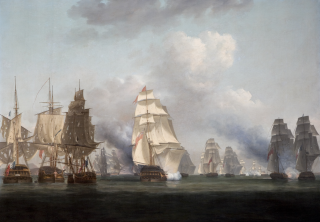
The Battle of Tory Island, sometimes called the Battle of Donegal, Battle of Lough Swilly or Warren’s Action, is a naval action of the French Revolutionary Wars, fought on October 12, 1798, between French and British squadrons off the northwest coast of County Donegal, then in the Kingdom of Ireland. The last action of the Irish Rebellion of 1798, the Battle of Tory Island ends the final attempt by the French Navy to land substantial numbers of soldiers in Ireland during the war.
Britain’s enemies in Continental Europe have long recognised Ireland as a weak point in Britain’s defences. Landing troops there is a popular strategic goal, not only because an invader can expect the support of a large proportion of the native population, but also because at least initially they will face fewer and less reliable troops than elsewhere in the British Isles. Additionally, embroiling the British Army in a protracted Irish campaign will reduce its availability for other theatres of war. Finally, French planners consider that a successful invasion of Ireland might act as the ideal platform for a subsequent invasion of Great Britain.
The Society of United Irishmen, led by Theobald Wolfe Tone, launches an uprising against British rule in Ireland in May 1798. At the request of the rebels, a small French force under General Jean Joseph Amable Humbert is landed at Killala, County Mayo, but by early September both this expedition and the rebellion has been defeated.
Unaware of Humbert’s surrender, the French despatch reinforcements under the command of Commodore Jean-Baptiste-François Bompart on September 16. Having missed one invasion force, the Royal Navy is more watchful. Roving frigate patrols cruise off the principal French ports and in the approaches to Ireland, while squadrons of battleships from the Channel Fleet sail nearby, ready to move against any new invasion force. In command of the squadron on the Irish station is Commodore Sir John Borlase Warren, a highly experienced officer (and politician) who has made a name for himself raiding the French coast early in the war.
The squadron carrying the reinforcements is soon spotted after leaving Brest. After a long chase, the French are brought to battle in a bay off the rugged County Donegal coast in the west of Ulster, very close to Tory Island. During the action the outnumbered French attempt to escape, but are run down and defeated piecemeal, with the British capturing four ships and scattering the survivors. Over the next fortnight, British frigate patrols scour the passage back to Brest, capturing three more ships. Of the ten ships in the original French squadron, only two frigates and a schooner reach safety. British losses in the campaign are minimal.
The battle marks the last attempt by the French Navy to launch an invasion of any part of the British Isles. It also ends the last hopes the United Irishmen have of obtaining outside support in their struggle against the British. After the action, Wolfe Tone is recognised aboard the captured French flagship and arrested. He is brought ashore by the British at Buncrana, on the Inishowen peninsula. He is later tried for treason, convicted, and commits suicide while in prison in Dublin, hours before he is to be hanged.
(Pictured: Attack of the French Squadron under Monsr. Bompart Chef d’Escadre, upon the Coast of Ireland, by a Detachment of His Majesty’s Ships under the Command of Sir J. B. Warren, October 12, 1798, by Nicholas Pocock, 1799)

 seamus dubhghaill