seamus dubhghaill

Promoting Irish Culture and History from Little Rock, Arkansas, USA


Leave a comment

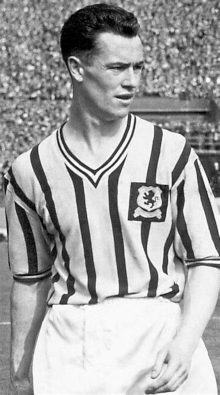
Birth of Peter McParland, Former Northern Irish Footballer

Peter James McParland MBE, former Northern Irish professional footballer who plays as an outside left, is born in Newry, County Down, Northern Ireland, on April 25, 1934.

McParland is spotted playing for Dundalk in the League of Ireland First Division by Aston Villa manager George Martin. Martin signs him for a fee of £3,880.

McParland holds a unique place in English football history as the first player in the game to score in and win both English major domestic knockout Finals. One of the finest headers and strikers of the ball of the past fifty years, he is regarded as one of the greatest players to represent both Aston Villa and Northern Ireland.

During his time with Aston Villa, McParland is influenced by Jimmy Hogan. He later wins the FA Cup in 1957, scoring twice in the final against Manchester United but also becoming involved in a controversial incident in which he shoulder-charges (at the time a legitimate form of challenge) the Manchester United keeper after only six minutes. This leaves United’s goalkeeper, Ray Wood, unconscious with a broken cheekbone. McParland’s two-goal haul is remembered fondly as an example of his all-round abilities as a player showcasing his diving header and volleying techniques.

McParland also wins the Second Division title in 1960 and the League Cup in 1961 while with Aston Villa. He is on the scoresheet for the second leg of the 1961 League Cup final, when Aston Villa overturns a 2–0 deficit against Rotherham United to win the second leg 3–0 at Villa Park, becoming the winners of the first Football League Cup.

Following Aston Villa, McParland joins local rivals Wolverhampton Wanderers for a brief period in 1962. Although he is only there for one season, he manages to score 10 goals in 21 games. The following season he moves on to Plymouth Argyle, his final English league club before hanging up his boots. In 1965, he is recruited to play for Toronto Inter-Roma FC of the Eastern Canada Professional Soccer League. He scores many memorable goals, especially one against the Hamilton Steelers to give his side the victory.

McParland plays for the Atlanta Chiefs of the North American Soccer League (NASL) in 1967 and 1968. He ends his career as player-manager of Glentoran.

McParland represents Northern Ireland 34 times and scores twice in his debut against Wales in the 1953–54 season. He also stars for Northern Ireland in the 1958 FIFA World Cup in which he scores five goals and helps his team to the quarterfinals. France defeats Northern Ireland 4–0 in their quarterfinal match.

McParland holds the record for being the highest-scoring Northern Irish player in World Cup finals history.

In April 2015, the feature-length documentary Spirit of ’58 is screened as part of the Belfast Film Festival. It features McParland prominently alongside Billy Bingham, Billy Simpson, Jimmy McIlroy and Harry Gregg, the other surviving players at the time, as it tells the story of Northern Ireland’s journey throughout the 1950s under the managership of Peter Doherty, culminating in the 1958 World Cup.

McParland is the last surviving player from the 1957 FA Cup Final following the death of Bobby Charlton on October 21, 2023. Following the death of Billy Bingham on June 9, 2022, McParland is the last surviving member of the Northern Ireland squad from the 1958 World Cup campaign. He is one of the last surviving members of the 1958 FIFA World Cup.
Leave a comment

Death of Eamonn Andrews, Radio & Television Presenter

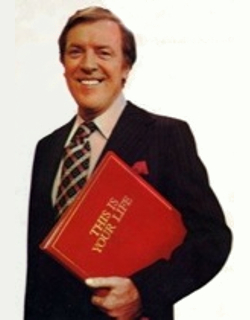
eamonn-andrewsEamonn Andrews, Irish radio and television presenter employed primarily in the United Kingdom from the 1950s to the 1980s, dies in London, England on November 5, 1987. From 1960 to 1964 he chairs the Radio Éireann Authority, which oversees the introduction of a state television service to the Republic of Ireland.

Andrews is born in Synge Street, Dublin, and educated at Synge Street CBS. He begins his career as a clerk in an insurance office. He is a keen amateur boxer and wins the Irish junior middleweight title in 1944.

In 1946 Andrews becomes a full-time freelance sports commentator, working for Radio Éireann, Ireland’s state broadcaster. In 1950, he begins presenting programmes for the BBC, being particularly well known for boxing commentaries, and soon becomes one of television’s most popular presenters. The following year, the game show What’s My Line? begins and Andrews is the host.

Throughout the 1950s, Andrews commentates on the major British heavyweight fights on the BBC Light Programme, with inter-round summaries by W. Barrington Dalby. On January 20 , 1956, he reaches No. 18 in the UK Singles Chart with a “spoken narrative” recording named “The Shifting Whispering Sands (Parts 1 & 2),” which is produced by George Martin with musical backing by the Ron Goodwin Orchestra, released by Parlophone as catalogue number R 4106, a double-sided 78rpm record. The song later reappears on Kenny Everett‘s compilation album The World’s Worst Record Show, which is released in June 1978.

Between 1955 and 1964, Andrews presents the long-running Sports Report on BBC’s Light Programme. In 1965, he leaves the BBC to join the ITV contractor ABC, where he pioneers the talk show format in the UK. He hosts a chat show on ITV, The Eamonn Andrews Show, for five years. He is known for coming up with off-the-cuff linkings that do not work, such as: “Speaking of cheese sandwiches, have you come far?” This is parodied by the character Seamus Android on Round the Horne in the 1960s, performed by Bill Pertwee. In the 1960s and 1970s he presents Thames Television‘s Today news magazine programme.

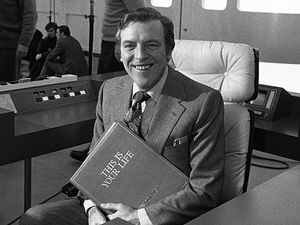
Andrews is probably best known as the presenter of the UK version of This Is Your Life, between its inception in 1955 and his death in 1987, when he is succeeded by Michael Aspel, who had also succeeded Andrews as the host of Crackerjack! more than twenty years earlier. Andrews is the first This Is Your Life subject on British television when he is surprised by the show’s creator, Ralph Edwards. He also creates a long-running panel game called Whose Baby? that originally runs on the BBC and later on ITV. He is a regular presenter of the early Miss World pageants.

Andrews’ chairs the Radio Éireann Authority between 1960 and 1964, overseeing the introduction of state television to the Republic of Ireland and establishing the broadcaster as an independent semi-state body. About this time, he also acquires a number of business interests in Ireland, including recording studios and a dance hall. He steps down from the RTE Authority amidst a bitter political storm started by the Catholic Church hierarchy over what is seen as the controversial content of The Late Late Show. Before leaving RTÉ, he defends the show as “freedom of expression.”

After months of illness during 1987, originally caused by a virus contracted during a plane journey but which is not recognised at the time, Andrews dies from heart failure on November 5, 1987 at the Cromwell Hospital in London. A funeral service is held at St. Anne’s Church in Portmarnock, where he had his home, and his body is buried in Balgriffin Cemetery to the north of Dublin. A memorial mass is held for him in Westminster Cathedral.

Andrews had recorded his last edition of This Is Your Life six days previously on October 30, 1987. After his death, the show, and two others that had yet to be broadcast, are postponed until, with his widow’s permission, they are broadcast in January 1988.


Leave a comment

Birth of Eamonn Andrews, Radio & Television Presenter

eamonn-andrewsEamonn Andrews, radio and television presenter considered to be Ireland’s first media superstar, is born in Synge Street, Dublin, on December 19, 1922.

Andrews is educated at Synge Street CBS and begans his career as a clerk in an insurance office. He is a keen amateur boxer and wins the Irish junior middleweight title in 1944.

In 1946, he becomes a full-time freelance sports commentator, working for Radio Éireann, Ireland’s national broadcaster. In 1950, he begins presenting programmes for the BBC, being particularly well known for boxing commentaries, and soon becomes one of television’s most popular presenters. He begins hosting the game show What’s My Line? in 1951.

Throughout the 1950s, he commentates on the major British heavyweight fights on the BBC Light Programme, with inter-round summaries by W. Barrington Dalby. On January 20, 1956, he reaches No. 18 in the UK Singles Chart with a “spoken narrative” recording named “The Shifting Whispering Sands (Parts 1 & 2),” which is produced by George Martin with musical backing by the Ron Goodwin Orchestra. The song later reappears on Kenny Everett‘s compilation album The World’s Worst Record Show, which is released in June 1978.

Between 1955 and 1964, Andrews presents the long-running Sports Report on BBC’s Light Programme, now Radio 2. In 1965, he leaves the BBC to join the ITV contractor ABC, where he pioneers the talk show format in the UK. He hosts a chat show on ITV, The Eamonn Andrews Show, for five years. He is known for coming up with off-the-cuff linkings that do not work such as, “Speaking of cheese sandwiches, have you come far?” This is parodied by the character Seamus Android on Round the Horne in the 1960s, performed by Bill Pertwee. In the 1960s he presents Thames Television‘s Today news magazine programme.

Andrews is probably best known as the presenter of the UK’s version of This Is Your Life, between its inception in 1955 and his death in 1987, when he is succeeded by Michael Aspel, who had also succeeded Andrews as host of Crackerjack more than two decades earlier. Andrews becomes the very first This Is Your Life subject on British television when he is surprised by the show’s creator, Ralph Edwards. Andrews also creates a long-running panel game called Whose Baby? that originally runs on the BBC and later on ITV. He is a regular presenter of the early Miss World pageants.

Andrews’ chairs the Radio Éireann Authority, now the RTÉ Board, between 1960 and 1964, overseeing the introduction of State television to Ireland and establishing the Irish State broadcaster as an independent semi-state body. About this time, he also acquires a number of business interests in Ireland, including recording studios and a dance hall.

After months of illness during 1987, originally caused by a virus contracted during an airline flight, but which is not recognised at the time, he dies from heart failure on November 5, 1987, at the age of 64, at Cromwell Hospital, London. He had recorded his last edition of This Is Your Life six days previously on October 30, 1987, surprising Crossroads actress Jane Rossington. After his death, the show, and two others that have yet to be broadcast, are postponed until, with his widow’s permission, they are broadcast in January 1988. His widow, Gráinne, whom he married in 1951, dies 18 months later. They had three adopted children.

His contribution to U.K. radio is commemorated in the The Radio Academy Hall of Fame. Andrews appears as the linking narrator who introduces the unrelated segments that comprise the portmanteau film, Three Cases of Murder (1955).