Unlike similar organisations of the time, which are antiquarian in nature, the SPIL aims at protecting the status of the Irish language, which is threatened with extinction at the time. Its mission statement says that it is “possible and desirable to preserve the Irish Language in those parts of the Country where it is spoken, with a view to its further extension and cultivation.” Hyde writes that the formation of the society can truly be said to be the first attempt made to recruit the common people to the cause of the Irish language. The society succeeds in having Irish included on the curriculum of primary and secondary schools and third-level colleges in 1878.
After the failure of the Young Ireland Rebellion of 1848, O’Leary attempts to rescue the Young Ireland leaders from Clonmel Gaol, and is himself imprisoned for a week from September 8, 1849. He takes part in a further attempted uprising in Cashel on September 16, 1849, but this proves abortive.
On September 16, 1865, O’Leary is arrested and later tried on charges of high treason, eventually reduced to “treason felony.” He is sentenced to twenty years of penal servitude, of which five years are spent in English prisons, prior to his release and exile in January 1871. During his exile, he lives mainly in Paris, also visiting the United States, remains active in the IRB and its associated organisations, and writes many letters to newspapers and journals.
On the expiration of his 20-year prison term and therefore of the conditions associated with his release in 1885, O’Leary returns to Ireland. He and his sister, the poetEllen O’Leary, both become important figures within Dublin cultural and nationalist circles, which include William Butler Yeats, Maud Gonne, Rose Kavanagh, Rosa Mulholland, George Sigerson, and Katharine Tynan. He also functions as an elder statesman of the separatist movement, being active in the Young Ireland Society, and acts as president of the Irish Transvaal Committee, which supports the Boer side in the Second Boer War.
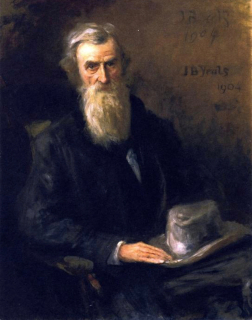
John O’Leary dies at his residence in Dublin on the evening of March 16, 1907. He is referred to famously by W.B. Yeats in his poem September 1913: “Romantic Ireland’s dead and gone/It’s with O’Leary in the grave.”
(Pictured: Painting of John O’Leary, a favorite subject of John Butler Yeats (1904). The National Gallery of Ireland owns three oil portraits of O’Leary.)
O’Sullivan spends his adult life in the Dublin suburb of Rathgar. In 1926 he marries the artist Estella Solomons, sister of Bethel Solomons. Her parents are opposed to the marriage as Seumas is not Jewish.
O’Sullivan’s books include Twilight People (1905), Verses Sacred and Profane (1908), The Earth Lover (1909), Selected Lyrics (1910), Collected Poems (1912), Requiem (1917), Common Adventures (1926), The Lamplighter (1929), Personal Talk (1936), Poems (1938), Collected Poems (1940), and Dublin Poems (1946). Terence de Vere White praises him as “a true poet,” and is critical of William Butler Yeats for leaving him out of his anthology of Irish poets, which he thinks a particularly strange decision since Yeats and O’Sullivan are friends, although they quarrel from time to time. In 1936 a version of a play by Irish playwrightTeresa Deevy called The King of Spain’s Daughter is included in The Dublin Magazine which is edited by Seumas O’Sullivan.
O’Sullivan and B.J. Brimmer Company are accredited within the ‘Acknowledgments’ of People and Music by Thomasine C. McGehee, published via Allyn & Bacon within the Junior High School Series and edited by James M. Glass, 1929 and 1931 respectively, for both the frontispieceIn Mercer Street and the excerpt from Ballad of a Fiddler on page 93.
O’Sullivan has a great admiration for Patrick Kavanagh, and in the 1940s he is one of the very few Irish editors who is prepared to publish his poetry.
O’Sullivan’s father, William Starkey (1836-1918), a physician, is also a poet and a friend of George Sigerson.
O’Sullivan is a friend of most of the leading literary figures in Dublin, including William Butler Yeats, James Stephens and George William Russell. His “at homes” on Sunday afternoons are a leading feature of Dublin literary life, as are Russell’s Sunday evenings and Yeats’s Monday evenings. He is inclined to be quarrelsome due to his heavy drinking and on one occasion he insults James Stephens publicly at a literary dinner. Even the kind-hearted Russell admits that “Seumas drinks too much.” Yeats’ verdict is that “the trouble with Seumas is that when he’s not drunk, he’s sober.”
Seumas O’Sullivan dies on March 24, 1958.
(Pictured: Portrait of Seumas O’Sullivan by Estella Frances Solomons)
George Sigerson, Irish physician, scientist, writer, politician, and poet, is born at Holy Hill, near Strabane in County Tyrone on January 11, 1836. He is a leading light in the Irish Literary Revival of the late 19th century in Ireland.
Sigerson is the son of William and Nancy (née Neilson) Sigerson and has three brothers, James, John and William, and three sisters, Ellen, Jane, and Mary Ann. He attends Letterkenny Academy but is sent by his father, who developed the spade mill and who played an active role in the development of Artigarvan, to complete his education in France.
His first book, The Poets and Poetry of Munster, appears in 1860. He is actively involved in political journalism for many years, writing for The Nation. Sigerson and his wife Hester are by now among the dominant figures of the Gaelic Revival. They frequently hold Sunday evening salons at their Dublin home to which artists, intellectuals, and rebels alike attend, including John O’Leary, W.B. Yeats, Patrick Pearse, Roger Casement, and 1916 signatory Thomas MacDonagh. Sigerson is a co-founder of the Feis Ceoil and President of the National Literary Society from 1893 until his death. His daughter, Dora, is a poet who is also involved in the Irish literary revival.
Nominated to the first Seanad Éireann of the Irish Free State, Sigerson briefly serves as the first chairman on December 11-12, 1922, before the election of James Campbell, 1st Baron Glenavy. Sigerson dies at his home at 3 Clare Street, Dublin, on February 17, 1925, at the age of 89, after a short illness. On February 18, 1925, the day after his death, the Seanad Éireann pays tribute to him.
The Sigerson Cup, the top division of third level Gaelic football competition in Ireland is named in his honour. Sigerson donates the salary from his post at UCD so that a trophy can be purchased for the competition. In 2009, he is named in the Sunday Tribune‘s list of the “125 Most Influential People In GAA History.” The cup is first presented in 1911, with the inaugural winners being UCD GAA.



 seamus dubhghaill