seamus dubhghaill

Promoting Irish Culture and History from Little Rock, Arkansas, USA


Leave a comment

Mary Peters Becomes First Irish Woman to Win an Olympic Gold Medal

Lady Mary Elizabeth Peters, LG, CH, DBE, Northern Irish former athlete and athletics administrator, wins the women’s pentathlon on September 3, 1972, at the 1972 Summer Olympics in Munich, West Germany, becoming the first Irish woman to win an Olympic Gold medal.

Peters is born on July 6, 1939, in Halewood, Lancashire, England, later living at 5 Mere Avenue in Alkrington, where she goes to primary school. She moves to Ballymena (and later Belfast) at the age of eleven when her father’s job is relocated to Northern Ireland. As a teenager, her father encourages her athletic career by building her home practice facilities as birthday gifts. She qualifies as a teacher and works while training.

After Ballymena, the family moves to Portadown where she attends Portadown College. The headmaster, Donald Woodman, and the PE teacher, Kenneth McClelland, introduce her to athletics, McClelland being her first coach. She is head girl of the school in 1956.

At the 1972 Summer Olympics in Munich, competing for Great Britain and Northern Ireland, Peters wins the gold medal in the women’s pentathlon. She had finished 4th in 1964 and 9th in 1968. To win the gold medal, she narrowly beats the local favourite, West Germany’s Heide Rosendahl, by 10 points, setting a world record score. After her victory, death threats are phoned into the BBC: “Mary Peters is a Protestant and has won a medal for Britain. An attempt will be made on her life, and it will be blamed on the IRA … Her home will be going up in the near future.” But Peters insists she will return home to Belfast. She is greeted by fans and a band at the airport and paraded through the city streets but is not allowed back in her flat for three months. Turning down jobs in the United States and Australia, where her father lives, she insists on remaining in Northern Ireland.

In 1972, Peters wins the BBC Sports Personality of the Year award: “Peters, a 33-year-old secretary from Belfast, won Britain’s only athletics gold at the Munich Olympics. The pentathlon competition was decided on the final event, the 200m, and Peters claimed the title by one-tenth of a second.”

She represents Northern Ireland at every Commonwealth Games between 1958 and 1974. In these games she wins two gold medals for the pentathlon, plus a gold and silver medal for the shot put.

Peters establishes a charitable Sports Trust in 1975 (now known as the Mary Peters Trust) to support talented young sportsmen and -women, both able-bodied and disabled, from across Northern Ireland in a financial and advisory capacity. The trust has made a large number of awards and has a list of well-known alumni that includes Graeme McDowell, Rory McIlroy, Jonathan Rea, Darren Clarke, David Humphreys, Bethany Firth, Ryan Burnett, Carl Frampton, Paddy Barnes, Michael Conlan, Kelly Gallagher, and Michael McKillop.

In May 2001, following her athletic career, Peters becomes a Trustee of The Outward Bound Trust and is Vice-President of the Northern Ireland Outward Bound Association. She is also Patron of Springhill Hospice in Rochdale, Greater Manchester.

Peters is appointed a Member of the Order of the British Empire (MBE) for services to athletics in the 1973 New Year Honours. For services to sport, she is promoted in the same Order to Commander (CBE) in the 1990 Birthday Honours and again to Dame Commander (DBE) in the 2000 Birthday Honours. In the 2015 New Year Honours, she is awarded as Member of the Order of the Companions of Honour (CH), also for services to sport and the community in Northern Ireland, and in 2017, she is made a Dame of the Order of Saint John (DStJ). She is appointed a Lady Companion of the Order of the Garter (LG) on February 27, 2019, and therefore granted the title Lady. She represents the Order at the 2023 coronation.

Northern Ireland’s premier athletics track, on the outskirts of Belfast, is named after Peters. A statue of her stands within it.

In April 2009, Peters is named the Lord Lieutenant of the City of Belfast; she retires from the post in 2014, being succeeded by Fionnuala Jay-O’Boyle. She is a Freeman of the Cities of Lisburn and Belfast.

Peters now lives in Derriaghy, within the Lisburn and Castlereagh district, just outside Belfast.

Leave a comment

Graeme McDowell Seals European Victory at the 2010 Ryder Cup

On Monday, October 4, 2010, Northern Ireland golfer Graeme McDowell delivers the match-winning point for the European team on the 17th green of the 2010 Ryder Cup at the Celtic Manor Resort in Newport, Wales. His is the last match of the twelve player singles matches against the defending champion United States team, with his opponent being Hunter Mahan. Europe wins the tournament 14.5 to 13.5, and it was his 5-foot putt that is conceded to give victory to Europe. For the first time in its history, the Ryder Cup stretches into a fourth day due to torrential rain on the first day.

Only the brilliance of the Northern Irishman, who holes a stunning birdie putt on the 16th green to extend his lead in the match, and the nervousness of Mahan, who duffs a chip shot on the par-three 17th that seals his defeat, finally turns back a United States team that threatened to deny Colin Montgomerie a captain’s victory to add to the many he has won as a player in this event.

“I didn’t hit a shot out there so it’s not much of an achievement,” Montgomerie says afterwards, dedicating the victory to Seve Ballesteros who is suffering from brain cancer and ultimately dies in 2011. “But it is a proud, proud personal moment for me and for all of us in European golf. My players all played magnificently, all 12 of them.”

McDowell, who had won the U.S. Open earlier in the year, is magnificent when his captain and his teammates need him to be. Through the years the Irish have developed a habit of holing the winning putt in this event and if the latest member of a club that includes Eamonn Darcy, Philip Walton and Paul McGinley is disappointed in being denied the chance to actually watch his ball roll into the hole, he hides it well.

“I didn’t need to hole a putt, thank God,” he says. “I was so nervous out there. I just can’t describe the feeling of this golf tournament – trying to win it for eleven other teammates, the caddies, the fans and Monty. It’s just a special feeling. There is nothing quite like it.”

Europe goes into the singles round holding a three-point lead and at one stage during the afternoon are ahead in eight of the twelve matches. An easy victory beckons, or at least it does until the United States wins a series of matches, some decisively (Tiger Woods over Francesco Molinari 4 & 3, Dustin Johnson over Martin Kaymer 6 & 4) and one by a narrow margin (Steve Stricker beats Lee Westwood on the 17th green). Even Phil Mickelson, one of the weakest players on the United States team over the previous three days, manages a victory, beating Peter Hanson 4 & 2.

The European team responds, with points coming from Luke Donald, who beats Jim Furyk one-up, and Ian Poulter, a victor over Matt Kuchar. However, as the day progresses a victory that had seemed inevitable begins to look uncertain.

In the end, it comes down to McDowell and Mahan on the 17th hole, watched by their teammates and captains, a good portion of the 35,000 mud-splattered souls at Celtic Manor, and a television audience around the world running into many millions. Major championships come with their own particular pressure but, as McDowell says, the Ryder Cup exerts pressure of an altogether different order. In the end the pressure proves too much for the American. His attempted chip from 15 yards short of the green does not even reach the green, far less the flag.


Leave a comment

Death of Open Champion Fred Daly

fred-daly

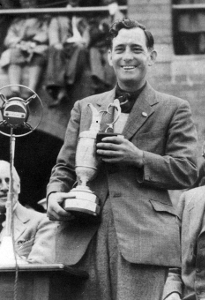
Frederick J. Daly, Northern Irish professional golfer best known for winning The Open Championship in 1947 at the Royal Liverpool Golf Club, Hoylake, dies on November 18, 1990.

Born in Portrush, County Antrim, Daly is the only Irishman from either side of the border to have won The Open until Pádraig Harrington wins it in 2007 and the only Northern Irish major winner until Graeme McDowell wins the U.S. Open in 2010. Daly wins the Open in 1947 while professional to the Balmoral Club in Belfast. He wins with a score of 293, a single stroke ahead of runners-up Reg Horne and amateur Frank Stranahan.

During his acceptance speech at Royal Liverpool, Daly says he is very honoured to receive the Claret Jug and take it back to Northern Ireland. He goes on to say that the trophy has never been to Ireland and that he is hoping that the change of air will help it. There is much applause and laughter at his humorous comments.

In addition, he adds the News of the World Match Play tournament, which is the main British Match Play Championship, becoming the first since James Braid (1905) to win both the Open and the Match Play title in the same year.

Daly is the only Ulsterman to win the Irish Open until 2016, when Rory McIlroy wins at The K Club. Daly wins in 1946 at Portmarnock, and plays on four Ryder Cup teams, in 1947, 1949, 1951, and 1953. Daly is awarded the MBE in the 1984 New Year Honours “for services to golf.”

Fred Daly, age 79, dies in Belfast on November 18, 1990, of a heart attack.