seamus dubhghaill

Promoting Irish Culture and History from Little Rock, Arkansas, USA


Leave a comment

The London Stock Exchange Bombing

The London Stock Exchange bombing occurs at 8:49 a.m. on the morning of July 20, 1990, with the explosion of a 5 to 10 lb. (2.3 to 4.5 kg) bomb of high explosives inside the London Stock Exchange building on Threadneedle Street in the City of London, England, planted by the Provisional Irish Republican Army (IRA). The building and surrounding area are evacuated after the IRA gives a telephone warning 40 minutes prior to the explosion, and thus nobody is wounded. As many as 300 people are evacuated from the building alone. The bomb’s strength blows a 10-foot hole inside the Stock Exchange Tower and causes massive damage to the visitors’ gallery on the first floor, which is frequently used by foreign tourists and schoolchildren and had been scheduled to open ten minutes after the explosion. The bomb is placed in the men’s toilets behind the gallery. The gallery and public viewing area is forced to close in 1992.

The bombing comes on the eighth anniversary of the July 20, 1982, Hyde Park and Regent’s Park bombings which killed eleven soldiers and wounded 53 people. The IRA launches a renewed campaign in London in 1990. During May, a soldier at an army recruiting centre is killed by a bomb in Wembley, while five are injured in a similar explosion in Eltham. In June 1990, bombs at the Honourable Artillery Company (HAC) and the Carlton Club injure 19 and 20 people respectively.

Scotland Yard‘s anti-terrorist chief George Churchill-Coleman says eight phone calls from the same man with an Irish accent are made between 8:02 a.m. and 8:20 a.m. to the City of London Police, the London Fire Brigade, Reuters, the Financial Times, The Salvation Army and the Stock Exchange itself. The caller telephones Reuters just after 8:00 a.m. and says, “This is the IRA. The bomb is due to go off in half an hour at the stock exchange.” The caller then gives a code word that the police say is known to them and used by the IRA to show that its threats are serious, and says, “Clear the building.”

The Stock Exchange’s chairman, however, says after the attack, “If the purpose of this callous act was to bring the City to a halt, they have failed singularly.” The explosion has little impact on stock trading since that is being carried out by computers elsewhere.

A spokesman for Prime Minister Margaret Thatcher says she is “appalled when people leave explosive devices in this manner in public areas.” On October 12, 1984, a bomb planted by the IRA at the Grand Brighton Hotel in Brighton, where the Conservative Party is holding its annual conference, kills five people and comes close to killing Thatcher.

In 1992, the IRA bombs the Baltic Exchange building in the city.

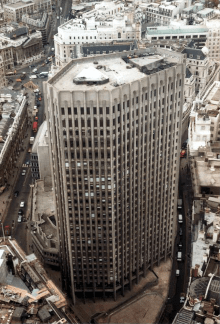
(Pictured: The Stock Exchange Tower in 1983, taken from the top of the National Westminster Tower (now Tower 42), clearly showing the symbolic coffin shape of the building)


Leave a comment

Sinn Féin MPs Enter the House of Commons

On January 21, 2002, Sinn Féin‘s four MPs take the historic step of signing up to use the facilities of the House of Commons, whose authority over Northern Ireland republicans have been fighting for almost a century. Party policy is also changed to allow MPs to sit in the Irish Parliament, the Dáil.

Amid concern among some republicans that the move comes close to recognising British rule, Sinn Féin president and Belfast West MP, Gerry Adams, insists that his party will never take its seats at Westminster. “There will never ever be Sinn Féin MPs sitting in the British houses of parliament,” he tells a Westminster press conference.

David Trimble, the Ulster Unionist Party (UUP) Northern Ireland First Minister, predicts this controversial move is a first step towards the same situation in Westminster.

However, flanked by his three fellow Sinn Féin MPs, Martin McGuinness (Mid Ulster), Pat Doherty (West Tyrone) and Michelle Gildernew (Fermanagh and South Tyrone), Adams says taking up seats in the Dáil is a very different proposition from doing so the Commons. No Sinn Féin member would take the loyalty oath to the Queen, needed to take up a seat in Parliament, but that was a mere side issue to the key question of sovereignty, he says. Even if the oath were amended, the party would still refuse to take its seats because republicans do not recognise parliament’s jurisdiction over Northern Ireland.

“There are lots of things which there can be no certainty of and there are some things of which we can be certain,” Adams says. “There will never, ever be Sinn Féin MPs sitting in the British Houses of Parliament. The transfer of power by London and Dublin to the Assembly in the north … is all proof of where we see the political centre of gravity on the island of Ireland and that is in the island of Ireland.”

Adams insists his party’s presence in the Commons is a “temporary” measure until they can join the parliament of a united Ireland.

A ban on MPs using Commons facilities without taking the loyalty oath was lifted in December 2001 to Conservative fury. Tories end three decades of cross-party cooperation over the move, which also entitles Sinn Féin’s four MPs to allowances of £107,000 a year each.

Shadow Secretary of State for Northern Ireland Quentin Davies claims Adams plans to use the cash for party political campaigning – something forbidden by Westminster rules. He accuses British Prime Minister Tony Blair of “deliberately contributing to a great propaganda coup in which … the British Government are licking their boots.” The Prime Minister’s spokesman says Blair acknowledges “many victims do feel very strongly about what has happened, but the Prime Minister’s view is that this peace process has saved many lives.”

Sitting alongside a giant Irish tricolour inside his new office, Adams likens his presence there to that of MPs who had served in the British Army and intelligence services – suggesting some of them still do. He also dismisses concerns about the misuse of the money, accusing those “complaining loudest” of being from parties “indicted for corruption and sleaze.”

Sinn Féin’s move into their new offices coincides with a “routine” meeting with the Prime Minister in Downing Street to discuss the peace process. The Sinn Féin president uses publicity surrounding the controversial move to issue a new challenge to Blair to tackle the loyalist “killing campaign.” Adams is joined in Downing Street by his three fellow Sinn Féin MPs.

“There have been 300 bombs over the last nine or ten months,” Adams says. “The British Prime Minister has to face up to the reality that the threat to the peace process within Northern Ireland comes from within loyalism.”

Adams blames Betty Boothroyd‘s decision to bar Sinn Féin MPs from using Commons facilities for the current controversy. “We are here, elected, with our mandate renewed and increased,” he adds.

Adams is asked how he would react if he met former Cabinet minister Lord Tebbit and his wife, who was badly injured by the 1984 Provisional Irish Republican Army (IRA) bomb attack at the Tories conference at the Grand Brighton Hotel in Brighton, at the Commons. “I don’t ignore anyone. As someone who has been wounded and shot and someone whose house has been bombed, I understand precisely how others who have suffered more than me feel about all of this,” Adams replies. “I would like to think that as part of building a peace process that all of us agree there must be dialogue.”

(Pictured: from left, Sinn Fein MPs Michelle Gildernew, Martin McGuinness, Gerry Adams and Pat Doherty)


Leave a comment

The Brighton Hotel Bombing

The Brighton hotel bombing, a Provisional Irish Republican Army (IRA) assassination attempt against the top tier of the British government, takes place on October 12, 1984, at the Grand Brighton Hotel in Brighton, England. A long-delay time bomb is planted in the hotel by IRA member Patrick Magee, with the intent of killing Prime Minister Margaret Thatcher and her cabinet, who are staying at the hotel for the Conservative Party conference. Although Thatcher narrowly escapes injury, five people are killed including a sitting Conservative MP, and 31 are injured.

Patrick Magee stays in the hotel under the pseudonym Roy Walsh during the weekend of September 14-17, 1984. During his stay, he plants the bomb under the bath in his room, number 629. The device, described as a “small bomb by IRA standards,” is fitted with a long-delay timer made from videocassette recorder components and a Memo Park Timer safety device. The device may have avoided detection by sniffer dogs due to it being wrapped in cling film to mask the smell of the explosive.

The bomb detonates at approximately 2:54 AM (BST) on October 12. The midsection of the building collapses into the basement, leaving a gaping hole in the hotel’s facade. Firemen say that many lives are likely saved because the well-built Victorian hotel remained standing. Margaret Thatcher is still awake at the time, working on her conference speech for the next day in her suite. The blast badly damages her bathroom but leaves her sitting room and bedroom unscathed. Both she and her husband escape injury. She changes her clothes and is led out through the wreckage along with her husband and her friend and aide Cynthia Crawford and driven to Brighton police station.

At about 4:00 AM, as Thatcher leaves the police station, she gives an impromptu interview to the BBC‘s John Cole, saying that the conference would go on as scheduled. Alistair McAlpine persuades Marks & Spencer to open early at 8:00 AM so those who have lost their clothes in the bombing can purchase replacements. Thatcher goes from the conference to visit the injured at the Royal Sussex County Hospital.

Five people are killed, none of whom are government ministers. But a Conservative MP, Sir Anthony Berry, is killed, along with Eric Taylor, North-West Area Chairman of the Conservative Party, Lady Jeanne Shattock, wife of Sir Gordon Shattock, Western Area Chairman of the Conservative Party, Lady Muriel Maclean, wife of Sir Donald Maclean, President of the Scottish Conservatives, and Roberta Wakeham, wife of Parliamentary Treasury Secretary John Wakeham. Donald and Muriel Maclean are in the room in which the bomb explodes, but Mr. Maclean survives.

Several more, including Walter Clegg, whose bedroom is directly above the blast, and Margaret Tebbit, the wife of Norman Tebbit, who is then President of the Board of Trade, are left permanently disabled. Thirty-four people are taken to the hospital and recover from their injuries. When hospital staff asks Norman Tebbit, who is less seriously injured than his wife, whether he is allergic to anything, he is said to answer “bombs.”


Leave a comment

Patrick Magee Found Guilty of Grand Brighton Hotel Bombing

patrick-joseph-magee

Patrick Joseph Magee of Belfast is found guilty on June 10, 1986, of planting a bomb at the Grand Brighton Hotel in 1984 which kills five people but misses its primary target, British Prime Minister Margaret Thatcher. The bombing is testament to the ingenuity of the Irish Republican Army (IRA) and its bomb makers.

The 30-pound bomb is planted behind a bath in a room on the sixth floor more than three weeks prior to the Prime Minister’s visit. Timed to go off on the final day of the conference, it explodes in the early morning hours of October 12, 1984 and nearly wipes out most of Thatcher’s cabinet, killing five prominent Conservatives and injuring thirty-four.

The bomb destroys a bathroom that Mrs. Thatcher had been in just a few minutes earlier.

Magee stays in the hotel four weeks previously under the false name of Roy Walsh, during the weekend of September 14-17, 1984. He plants the bomb, which includes a long-delay timer, in the bathroom wall of his room, number 629. Magee becomes the primary suspect when forensic officers find his palm print on a hotel registration card following the blast.

Magee is arrested in the Queen’s Park area of Glasgow on June 22, 1985 with other members of an active service unit, including Martina Anderson, while planning other bombings.

Sentenced to a minimum 35 years in jail, he is released from prison in 1999 as part of the Good Friday Agreement early release program. Magee is one of many on both sides of the conflict whose release raises differing emotions.

In one of the more compelling twists associated with the Northern Ireland troubles, Magee works diligently since his release to ease tensions in Northern Ireland and develops a strong working relationship with Jo Berry, daughter of Sir Anthony Berry MP who was killed in the Grand Brighton Hotel blast. They first meet publicly in November 2000 in an effort at achieving reconciliation. They have met publicly on more than one hundred occasions since that date.