
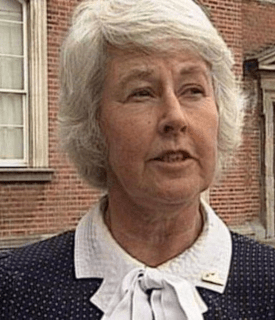
Mary Jennifer Guinness, English-born Irish socialite, member of the Guinness family and victim of a notorious 1986 kidnapping that lasts eight days, passes away peacefully at home on January 23, 2016, after a long battle with cancer. She is surrounded by her family, son Ian and daughters Gillian and Tania and long-term partner Alex Booth.
Guinness is born in England on August 22, 1937. On April 9, 1959, she marries merchant banker John Henry Guinness, a member of the Guinness brewing dynasty and chairman of Guinness Mahon. She is predeceased by her husband, who dies two years after the kidnapping in 1988.
“She had been sick for a long time. We will remember her as a most loving mother,” her son Ian says.
Guinness had been an enthusiastic sailor and member of Howth Yacht Club. “It is with great sadness that the Commodore and Officers of Howth Yacht Club have to inform members of the passing of esteemed member Jennifer Guinness,” a posting on the club website says.
Guinness, at the age of 48, makes headlines around the world after she is abducted from her luxury home in Howth, Dublin on April 8, 1986, by three masked gunmen armed with an Uzi submachine gun. They pistol-whip her husband and demand a £2.m ransom from him.
She is held for eight days in five various locations and is forced into the boot of a car and a cardboard box during her ordeal. She is also chained to a tree and a bed and at one point, even handcuffed to one of her captors. She is eventually rescued by Garda Síochána from a house on Waterloo Road in Ballsbridge following an all-night standoff with the kidnappers.
It does not take long for her kidnappers to be brought to justice. The following June, John “The Colonel” Cunningham is sentenced to seventeen years in prison, alongside his brother Michael Cunningham, who gets fourteen years. The notorious brothers, who have strong links with the gang led by Martin “The General” Cahill, are behind a string of armed robberies in the 1970s.
Michael Cunningham, who is released from prison in 1995, dies of a heart attack in January 2016. His brother escapes from the Shelton Abbey Prison in 1995 but is tracked down in Holland in 2000 where he serves four years in prison on drug charges before being extradited to Ireland in 2004 to serve out the rest of his sentence. He is released in 2007 and moves to Spain.
After her kidnap ordeal, Guinness says that she never gave in to despair during her eight-day ordeal. “I had no doubt at all, most of the time, that my life was in danger,” she says during a news conference, “but I couldn’t afford to allow myself to lose hope.”
When asked what kept her going during her captivity, Guinness says, “A certain amount of anger, a lot of determination and just a conviction that they weren’t going to get to me.” She draws laughter from reporters when she says, “I kept saying, ‘You’ve got the wrong branch of the family. John’s a banker, but two million is not our style of life.'”
Investigating Gardai praise her courage. Superintendent Frank Hanlon says she was “a considerable asset toward the ending of this incident through her advice to all parties.”
(From: “Jennifer Guinness – victim of a notorious 1986 kidnapping that lasted eight days – has died” by Jerome Reilly, Irish Independent, http://www.independent.ie, January 23, 2016)

 seamus dubhghaill