seamus dubhghaill

Promoting Irish Culture and History from Little Rock, Arkansas, USA


Leave a comment

The Founding of the Wexford Festival Opera

Wexford Festival Opera (Irish: Féile Ceoldráma Loch Garman), an opera festival that takes place in the town of Wexford in southeastern Ireland, first takes place on October 21, 1951.

Tom Walsh, an avid opera lover, dreamed of staging an opera production in his hometown Wexford. He starts the Wexford Opera Study Circle in 1950, and invites Sir Compton Mackenzie, the founder of the magazine Gramophone and a writer on music, for the inaugural lecture for the circle. Mackenzie and Walsh discuss the idea of a local opera festival, and Mackenzie becomes the first President of the Wexford Festival of Music and the Arts.

The result is that a group of opera lovers, including Dr. Tom Walsh who becomes the festival’s first artistic director, plan a “Festival of Music and the Arts” (as the event is first called) from October 21 to November 4, 1951. The highlight is a production of the 19th century Irish composer Michael William Balfe‘s 1857 The Rose of Castille, a little-known opera whose composer had lived in Wexford.

Setting itself aside from the well-known operas during its early years places Wexford in a unique position in the growing world of opera festivals, and this move is supported by well-known critics such as the influential Desmond Shawe-Taylor of The Sunday Times, who communicates what is happening each autumn season.

During its first decade, Wexford offers an increasingly enthusiastic and knowledgeable audience such rarities as Albert Lortzing‘s Der Wildschütz and obscure works (for the time) such as Vincenzo Bellini‘s La sonnambula is staged, with Marilyn Cotlow as Adina and Nicola Monti as Elvino. Bryan BalkwillCharles Mackerras and John Pritchard are among the young conductors, working with subsequently famous producers and designers like Micheál Mac Liammóir. For the time, the results are astounding, and the festival is soon attracting leading operatic talent, both new and established.

Albert Rosen, a young conductor from Prague, begins a long association with the company in 1965, and he goes on to conduct eighteen Wexford productions. He is later appointed Principal Conductor of the RTÉ Symphony Orchestra and is Conductor Laureate at the time of his death in 1997.

In 1967, Walter Legge, the EMI recording producer and founder of the Philharmonia Orchestra is asked to take over the running of the festival, but within a month of the appointment he suffers a severe heart attack and is obliged to withdraw. The 26-year-old former Trinity College Dublin (TCD) student Brian Dickie takes over the running of the Festival. A new era of outstanding singing emerges, with the first operas in Russian and Czech plus a new emphasis on the French repertory as represented by Léo Delibes’ Lakmé in 1970 and Georges Bizet‘s Les pêcheurs de perles in 1971.

Dickie is persuaded to return to Glyndebourne, but his successor in 1974 is Thomson Smillie who comes from the Scottish Opera. In 1976, Benjamin Britten‘s The Turn of the Screw is presented along with a rarity in Domenico Cimarosa‘s one-man piece Il maestro di cappella. Other rare Italian operas of the 18th century are presented in 1979 and subsequent years.

In subsequent years the festival is run by Adrian Slack (1979-81), Elaine Padmore (1982-94), Luigi Ferrari (1995-2004), David Agler (2005-19) and Rosetta Cucchi (2020-present).

The festival’s home of so many years, the Theatre Royal, is demolished and replaced by the Wexford Opera House on the same site. The opera house is officially opened on September 5, 2008, in a ceremony with the Taoiseach Brian Cowen, followed by a live broadcast of RTÉ‘s The Late Late Show from the O’Reilly Theatre. The first opera in the new building opens on October 16, 2008. Wexford Opera House provides the festival with a modern venue with a 35% increase in capacity by creating the 771-seat O’Reilly Theatre and a second, highly flexible Jerome Hynes Theatre, with a seating capacity up to 176. The architect is Keith Williams with the Office of Public Works. The acoustics and structure are designed by Arup.

In 2006, because of the closure of the Theatre Royal, a reduced festival takes place in the Dún Mhuire Hall on Wexford’s South Main Street. Only two operas are staged over a period of two weeks, instead of the usual three operas over three weeks. In 2007, the festival takes place in the summer in a temporary theatre on the grounds of Johnstown Castle, a stately home roughly 5 km from the town centre.

The building is officially renamed as Ireland’s National Opera House by the Minister for Arts, Heritage, Regional, Rural and Gaeltacht AffairsHeather Humphreys, at the opening of the 2014 Wexford Festival.


1 Comment

Taoiseach Varadkar Announces Simon Coveney as the New Tánaiste

Taoiseach Leo Varadkar announces Simon Coveney as the new Tánaiste on November 30, 2017, replacing Frances Fitzgerald who resigned two days earlier over the Maurice McCabe controversy. Coveney, who was Varadkar’s rival for the Fine Gael leadership earlier in the year, is to continue to serve as Minister for Foreign Affairs and Trade with responsibility for Brexit.

Varadkar says in appointing Coveney as Tánaiste he is “very conscious of the important role he plays as Minister of Foreign Affairs, as minister responsible for Brexit.” He adds, “I believe his appointment as Tánaiste and deputy prime minister will enhance his position in representing the government overseas in the negotiations currently under way.”

Minister Heather Humphreys is also announced as Minster for Business, Enterprise and Innovation, and Josepha Madigan is announced as Minister for Culture, Heritage and the Gaeltacht.

Frances Fitzgerald steps down from the role of Tánaiste on November 28, after new revelations about what she knew of the garda strategy and aggressive stance towards Maurice McCabe at the O’Higgins inquiry in 2015.

In a statement, Fitzgerald says, “Today I made the decision to tender my resignation to the Taoiseach, stepping down with immediate effect as Tánaiste and Minister for Business, Enterprise and Innovation. It has been the greatest honour of my life to serve in Government, but I believe it is necessary to take this decision to avoid an unwelcome and potentially destabilising general election at this historically critical time.

Fitzgerald adds, “Throughout my career I have always sought to act with integrity and responsibility, and that is why I have decided on this occasion to put the national interest ahead of my own personal reputation. I have always believed in fairness and equality and these principles have guided my work as Minister for Children and Youth Affairs, as Minister for Justice and Equality, and now as Minister for Business, Enterprise and Innovation.’

Fitzgerald concludes, “I would like to thank the Taoiseach for showing the same courage and determination to protect my good name that he displayed three years ago when he stood up and defended the reputation of Maurice McCabe. What I admire most about the Taoiseach is that he has always believed in doing what was right – not what was popular or politically expedient. I will always be grateful for his confidence and support and for giving me the opportunity to serve in a Government that is making a real difference in people’s lives at a critical time in our history.”

(From: “Simon Coveney appointed new Tánaiste after Frances Fitzgerald steps down over Maurice McCabe controversy” by Lauren Kelly and Deborah McAleese, The Irish Sun, November 30, 2017 | Photo Credit: RollingNews.ie)


Leave a comment

Ulster Day

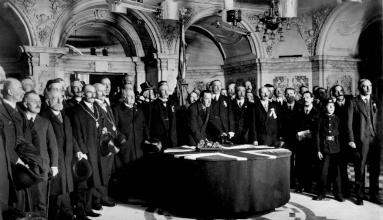
Ulster’s Solemn League and Covenant, commonly known as the Ulster Covenant, is signed by nearly 500,000 people on and before September 28, 1912, in protest against the Third Home Rule Bill introduced by the British Government in the same year.

The Covenant is first drafted by Thomas Sinclair, a prominent unionist and businessman from Belfast. Sir Edward Carson is the first person to sign the Covenant at Belfast City Hall with a silver pen, followed by Charles Stewart Vane-Tempest-Stewart, 6th Marquess of Londonderry (the former Lord Lieutenant of Ireland), representatives of the Protestant churches, and then by Sir James Craig. The signatories, 471,414 in all, are all against the establishment of a Home Rule parliament in Dublin. The Ulster Covenant is immortalised in Rudyard Kipling‘s poem “Ulster 1912.” On September 23, 1912, the Ulster Unionist Council votes in favour of a resolution pledging itself to the Covenant.

The Covenant has two basic parts: the Covenant itself, which is signed by men, and the Declaration, which is signed by women. In total, the Covenant is signed by 237,368 men; the Declaration, by 234,046 women. Both the Covenant and Declaration are held by the Public Record Office of Northern Ireland (PRONI). An online searchable database is available on the PRONI website.

In January 1913, the Ulster Volunteers aim to recruit 100,000 men between the ages of 17 and 65 who had signed the Covenant as a unionist militia. A British Covenant, similar to the Ulster Covenant in opposition to the Home Rule Bill, receives two million signatures in 1914.

The majority of the signatories of the Covenant are from Ulster, although the signing is also attended by several thousand southern unionists. Acknowledging this, Carson pays tribute to “my own fellow citizens from Dublin, from Wicklow, from Clare [and], yes, from Cork, rebel Cork, who are now holding the hand of Ulster,” to cheers from the crowd.

Robert James Stewart, a Presbyterian from Drum, County Monaghan, and the grandfather of Heather Humphreys, the Minister for Arts, Heritage and the Gaeltacht (2014-16) in the Republic of Ireland, is one of around 6,000 signatories in County Monaghan, where one quarter of the population is Protestant before the establishment of the Irish Free State. Almost 18,000 people sign either the Covenant or the Declaration in County Donegal.

The signature of Frederick Hugh Crawford is claimed by him to have been written in blood. However, this is disputed. Based on the results of a forensic test that he carries out in September 2012 at PRONI, Dr. Alastair Ruffell of Queen’s University Belfast asserts that he is 90% positive that the signature is not blood. Crawford’s signature is injected with a small amount of luminol. This substance reacts with iron in blood’s hemoglobin to produce a blue-white glow. The test is very sensitive and can detect tiny traces even in old samples. Crawford’s signature is still a rich red colour today which would be unlikely if it had been blood. Nevertheless, some unionists are not convinced by the evidence.

The term “Solemn League and Covenant” recalls a key historic document signed in 1643, by which the Scottish Covenanters make a political and military alliance with the leaders of the English Parliamentarians during the First English Civil War.

The Ulster Covenant is used as a template for the “Natal Covenant,” signed in 1955 by 33,000 British-descended Natalians against the nationalist South African government’s intention of declaring the Union a republic. It is signed in Durban‘s City Hall. Loosely based on Belfast’s Ulster Covenant, the Ulster scene is almost exactly reproduced.

September 28 is today known as “Ulster Day” to unionists.

(Pictured: Sir Edward Carson signing the Solemn League and Covenant)


Leave a comment

Remembrance Sunday Ceremonies 2016

Taoiseach Enda Kenny and Tánaiste Frances Fitzgerald attend Remembrance Sunday ceremonies in Northern Ireland on November 13, 2016, while a cross commemorating Irish soldiers in World War I is dedicated at Dublin‘s Glasnevin Cemetery.

Kenny, who has taken part in the ceremony every year since 2012, lays a wreath of green laurels alongside the many red poppies at the war memorial in Enniskillen, County Fermanagh. Northern Ireland’s First Minister Arlene Foster, a Member of the Legislative Assembly (MLA) for Fermanagh and South Tyrone, also attends the event.

Although there are no discussions between the pair, Kenny confirms he will meet with Foster in Dublin on Tuesday, November 15. The pair are also due to meet in Armagh on Friday, November 18 for a North/South ministerial meeting, where Brexit-related issues are expected to dominate the agenda.

Tánaiste Frances Fitzgerald travels to Belfast, where she lays a laurel wreath at the Cenotaph at city hall. Fitzgerald is joined at the ceremony by Secretary of State for Northern Ireland James Brokenshire.

Speaking afterwards, Fitzgerald, whose grandfather served as a soldier in the British army and whose father was a colonel in the Irish Army, says it has been an important engagement. “So many people across the island lost their lives; 50,000 families affected by loss of a loved one during the First World War. We have had a government minister here since 2012 and I think it is really important to come together, to remember together and to look at our shared histories.”

In England, British Prime Minister Theresa May is among those who gather at the Cenotaph in London for a commemoration ceremony.

Meanwhile, Heather Humphreys, the Minister for Arts, Heritage, Regional, Rural and Gaeltacht Affairs, dedicates the France-Ireland Memorial at Glasnevin Cemetery. Humphreys is joined by the French Minister of State for Veterans and Remembrance at the Ministry of Defence Jean-Marc Todeschini for the ceremony. The memorial is a gift to Ireland from France in recognition of Irish sacrifices made “in the defence and freedom of France, particularly in the First World War.”

(From: “Taoiseach, Tánaiste attend Remembrance Sunday ceremonies,” Raidió Teilifís Éireann (RTÉ), http://www.rte.ie, November 13, 2016 | Pictured: Taoiseach Enda Kenny lays a wreath of green laurels in Enniskillen)