In 1689, Capell is elected MP for Cockermouth and is Lord of the Treasury, between 1689 and 1690. He is invested again as Privy Councillor, on February 14, 1689. He is elected MP for Tewkesbury in 1690, and sits until April 11, 1692, when he is ennobled as Baron Capell of Tewkesbury, in the County of Gloucester. One year later, he becomes Lord Justice of Ireland and in turn a Privy Councillor of Ireland, in June 1693. In 1695 and 1696, he is Lord Deputy of Ireland. His term as Lord Deputy is not considered successful because of him being a firm Whig and presiding over an administration which is deeply divided between Whigs and Tories. He does nothing to help change this situation.
Capell dies at the age of 58 in Chapelizod, County Dublin, on May 30, 1696. He is buried on September 8, 1696, in Little Hadham, Hertfordshire. The barony dies with him.
On February 16, 1659, Capell marries Dorothy Bennet, daughter of Richard Bennet. The marriage is childless but does bring part of what later becomes Kew Palace into the Capell family, leading to its becoming known as Capel House. Dorothy dies in 1721, and through her will endows a number of charities.
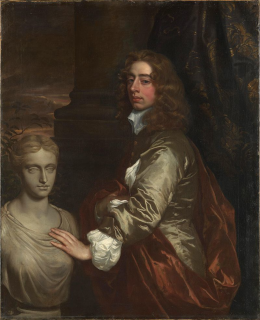
(Pictured: “Sir Henry Capel (1638-1696),” oil on canvas by Peter Lely, Metropolitan Museum of Art)
Levinge is the second son of Richard Levinge of Parwich Hall, Derbyshire, Recorder of Chester, and Anne Parker, daughter of George Parker of Staffordshire and his wife Grace Bateman. The Levinges (sometimes spelled “Levin”) are a long-established Derbyshire family with a tradition of public service. Through his mother he is a first cousin of Thomas Parker, 1st Earl of Macclesfield, Lord High Chancellor of Great Britain.
Levinge is one of the first to declare for William III of England at the Glorious Revolution and is sent by the new Government to Ireland as Solicitor-General in 1689. In 1692 he is elected as a member of the Irish House of Commons for Belfast and for Blessington, but chooses to sit for Blessington, a seat he holds until 1695. During this time, he serves as Speaker of the Irish House of Commons. In politics he is a moderate Tory, noted throughout his career for his desire to conciliate. In an age of bitter political faction this earns him the uncharitable nickname “Tom Double.” Although he supports the Penal Laws, as no Irish officeholder then could do otherwise, he is very tolerant in religious matters and has several Roman Catholic friends, including his predecessor as Solicitor-General, Sir Theobald Butler.
Levinge later represents Longford Borough from 1698 to September 1713 and Kilkenny City from 1713 to November 1715 in the Irish Parliament. In 1713 he is also returned for Gowran but chooses to sit for Kilkenny. He is created a Baronet of High Park in the County of Westmeath, in the Baronetage of Ireland on October 26, 1704.
Levinge had expressed his interest in being appointed to the English Bench but meets with no success in his efforts to achieve office in England. Under George I of Great Britain, despite being of the “wrong” political persuasion, and his growing age, his famous moderation, and his 30 years’ experience of Irish public life make him acceptable as an Irish judge to the Government, in which he has a powerful supporter in his cousin Lord Macclesfield. In 1721 he becomes Chief Justice of the Irish Common Pleas for Ireland and a member of the Privy Council of Ireland. He complains bitterly of the poor quality of his junior judges, and asks for suitable replacements, although he complains equally about some of those whose names are put forward as possible replacements. Despite being in great pain from gout in his last years, he remains on the Bench until his death on July 13, 1724.
Levinge divides his time between his ancestral home, Parwich Hall, which he purchases from his childless elder brother, and his newly acquired property Knockdrin Castle, County Westmeath. Most of his estates passes to his eldest son, who extensively rebuilds Parwich.
(Pictured: Knockdrin Castle, County Westmeath, the main Levinge residence in Ireland)
Brodrick is the second son of Sir St. John Brodrick of Ballyannan, near Midleton in County Cork, by his wife Alice, daughter of Laurence Clayton of Mallow, County Cork. His father receives large land grants during The Protectorate, and thus the family has much to lose if the land issue in Ireland is settled to the satisfaction of dispossessed Roman Catholics. He is educated at Magdalen College, Oxford and the Middle Temple, being called to the English bar in 1678. He and his relatives flee Ireland during the Glorious Revolution. They are attainted under the rule of King James II in Ireland. In exile in England, Brodrick argues for a speedy reconquest.
In 1690 Brodrick returns to Dublin and is given the legal office of Third Serjeant. He also becomes Recorder of Cork. He is dismissed as Serjeant in 1692, apparently on the ground that there is no work for him to do. While complaining bitterly about his dismissal, he admits privately that his post has been a superfluous one.
As a prominent Whig supporter of the outcome of the Glorious Revolution he is not always in agreement with court policies in Ireland, which he considers too lenient on the Jacobites. The dismissal of the First Serjeant, John Osborne, at the same time as Brodrick is due to his even stronger opposition to Court policy. Despite this he often holds Irish government offices and aspires to manage the Irish Parliament for English ministers. He represents Cork City in the Irish Parliament, which meets in 1692 and holds this seat until 1710. He is a vocal opponent of court policies, until the new Whig Lord Deputy of Ireland, Lord Henry Capell, decides to appoint him Solicitor-General for Ireland in 1695. He promotes penal laws against Catholics, whilst also supporting greater powers for the Irish Parliament.
Brodrick is Speaker of the Irish House of Commons from September 21, 1703. After promoting resolutions critical of the Lord Lieutenant of Ireland he loses his post as Solicitor-General in 1704. From 1707 until 1709 he is Attorney-General for Ireland. He becomes Chief Justice of Ireland in 1710 and is replaced as Speaker on May 19, 1710, but again holds the office in the next Parliament (November 25, 1713 – August 1, 1714), where he also represents County Cork. He is appointed Lord Chancellor of Ireland in 1714 and is ennobled in the Peerage of Ireland in 1715, as the 1st Baron Brodrick. He is advanced to the rank of 1st Viscount Midleton in 1717.
Brodrick feuds with his successor as Speaker William Conolly, as they are rivals to be the leading figure in Irish politics. Despite intrigues in England, he loses out and resigns as Lord Chancellor in 1725. He leaves behind him a legacy of bitterness and ill-will for which he is not really responsible as the Irish peers choose to blame him for the loss of their powers under the Sixth of George I, rather than their own misjudgment in imprisoning the Barons of the Exchequer.



 seamus dubhghaill