seamus dubhghaill

Promoting Irish Culture and History from Little Rock, Arkansas, USA


Leave a comment

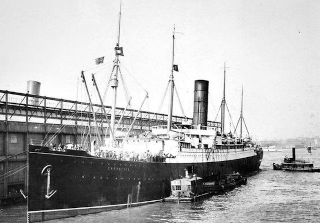
RMS Carpathia Arrives in New York City with RMS Titanic Survivors

The RMS Carpathia, a Cunard Line transatlantic passenger steamship, arrives in New York City on April 18, 1912, with 705 survivors from the RMS Titanic, which sank in the North Atlantic three days earlier.

As she is making her way from New York to Fiume, Austria-Hungary (now Rijeka, Croatia), RMS Carpathia receives a distress call from the “unsinkable” RMS Titanic. RMS Carpathia’s captain, Arthur Rostron, later testifies that the distance to RMS Titanic was 58 nautical miles (67 miles) and was expected to take three and a half hours to reach the doomed liner as its top speed, which was about 14.5 knots.

However, braving dangerous ice fields of its own, Rostron orders extra stokers to feed coal and cut off heating and hot water elsewhere in order to supply the ship’s engines with as much steam as possible. These decisions help accelerate the ship to more than 17 knots and the RMS Carpathia arrives on the scene approximately one hour and 40 minutes after RMS Titanic went down. For the next four and a half hours, the ship rescues 705 survivors from RMS Titanic‘s lifeboats.

Slowed by storms and fog since early Tuesday, April 16, RMS Carpathia arrives in New York City on the cold and rainy evening of Thursday, April 18, escorted by the scout cruiser USS Chester. RMS Carpathia first bypasses Pier 54, its Cunard Line pier, and sails up the Hudson River to Pier 59, the berth for White Star Line and where RMS Titanic was supposed to have arrived. Having dropped off the empty lifeboats, RMS Carpathia then sails back toward Pier 54.

A tugboat filled with photographers follows the ship to the pier, and the flashlight of cameras lights up the ship in the night sky to reveal that the decks are crammed with passengers.

Tens of thousands of people gather around Pier 54 to meet them and receive the first physical confirmation of the maritime disaster. On the orders of Rostron, RMS Carpathia‘s passengers disembark first, believing the scene will become tumultuous as soon as RMS Titanic survivors first appear. That moment comes when a teary-eyed woman with makeshift clothes descends a gangway and stumbles away from the boat into the arms of an officer.

The RMS Carpathia is initially a transatlantic passenger ship that makes its maiden voyage in 1903. During World War I, she is used to transfer Canadian and American Expeditionary Forces to Europe.

On July 15, 1918, under the command of Captain William Prothero, RMS Carpathia is a part of a large convoy that is making its way from Liverpool to Boston. Two days later, carrying 57 passengers and 166 crew, she is torpedoed on the port side by a German U-boat off the southwest coast of Ireland.

A second strike follows, which penetrates the engine room, killing three firemen and two trimmers. Prothero gives the order to abandon ship and all passengers and the surviving crew members board the lifeboats.

A third torpedo strike hits the gunner’s rooms, resulting in a large explosion that dooms the ship. The U-boat starts approaching the lifeboats when the HMS Snowdrop arrives on the scene and drives away the submarine with gunfire before picking up survivors.

The wreck of the RMS Carpathia is only discovered in 2000 after an 80 year-long search for the missing ship.

(From: “On This Day: Carpathia arrives in New York with Titanic survivors” by Michael Dorgan, IrishCentral, http://www.irishcentral.com, April 15, 2022)

1 Comment

Birth of John Morrissey, Irish American Politician & Boxing Champion

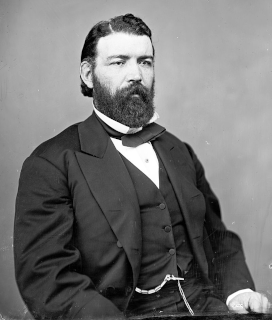
John Morrissey, Irish American politician, bare-knuckle boxing champion and criminal also known as ‘Old Smoke,’ is born on February 12, 1831, at Templemore, County Tipperary.

Morrissey is the only son among eight children of Timothy Morrissey, factory worker, and Julia (or Mary) Morrissey. In 1834 the family emigrates to Canada and then the United States, settling at Troy, New York. From the age of ten he works, first in a mill, and then as an iron worker due to his size and strength. He becomes involved in various street gangs, developing a reputation as a pugilist of great strength and resolve. As leader of the Down-Town gang, he defeats six members of the rival Up-Town gang in a single afternoon in 1848. He takes work on a Hudson River steamer and marries Sarah Smith, daughter of the ship’s captain, around 1849. They have one child who dies before reaching adulthood.

In a New York saloon Morrissey challenges Charley ‘Dutch’ Duane to a prize fight and, when he is not to be found, with typical bravado he extends the challenge to everyone present. This impresses the owner, Isaiah Rynders, the Tammany Hall politician, and he employs Morrissey to help the Democratic Party, which involves intimidating voters at election time. A fistfight with gang rival Tom McCann earns him the nickname ‘Old Smoke.’ Mid-fight he is forced onto a bed of coals, but despite having his flesh burned, refuses to concede defeat. He fights his way back and beats McCann into unconsciousness. Stowing away to California to challenge other fighters, he begins a gambling house to raise money and embarks on a privateering expedition to the Queen Charlotte Islands in a quixotic attempt to make his fortune.

In his first professional prize fight on August 21, 1852, Morrissey defeats George Thompson at Mare Island, California, in dubious circumstances, and begins calling himself the ‘champion of America.’ However, it is only on October 12, 1853, that he officially earns this title, when he wins the heavyweight championship of America in a bout at Boston Corner, New York, against Yankee Sullivan. The fight lasts thirty-seven rounds, and Morrissey has the worst of most of them, but he is awarded the contest after a free-for-all in the ring.

Increasingly involved in New York politics, Morrissey and his supporters fight street battles against the rival gang of William Poole, known as ‘Bill the Butcher,’ a Know Nothing politician later fictionalised in the film Gangs of New York (2002). On July 26, 1854, the two men fight on the docks, but Morrissey is beaten badly and forced to surrender. This marks the beginning of a bitter feud between the two parties, with heavy casualties on both sides, which climaxes on March 8, 1855, when Poole is murdered. Morrissey is indicted as a conspirator in the crime but is soon released because of his political connections.

On October 20, 1858, Morrissey fights John C. Heenan (1835–73) in another heavyweight championship bout. Heenan breaks his hand early in the fight and is always at a disadvantage. After taking much punishment Morrissey finally makes his dominance count. There is a rematch on April 4, 1859, which Morrissey again wins, and after this he retires from the ring. Investing his prize money, he runs two saloons and a gambling house in New York. With the huge profits from his gambling empire, he invests in real estate in Saratoga Springs, New York, opening the Saratoga Race Course there in 1863 which has endured to become America’s oldest major sports venue.

A political career beckons as a reward for Morrissey’s consistent support for the Democratic Party. He is elected to the United States House of Representatives in 1866 representing New York’s fifth district, is re-elected the following year, and serves until March 3, 1871. He supports President Andrew Johnson against demands for his impeachment and is skeptical about the Radicals’ plans for reconstruction in the south. In his final years he serves in the New York State Senate (1875–78).

After contracting pneumonia, Morrissey dies at the Adelphi Hotel, Saratoga Springs, on May 1, 1878, and is buried at Saint Peter’s Cemetery, Troy. On the day of his funeral, flags at New York City Hall are lowered to half-mast, while the National Police Gazette declares on May 4, 1878, that “few men of our day have arisen from beginnings so discouraging to a place so high in the general esteem of the community.” His name is included in the list of ‘pioneer’ inductees in the International Boxing Hall of Fame in Canastota, New York, and each year the John Morrissey Stakes are held at Saratoga Race Course in honour of its founder.

(Pictured: John Morrissey, U.S. Representative from New York, circa 1870s, source Library of Congress)


1 Comment

Death of Admiral Sir Peter Warren

peter-warren

Admiral Sir Peter Warren, KB, British naval officer from Ireland who commands the naval forces in the attack on the French Fortress of Louisbourg, Nova Scotia in 1745, dies on July 29, 1752. He also sits as MP for Westminster.

Warren is born on March 10, 1703, in Warrenstown, County Meath, the youngest son of Michael Warren and Catherine Plunkett, née Aylmer, who was the first wife of Sir Nicholas Plunkett.

In 1716, when he is 13 years old, Warren signs on as an ordinary seaman in Dublin and he and his brother initially serve together. He rapidly rises in the ranks, becoming a Captain in 1727. His ship patrols American colonial waters to provide protection from French forces. He becomes involved in colonial politics and land speculation.

In 1744, Warren is made commodore and commands a 16-ship squadron off the Leeward Islands, capturing 24 ships in four months. In 1745, he commands a group of ships that support the Massachusetts forces in the capture of the Fortress of Louisbourg. The prize system of the time allows naval officers to profit from the capture of enemy ships, and this expedition earns Warren a fortune, a promotion to the rank of Rear Admiral of the Blue, and a knighthood.

From July 1747 to August 3, 1747, Warren is appointed to the command of the Western Squadron. He is second in command of the British fleet on the HMS Devonshire at the First Battle of Cape Finisterre. His conduct in the battle wins him further fame, a promotion to Vice Admiral of the Red and much prizemoney.

Warren’s lands include several thousand acres on the south side of the Mohawk River west of Schenectady, New York, now known as Florida, Montgomery County, New York, roughly across from present day Amsterdam. He brings two nephews, William Johnson, eventually Sir William Johnson, and Michael Tyrrell to clear and manage the land. Tyrrell soon leaves, asking his uncle for support with a naval appointment. Tyrrell has a very distinguished naval career, rising to Admiral. He becomes sick while headed to London from the West Indies and is buried at sea. In 1741, Warren builds Warren House, a mansion overlooking the Hudson River on his 300-acre estate in Greenwich Village. He also owns property on Long Island, the van Cortland Estate in Westchester County, New York and South Carolina.

While on a visit to Ireland in 1752, Peter Warren dies suddenly in Dublin on July 29, 1752 “of a most violent fever.” The towns of Warren, Rhode Island and Warren, New Hampshire are named after him, as well as Warren Street in Lower Manhattan.