seamus dubhghaill

Promoting Irish Culture and History from Little Rock, Arkansas, USA


Leave a comment

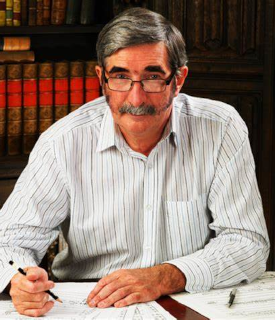
Birth of John Buckley, Composer & Pedagogue

John Buckley, Irish composer and pedagogue, is born in Templeglantine, County Limerick, on December 19, 1951. He is a co-founder of the Ennis Summer School and a member of Aosdána, Ireland’s state-sponsored academy of creative artists.

Buckley grows up in a rural environment and is introduced to traditional music learning the button accordion from the local player Liam Moloney when he is 9 years of age. In 1969 he moves to Dublin to study for the Teacher’s Diploma at St. Patrick’s College, Drumcondra. Here he has his first opportunity to hear live classical and modern music including contemporary and avantgarde works by Irish composers including Aloys Fleischmann, Brian Boydell, John Kinsella, and Seóirse Bodley, as well as works by international composers such as Krzysztof Penderecki. He becomes a student at the Royal Irish Academy of Music, Dublin (1969–74), studying the flute with Doris Keogh and composition with A. J. Potter and James Wilson. He continues his musical studies with Alun Hoddinott in Cardiff, Wales (1978–82), Aloys Fleischmann in Cork (M.A. in composition, 1980), and briefly with John Cage during a summer school for composers and choreographers at Guildford, Surrey, in 1981. Initially working as secondary school teacher, from 1982 he is able to work independently as a composer.

In 1983, Buckley is the co-founder, with James Wilson, of the annual Ennis Summer School for composition, which becomes an influential training ground for aspiring young Irish composers; pupils include Michael Alcorn, Rhona Clarke, and Gráinne Mulvey. He becomes a member of Aosdána in 1984. Since 2001 he has been a lecturer in music at St. Patrick’s College, Drumcondra. From the National University of Ireland at Maynooth (now Maynooth University) he receives a PhD in 2002 and a DMus in 2007.

Apart from membership in Aosdána, Buckley is honoured with the Varming Prize (1976), the Macaulay Fellowship (1978), the Arts Council‘s Composers’ Bursary (1982) and the Marten Toonder Award (1991).

Buckley’s output includes many commissions for solo instruments, chamber ensembles, choirs, bands and orchestra. His music has been widely performed and broadcast in Ireland and in more than fifty countries worldwide. He has represented Ireland at the UNESCO International Rostrum of Composers on five occasions and at the 1990 Prix Italia. His music has also been performed at five International Society for Contemporary Music (ISCM) festivals.

Buckley’s music does not adhere to any particular compositional school. He acknowledges the influence of Luciano Berio, Witold Lutoslawski, György Ligeti, and Olivier Messiaen. His harmonic approach is freely atonal. Structurally, there is frequently a gradual build-up from initially very limited pitch material to large formal constructions. Many compositions work towards a climax in the fourth quarter of a piece and then return to initial pitch sequences. In a number of early works he explores the Celtic myths of his native Ireland in orchestral scores such as Taller than Roman Spears (1977) and Fornocht do chonac thú (1980) and in small-scale works such as Oileáin (1979) for piano, Boireann (1983) for flute and piano, or I am Wind on Sea (1987) for mezzo-soprano and percussion. Later this aspect becomes less important for him. Works since the late 1980s display “a textural subtlety in marked contrast to the more robust sonorities explored in Buckley’s earlier keyboard works,” a “French refinement of sound, and an elevation of timbre as central characteristics” and “a concern with achieving a greater degree of formal unity” and “an exploration of analogies between sound and light.” O’Leary (2013) describes his style as “characterised by a broad harmonic idiom, contrasting consonance and dissonance in a non-tonal but strongly coloured soundworld.”

In 2010, Buckley arranges a number of Irish traditional songs for flute, some with harp, viola, percussion and string quartet. These are skilled and tasteful settings in a tonal harmonic language, quite unlike his original compositions.


Leave a comment

Birth of Jerome de Bromhead, Composer & Classical Guitarist

Jerome de Bromhead, Irish composer, classical guitarist, and member of Aosdána, is born in Waterford, County Waterford, on December 2, 1945.

De Bromhead studies with A. J. Potter and James Wilson at the Royal Irish Academy of Music in Dublin, with further studies with Seóirse Bodley in 1975 and Franco Donatoni in 1978. He holds an M.A. in music, art history and English from Trinity College Dublin. As a guitarist, he studies with Elspeth Henry (1967–68) and at the Guitar Centre, London (1969).

De Bromhead’s compositions include works for solo guitar as well as orchestral, choral and chamber music. His Symphony No. 1 (1986) represents Ireland at the International Rostrum of Composers at UNESCO‘s headquarters in Paris. He describes his style as “neither a Postmodernist nor a deaf-as-a-postmodernist. Above all I am suspicious of anything that seems like dogma.”

De Bromhead’s harpsichord piece Flux (1981) is performed at the ISCM World Music Days in Germany in 1987 and is now published by Tonos Verlag of Darmstadt.

According to guitarist John Feeley, de Bromhead’s solo guitar composition Gemini (1970) is “a sophisticated work, both technically and compositionally. It has the dynamism of youth, with a sense of freshness and it projects an attractive, driving energy […] It is an effective concert work, which speaks well on the instrument and is particularly gratifying for the performer.”

De Bromhead works at RTÉ as a television news director and announcer, as well as a senior music producer for radio, until a serious accident forces him to retire in 1996. He currently lives in Dublin.

The Contemporary Music Centre (www.cmc.ie) provides scores and sample recordings of a selection of de Bromhead’s works, available here.


Leave a comment

The Catalpa Rescue

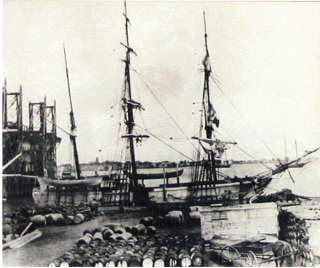
catalpa

The whaling ship Catalpa is given a tumultuous welcome as it sails into New York harbor on August 19, 1876. She has no whales on board, but a far more valuable cargo, six Fenian prisoners from the British penal colony of Western Australia.

Clan na Gael‘s John Devoy, with the help of his friend John Boyle O’Reilly, a Fenian who had once escaped from Australia himself and editor of the Boston newspaper The Pilot, plan the escape. Somehow maintaining the secrecy of the mission, the two arrange to buy and crew the whaler Catalpa, purchased in New Bedford, Massachusetts, for the attempt.

The Catalpa sets out in April 1875 with most of the crew unaware of their actual mission. They reach western Australia in March 1876.

The first intended day for escape from the penal colony is April 6, but the appearance of HMS Convict and other Royal Navy ships and customs officers quickly lead to a postponement. The escape is rearranged for April 17, when most of the Convict Establishment garrison is watching the Royal Perth Yacht Club regatta.

Catalpa drops anchor in international waters off Rockingham and dispatches a whaleboat to shore. At 8:30 AM, six Fenians, Thomas Darragh, Martin Hogan, Michael Harrington, Thomas Hassett, Robert Cranston and James Wilson, who are working in work parties outside the prison walls abscond. They are met by Fenian agents John Breslin and Thomas Desmond and picked up in horse traps. A seventh Fenian, James Kiely, is left behind. The men race 12 miles south to Rockingham pier where Captain George Smith Anthony awaits them with the whaleboat. A local named Bell he had spoken to earlier sees the men and quickly alerts the authorities.

As they row to the Catalpa a fierce squall strikes, breaking the whaleboat’s mast. The storm lasts until dawn on April 18 and is so intense that Anthony later states that he did not expect the small boat to survive. At 7:00 AM, with the storm over, they again make for the Catalpa but an hour later spot the screw steamer SS Georgette, which has been commandeered by the colonial governor, heading for the whaler. The men lay down in the whaleboat and it is not seen by the SS Georgette. The SS Georgette finds the Catalpa, but in Captain Anthony’s absence the First Mate refuses to allow the colonial police to board as the ship is outside the colony’s three-mile limit. The steamer is forced to return to Fremantle for coal after following the Catalpa for several hours.

As the whaleboat again makes for the ship a police cutter with 30 to 40 armed men is spotted. The two boats race to reach the Catalpa first, with the whaleboat winning, and the men climbing aboard as the police cutter passes by. The cutter turns, lingers briefly beside the Catalpa, and then heads to shore.

Early on April 19 the refuelled and now heavily armed SS Georgette returns and comes alongside the whaler, demanding the surrender of the prisoners and attempting to herd the ship back into Australian waters. They fire a warning shot with the 12-pounder cannon that had been installed the night before. Ignoring the demand to surrender, Anthony raises and then points towards the U.S. flag, informing the SS Georgette that an attack on the Catalpa will be considered an act of war against the United States, and proceeds westward.

Governor William Cleaver Robinson has ordered the police on the SS Georgette not to create an incident outside territorial waters. After steaming around threateningly for about an hour, the SS Georgette heads back to Fremantle and Catalpa slips away into the Indian Ocean.

The Catalpa does its best to avoid Royal Navy ships on its way back to the United States. O’Reilly receives the news of the escape on June 6 and releases the news to the press. The news sparks celebrations in the United States and Ireland and anger in Britain and Australia, although there is also sympathy for the cause within the Australian population. The Catalpa arrives in New York Harbor on August 19, 1876. Clan na Gael and the Fenians achieve one of their greatest victories over the British Empire.