seamus dubhghaill

Promoting Irish Culture and History from Little Rock, Arkansas, USA


Leave a comment

Birth of Irish Politician Mary MacSwiney

Mary MacSwiney, Irish politician and educationalist, is born in London on March 27, 1872, to an Irish father and English mother. In 1927, she becomes leader of Sinn Féin when Éamon de Valera resigns from the presidency of the party.

MacSwiney returns to Ireland with her family at the age of six and is educated at St. Angela’s School in Cork. At the age of twenty, she obtains a teaching post at a private school in England and studies for a Teaching Diploma at the University of Cambridge, which is normally reserved for men.

Influenced by her younger brother Terence MacSwiney‘s staunch Irish republicanism, MacSwiney joins the Gaelic League and Inghinidhe na hÉireann. She is a founder member of Cumann na mBan when it is formed in 1914 in Cork and becomes a National Vice-President of the organisation. She leads the denunciation of British rule at the Convention of November 1914. In 1916, she is arrested and imprisoned following the Easter Rising and is also dismissed from her teaching position due to her republican activities. Several months later, upon her release from prison, she and her sister Annie re-found Scoil Íte, a sister school to Patrick Pearse‘s St. Enda’s School, and she remains involved with the school for the rest of her life.

MacSwiney supports the Irish War of Independence in 1919–21. After the death of her brother Terence in October 1920 on hunger strike during the height of the war, she is elected for Sinn Féin to the Cork Borough constituency in 1921. She gives evidence in Washington, D.C., before the American Commission on Conditions in Ireland. For nine months she and Terence’s widow, Muriel, tour the United States lecturing and giving interviews.

MacSwiney is active in her friendship with Harry Boland and de Valera, whom she cultivates assiduously. In October 1921, a second delegation is to be sent to London which for the first time includes Michael Collins. MacSwiney, who remains implacably opposed, pleads with de Valera to be allowed to go. She is refused as de Valera thinks her to be “too extreme.” She strongly opposes the Anglo-Irish Treaty, debating during December 1921 to January 1922 to resume the war. On December 21 she speaks for three hours, criticising the agreement from all angles.

MacSwiney is arrested at Nell Ryan’s home, a safe house, at 40 Herbert Park, Ballsbridge, on November 4, 1922, when it is raided by Free State soldiers. She is interned at Mountjoy Gaol and immediately goes on hunger strike. Cumann na mBan organizes vigils outside the prison in protest of Mary’s and the others internment. The Women’s Prisoner’s Defence League is formed in August 1922 to protect their rights. During the hunger strike she refuses doctor’s visits and is resigned to her death. Her condition is critical, and she is given the Last Rites by a Catholic priest. The Government is not prepared to allow strikers die, so she is released.

En route to Liam Lynch‘s funeral, MacSwiney is again arrested when the car in which she is riding is stopped and she is recognised. She is taken with Kate O’Callaghan to Kilmainham Gaol. Fearless of death, she begins another protest. They continued to be interned without charge, but it is explained she is distributing anti-government propaganda. After nineteen days of hunger strike, she is due to be released on April 30, 1923. The Governor allows O’Callaghan to go but stays a decision on MacSwiney. Most of the women on hunger strike are sent to the North Dublin Union.

MacSwiney retains her seat at the 1923 Irish general election and, along with other Sinn Féin members, refuses to enter the Dáil Éireann.

In March 1926 the party holds its Ardfheis. MacSwiney and Father Michael O’Flanagan lead the section from which Éamon de Valera and Fianna Fáil break away. De Valera has come to believe that abstentionism is not a workable tactic and now sees the need to become the elected government of the Dáil. The conference instructs a joint committee of representatives from the two sections to arrange a basis for co-operation. That day, it issues a statement declaring “the division within our ranks is a division of Republicans.” The next day, de Valera’s motion to accept the Free State Constitution, contingent upon the abolition of the Oath of Allegiance, narrowly fails by a vote of 223 to 218. However, de Valera takes the great majority of Sinn Féin support with him when he founds Fianna Fáil.

MacSwiney continues to maintain a republican position until her death. By then she is vice-president of Sinn Féin and Cumann na mBan but loses her seat at the June 1927 Irish general election. When lack of funds prevents Sinn Féin contesting the second election called that year, MacSwiney declares “no true Irish citizen can vote for any of the other parties.”

Mary MacSwiney dies at her home in Cork on March 8, 1942. Her stance, both before and after the Treaty, may be summed up by her statement, “A rebel is one who opposes lawfully constituted authority and that I have never done.”


Leave a comment

Assassination of Irish American John Fitzgerald Kennedy

kennedy-assassination

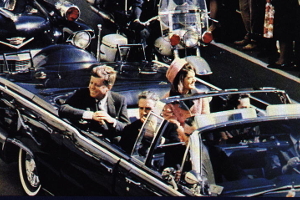
John Fitzgerald Kennedy, the 35th President of the United States, is assassinated at 12:30 PM CST (18:30 UTC) on Friday, November 22, 1963, in Dealey Plaza, Dallas, Texas. Kennedy is the first Roman Catholic president of the United States and descendant of immigrants from Ireland.

At 12:30 PM CST, as Kennedy’s uncovered 1961 Lincoln Continental four-door convertible limousine enters Dealey Plaza, Nellie Connally, the First Lady of Texas, turns around to President Kennedy, who is sitting behind her, and comments, “Mr. President, you can’t say Dallas doesn’t love you,” to which President Kennedy acknowledges by saying “No, you certainly can’t.” These are the last words ever spoken by John F. Kennedy.

From Houston Street, the presidential limousine makes the planned left turn onto Elm Street, allowing it access to the Stemmons Freeway exit. As it turns onto Elm, the motorcade passes the Texas School Book Depository. Shots are fired at Kennedy as the motorcade continues down Elm Street. About 80% of the witnesses recall hearing three shots.

A minority of the witnesses recognize the first gunshot they hear as weapon fire, but there is hardly any reaction to the first shot from a majority of the people in the crowd or those riding in the motorcade. Many later say they heard what they first thought to be a firecracker, or the backfire of a vehicle, just after the President started waving.

Within one second of each other, Kennedy, Texas Governor John Connally, and First Lady Jacqueline Kennedy, all turn abruptly from looking to their left to looking to their right. Connally, like the President a World War II military veteran, testifies that he immediately recognizes the sound of a high-powered rifle. He also testifies that when his head is facing about 20 degrees left of center, he is hit in his upper right back by a bullet he does not hear fired. After Connally is hit he shouts, “Oh, no, no, no. My God. They’re going to kill us all!”

Mrs. Connally testifies that just after hearing a loud, frightening noise that comes from somewhere behind her and to her right, she turns toward President Kennedy and sees him with his arms and elbows raised high, with his hands in front of his face and throat. She then hears another gunshot and then Governor Connally yelling. Mrs. Connally then turns away from Kennedy toward her husband, at which point another gunshot sounds and she and the limousine’s rear interior are covered with fragments of skull, blood, and brain.

According to the Warren Commission and the House Select Committee on Assassinations, as President Kennedy waves to the crowds on his right with his right arm upraised on the side of the limo, a shot enters his upper back, penetrates his neck, slightly damages a spinal vertebra and the top of his right lung, and exits his throat nearly centerline just beneath his larynx, nicking the left side of his suit tie knot. He raises his elbows and clenches his fists in front of his face and neck, then leans forward and left. Mrs. Kennedy, facing him, then puts her arms around him in concern.

A second shot strikes the President as the presidential limousine is passing in front of the John Neely Bryan north pergola concrete structure. Both the Warren Commission and the House Select Committee on Assassinations concludes that the second shot to hit the president enters the rear of his head and passing in fragments through his head, created a large, roughly oval hole on the rear, right side. The president’s blood and fragments of his scalp, brain, and skull land on the interior of the car, the inner and outer surfaces of the front glass windshield and raised sun visors, the front engine hood, the rear trunk lid, the follow-up Secret Service car and its driver’s left arm, and motorcycle officers riding on both sides of the President behind him.

After the President has been shot in the head, Mrs. Kennedy begins to climb out onto the back of the limousine, though she later has no recollection of doing so. United States Secret Service Special Agent Clint Hill, who is riding on the left front running board of the follow-up car, believes she is reaching for something, perhaps a piece of the President’s skull. He jumps onto the back of the limousine while at the same time Mrs. Kennedy returns to her seat. He clings to the car as it exits Dealey Plaza and accelerates, speeding to Parkland Memorial Hospital.

After Mrs. Kennedy crawls back into her limousine seat, both Governor Connally and Mrs. Connally hear her say more than once, “They have killed my husband,” and “I have his brains in my hand.”

The staff at Parkland Hospital’s Trauma Room 1 who treat President Kennedy observe that his condition is “moribund,” meaning that he has no chance of survival upon arriving at the hospital. George Burkley, the President’s personal physician, states that a gunshot wound to the skull is the cause of death. Burkley signs President Kennedy’s death certificate.

At 1:00 PM, CST (19:00 UTC), after all heart activity has ceased and after Father Oscar Huber has administered last rites, the President is pronounced dead.


Leave a comment

Bridget Cleary Burned to Death by Husband

bridget-cleary

Bridget Cleary is burned to death on March 15, 1895, by her husband who believes her spirit has been taken by bad faeries and replaced with a changeling.

Cleary is born Bridget Boland around 1869 in Ballyvadlea, County Tipperary. Bridget meets Michael Cleary in Clonmel in August 1887, where he works as a cooper and she serves as a dressmaker’s apprentice, and they marry a short time later.

After the marriage, she returns to her townland of Ballyvadlea to live with her parents while Michael continues to work as a cooper in Clonmel. During this period of living apart, Bridget’s independence grows and she begins keeping her own flock of chickens and selling the eggs to neighbours. She is also a professional woman which is somewhat unusual for the era and area. She obtains a Singer sewing machine, which is state-of-the-art at the time, and is variously described as a dressmaker and a milliner.

Despite their eight years of marriage, the couple has no children by the time of Bridget’s death. Following the death of Bridget’s mother, the Clearys find themselves responsible for Bridget’s elderly father, Patrick Boland. His residence with the couple enables them to secure a house reserved for labourers. Neither Bridget nor Michael is entitled to this cottage, but as Patrick had been a labourer in his youth, they are able to acquire the best house in the village. However, there is no widespread interest in the house as it is built on the site of a supposed fairy ringfort.

In early March 1895, Bridget becomes ill although her specific diagnosis is unknown. On March 13, more than a week into her illness, a physician visits her home. Her condition is considered sufficiently grave that a priest soon follows to administer last rites. Several friends and family members attend her over the next two days and a number of home remedies are administered including one ritual that anticipates her later demise. Her father and her husband accuse her of being a fairy sent to take Bridget’s place. Urine is thrown on her and she is carried before the fireplace to cast the fairy out. By March 16, rumours begin to circulate that Bridget is missing and the local police begin searching for her. Michael is quoted as claiming that his wife has been taken by fairies. Witness statements are gathered over the ensuing week and, by the time Bridget’s burned corpse is found in a shallow grave on March 22, nine people have been charged in her disappearance, including her husband. A coroner‘s inquest the next day returns a verdict of death by burning.

Legal hearings take place from April 1 to April 6, 1895. The court session begins on July 3. Evidence indicates that Michael attempted to force-feed his wife, throwing her down on the ground before the kitchen fireplace. Bridget’s chemise catches fire and Michael then throws lamp oil on Bridget. Witnesses are unclear as to whether she is already dead by this point. Michael keeps the others away from her body as it burns, insisting that she is a changeling and has been for a week. Michael believes that this will allow him to get his wife back from the fairies.

Michael Cleary is found guilty of manslaughter and spends 15 years in prison.