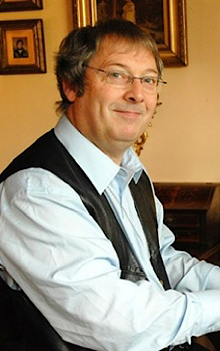
Holohan is chairman of the Association of Irish Composers from 1987 to 1989 and is later appointed chairman of the Droichead Arts Centre in Drogheda, County Louth, where he has lived since 1983.
Holohan is elected to Aosdána in 1999 and later serves as a member and chair of its Toscaireacht, its ten-member steering body.
Holohan’s music has been performed and broadcast in Ireland and internationally. Career highlights in Drogheda include performances of Cromwell (1994), The Mass of Fire (1995) and No Sanctuary (1997).
Holohan’s work has been reviewed in Irish music journalism. Writing in The Journal of Music following a National Concert Hall composers’ showcase, Benedict Schlepper-Connolly describes The Dream of Aengus as demonstrating Holohan’s “orchestrational control,” and characterises Portrait of the Artist as “captivating,” while noting the influence of Irish traditional music within his choral writing.
Regional press coverage has also documented performances and recordings of his work, including reports on the release of the piano album Fields of Blue and Whiteand concerts of his music in Drogheda.
The inaugural meeting of Aosdána, an Irish association of artists, takes place in the Old Parliament House in Dublin on April 14, 1983. It is created in 1981 on the initiative of a group of writers with support from the Arts Council of Ireland. Membership, which is by invitation from current members, is limited to 250 individuals, up from 200 prior to 2005. Its governing body is called the Toscaireacht.
At the suggestion of writer Anthony Cronin, who becomes a founding member, Aosdána is originally established in 1981 by TaoiseachCharles Haughey, well known for his support for the Arts, although columnist Fintan O’Toole has argued that this also serves to deflect criticism of Haughey’s political actions. Haughey’s successor, Garret FitzGerald, formally addresses the inaugural assembly of Aosdána in Dublin.
The process of induction into Aosdána relies entirely on members proposing new members. Applications by artists themselves are not allowed. Some members receive a stipend, called the Cnuas, from the Arts Council of Ireland. This stipend is intended to allow recipients to work full-time at their art. The value of the Cnuas in 2015 is €17,180.
The poet Pearse Hutchinson, a member of Aosdána, describes the organisation as “a miracle and a godsend” that allows him to continue writing at a time when he might have had to give up. Composer Roger Doyle has also spoken about the difference it makes, “I was elected to Aosdána in 1986. This gave me a small stipend from the Government each year, which enabled me to devote all my time to composing. This changed my life for the better and I have composed non-stop since then.”
The Toscaireacht is a committee of ten members, called Toscairí, of the Aosdána. It meets several times a year to deal with the administration and external relations of Aosdána, reports to every General Assembly, which meets once a year, and sets its Agenda. When new members of Aosdána are proposed, the Toscairí have the task of verifying that the nomination process has been complied with, and also that the candidate is willing to accept membership, before the next stage of election is begun.
Toscairí are elected to the Toscaireacht by the members of Aosdána for two year terms. All members of Aosdána are eligible for election, and nominations must be made in writing by three members. The electoral process is in two stages. First, within each of Aosdána’s three disciplines (Music, Literature, and Visual Arts), the two nominees with the highest number of votes are elected. This guarantees a minimum of two Toscairí from each of the disciplines. Next, the remaining four places are filled by the remaining nominees from any discipline who have the highest number of votes.
The procedure at meetings is laid down in the Toscaireacht’s Standing Orders. Minutes of its meetings appear on Aosdána’s web site (aosdana.artscouncil.ie).


 seamus dubhghaill