seamus dubhghaill

Promoting Irish Culture and History from Little Rock, Arkansas, USA


Leave a comment

Oliver Cromwell Abandons the First Siege of Waterford

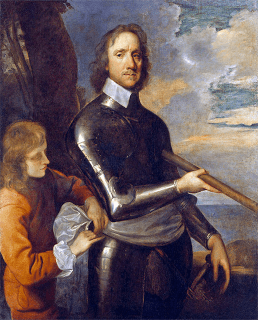
Oliver Cromwell abandons the First Siege of Waterford on December 2, 1649, and goes into winter quarters at Dungarvan. Waterford is besieged twice during 1649 and 1650 during the Cromwellian conquest of Ireland. The town is held by Confederate Ireland, also referred to as the Irish Catholic Confederation, under General Richard Farrell and English Royalist troops under General Thomas Preston. It is besieged by English Parliamentarians under Cromwell, Michael Jones and Henry Ireton.

Waterford is a Catholic city and like most other towns in southeast Ireland, the populace has supported the Confederate Catholic cause since the Irish Rebellion of 1641. Late in 1641, Protestant refugees, displaced by the insurgents, begin to arrive in the town, creating tension among the Catholic townspeople. The city’s mayor wants to protect the refugees, but the recorder and several of the aldermen on the city council want to strip them of their property and let in the rebels, who arrive outside the walls in early 1642. At first, the Mayor’s faction is successful in refusing to admit rebel forces, but by March 1642, the faction in the municipal government sympathetic to the rebellion prevails. The Protestants in Waterford are expelled, in most cases put on ships to England, sometimes after having their property looted by the city mob. In 1645, Confederate troops under Thomas Preston besiege and capture nearby Duncannon from its English garrison, thus removing the threat to shipping coming to and from Waterford.

Waterford’s political community is noted for its intransigent Catholic politics. In 1646, a synod of Catholic Bishops, based in Waterford, excommunicate any Catholic who supports a treaty between the Confederates and English Royalists, which does not allow for the free practice of the Catholic religion. The Confederates finally agree to a treaty with Charles I of England in 1648, in order to join forces with the Royalists against their common enemy, the English Parliament, which is both anti-Catholic and hostile to the King. The Parliamentarians land a major expeditionary force in Ireland at Dublin, under Cromwell in August 1649.

The English Parliamentarian New Model Army arrives to besiege Waterford in October 1649. One of the stated aims of Cromwell’s invasion of Ireland is to punish the Irish for the mistreatment of Protestants in 1641. Given Waterford’s history of partisan Catholic politics, this provokes great fear amongst the townspeople. This fear is accentuated by the fate of Drogheda and nearby Wexford which had recently been taken and sacked by Cromwell’s forces and their garrisons massacred.

Waterford is very important strategically in the war in Ireland. Its port allows for the importation of arms and supplies from continental Europe and its geographical position commands the entrance of the rivers Suir and Barrow.

Before besieging Waterford, Cromwell has to take the surrounding garrisons held by Royalist and Confederate troops in order to secure his lines of communication and supply. Duncannon, whose fort commands the sea passage into Waterford, is besieged by Parliamentarians under Ireton from October 15 to November 5. However, due to a stubborn defence, the garrison there under Edward Wogan holds out. This means that heavy siege artillery cannot be brought up to Waterford by sea.

New Ross surrenders to Cromwell on October 19 and Carrick-on-Suir is taken on November 19. A counterattack on Carrick by Irish troops from Ulster under a Major Geoghegan is repulsed on November 24, leaving 500 of the Ulstermen dead.

Having isolated Waterford from the east and north, Cromwell arrives before the city on November 24. However, Waterford still has access to reinforcements from the west and up to 3,000 Irish soldiers from the Confederate’s Ulster Army under Richard O’Farrell are fed into the city in the course of a week. O’Farrell, having been a successful officer in the Spanish Army, is highly trained and experienced in siege warfare from battles in Flanders. Cromwell has come up against a superior minded soldier and commander. The weather is extremely cold and wet, and the Parliamentarian troops suffer heavily from disease. Out of 6,500 English Parliamentarian soldiers who besiege Waterford in 1649, only 3,000 or so are still fit by the time the siege is called off. Added to this, Cromwell is able to make little headway in taking the city. The capture of a fort at Passage East enables him to bring up siege guns by sea, but the wet weather means that it is all but impossible to transport them close enough to Waterford’s walls to use them. Farrell proves tactically superior in defending Waterford and repels Cromwell’s attempts. Eventually Cromwell has to call off the siege on December 2 and go into winter quarters at Dungarvan. Among his casualties is his commander Michael Jones, who dies of disease.

Leave a comment

The Battle of Dungan’s Hill

battle-of-dungans-hill

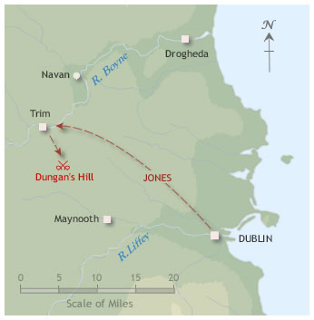
The Battle of Dungan’s Hill takes place in County Meath on August 8, 1647. It is fought between the armies of Confederate Ireland and the Parliament of England during the Wars of the Three Kingdoms. The battle takes place near the modern village of Summerhill and along the present main road between Trim and Kilcock.

By 1647, The Irish Catholic Confederation controls all of Ireland except for Parliamentarian enclaves around Dublin and Cork and a Scottish outpost in Ulster. The previous year they had rejected a treaty with the English Royalists in favour of eliminating the remaining British forces in Ireland.

In August 1647, the Confederate Leinster army under Thomas Preston is attempting to take Dublin from the English Parliamentarian garrison under Michael Jones, when it is intercepted by the Roundheads and forced to give battle. Jones had marched to Trim to relieve the Parliamentarian outpost there at Trim Castle. Preston, who had been shadowing Jones’ movements, attempts to march on Dublin before Jones’ army returns there, but covers only 12 of the 40 miles before being caught at Dungan’s Hill, where the Confederate forces have to form up for battle.

From a Parliamentarian point of view, victory in this battle is presented to them by the incompetence of the Irish commander. Preston is a veteran of the Thirty Years’ War, where he had been a commander of the Spanish garrison at Leuven, but has no experience in open warfare or handling cavalry. Jones, by contrast, had been a cavalry officer in the English Civil War. As a result, Preston tries to move his cavalry along a narrow covered lane where they are trapped and subjected to enemy fire without being able to respond. Even worse, Preston has placed a large number of his troops in wheat fields over seven feet tall. As a result these troops are unable to see the Parliamentarians until it is too late. With the Confederate army spread out and in confusion, Jones’ troops fall in amongst them causing the demoralised Irish cavalry to flee the field, leaving the remainder of Preston’s infantry unsupported.

The Confederate army’s infantry are primarily equipped with pikes and heavy muskets and trained to stand in tercios in the Spanish manner. This means they are difficult to break, but also highly immobile, without cavalry to cover their cumbersome formation when it moves. What is worse, Preston has positioned them in a large walled field, so that when their cavalry has run away, the Parliamentarians can surround and trap them. Some of the Irish infantry, Scottish Highlanders brought to Ireland by Alasdair Mac Colla, manage to charge and break through Jones’ men and escape into a nearby bog, where the English cavalry could not follow. Preston and 2,000 to 3,000 of his regular infantry manage to follow the Highlanders to safety, but the remainder are trapped.

What happens next is disputed. The Irish infantry manages to hold off several assaults on their position, before trying to follow their comrades into the safety of the bog. This makes them lose their formation and the Parliamentarians get in amongst them and then surround them in the bogland. Parliamentarian accounts simply say that the Irish force is then destroyed. Irish accounts, however, claim that the Confederate troops surrender and are then massacred. One account, by a Catholic friar named O Meallain, says that the corpses of the Irish foot soldiers are found with their hands tied. A recent study suggests that the Irishmen probably tried to surrender, but that, according to the conventions of 17th century warfare, this had to be accepted before it entitled them to safety. In this case, it was not accepted and the infantrymen were butchered.

Around 3,000 Confederate troops and a small number of Parliamentarians die at Dungan’s Hill. One of the English regimental commanders, Colonel Anthony Hungerford, is shot in the mouth, a wound that invalids him out of the English Army. Most of the dead are Irish infantrymen killed in the last stage of the battle. Those prisoners who are taken are mainly officers, whom the Parliamentarians can either ransom or exchange for prisoners of their own. Richard Talbot, a junior cavalry officer but later Earl of Tyrconnell and Lord Deputy of Ireland, is among the Confederate prisoners.

In the immediate aftermath of the battle, Owen Roe O’Neill‘s Ulster Army marches through the pass of Portlester Mill to mount an effective rearguard action, routing Jones’ advanced brigade and enabling the survivors of the Leinster army to escape. Jones, fearing O’Neills army, does not continue the pursuit and returns to Dublin. O’Neill and his Ulstermen return four months later to bury the dead Confederates.


Leave a comment

The Battle of Rathmines

The Battle of Rathmines is fought in and around what is now the Dublin suburb of Rathmines on August 2, 1649, during the Irish Confederate Wars. It is fought between an English Parliamentarian army under Michael Jones which holds Dublin and an army composed of Irish Confederate and English Royalist troops under the command of the James Butler, 1st Duke of Ormond.

By 1649, Ireland has already been at war for eight years, since the outbreak of the Irish Rebellion of 1641. The English Parliament holds only two small enclaves, Dublin and Derry, in Ireland.

In July 1649, Ormond, marches his coalition forces of 11,000 men to the outskirts of Dublin with the intent of taking the city from its Parliamentary garrison, which had landed there in 1647. Ormond takes Rathfarnham Castle and camps at Palmerston Park in Rathgar, about 4 km south of the city. The area from Ormond’s camp to the city of Dublin is now a heavily urbanised area, but in 1649, it is open countryside. Ormond begins inching his forces closer to Dublin by taking the villages around its perimeter and to this end, sends a detachment of troops to occupy Baggotrath Castle, on the site of present-day Baggot Street bridge. For reasons which have never been clear, they take several hours to reach Baggotrath, a distance of about a mile, and they arrive to find that the Parliamentary troops have already occupied the castle.

However, Ormond is not expecting Michael Jones, the Parliamentary commander, to take the initiative and has not drawn up his troops for battle. Unfortunately for the Royalists, this is exactly what Jones does, launching a surprise attack on August 2 from the direction of Irishtown with 5,000 men and sending Ormond’s men at Baggotsrath reeling backwards towards their camp in confusion.

Too late, Ormond and his commanders realise what is going on and send units into action piecemeal to try to hold up the Parliamentarian advance, so that they can form their army into battle formation. However, Jones’ cavalry simply outflanks each force sent against them, sending them too fleeing back south through the townland of Rathmines. The battle becomes a rout as scores of fleeing Royalist and Confederate soldiers are cut down by the pursuing Roundheads. The fighting finally ends when the English Royalist troops under Murrough O’Brien, 1st Earl of Inchiquin, mounts a disciplined rearguard action, allowing the rest to get away. Ormond claims he has lost less than a thousand men. Jones claims to have killed around 4,000 Royalist or Confederate soldiers and taken 2,517 prisoners, while losing only a handful himself. Ormond certainly loses at least one leading officer, Christopher Plunkett, 2nd Earl of Fingall, who is fatally wounded and dies in Dublin Castle a few days later. Ormond also loses his entire artillery train and all his baggage and supplies.

In the aftermath of the battle, Ormond withdraws his remaining troops from around Dublin, allowing Oliver Cromwell to land in the city at Ringsend with 15,000 veteran troops on August 15. Cromwell calls the battle “an astonishing mercy,” taking it as a sign that God has approved of his conquest of Ireland. Over the next four years he completes the Cromwellian conquest of Ireland.

Without Jones’ victory at Rathmines, the New Model Army would have had no port to land at in Ireland and the Cromwellian conquest of Ireland would have been much more difficult. Ormond’s incompetent generalship at Rathmines disillusions many Irish Confederates with their alliance with the English Royalists and Ormond is ousted as commander of the Irish forces the following year.