seamus dubhghaill

Promoting Irish Culture and History from Little Rock, Arkansas, USA


Leave a comment

Birth of Eamon Dunphy, Media Personality & Journalist

Eamon Martin Dunphy, Irish media personality, journalist, broadcaster, author, sports pundit and former professional footballer, is born in Dublin on August 3, 1945.

Dunphy grows up in Drumcondra, Dublin, in what he describes as “a one-room tenement flat [with] no electricity, no hot water.” He attends Saint Patrick’s National School, Drumcondra. In 1958, he gets a one-year government scholarship to Sandymount High School but has to work as a messenger at the tweed clothing shop Kevin and Howlin.

A promising footballer, Dunphy leaves Dublin while still a teenager to join Manchester United as an apprentice. He does not break into the first team at United, and subsequently leaves to play for York City, Millwall, Charlton Athletic, Reading and Shamrock Rovers. It is at Millwall that he makes the most impact. He is considered an intelligent and skillful player in the side’s midfield. He is a member of “The Class of ’71,” the Millwall side that fails by just one point to gain promotion to the Football League First Division.

Dunphy plays 23 times for the Republic of Ireland and is Millwall’s most capped international footballer with 22 caps, until surpassed by David Forde and Shane Ferguson. He makes his Ireland debut on November 10, 1965, in the playoff at the Parc des Princes in Paris for the 1966 FIFA World Cup which Spain wins 1–0, thanks to a José Ufarte goal. He goes on to become, in his own words, “a good player, not a great player.”

Dunphy accompanies Johnny Giles back to Ireland to join Shamrock Rovers in 1977. Giles wants to make the club Ireland’s first full-time professional club and hopes to make Rovers into a force in European football by developing talented young players at home who would otherwise go to clubs in England. Dunphy is originally intended to be in charge of youth development. However, despite an FAI Cup winners medal in 1978, his only medal in senior football, and two appearances in the UEFA Cup Winners’ Cup, he becomes disillusioned with the Irish game and drops out of football altogether to concentrate on a career in journalism.

After retiring from the game, Dunphy first begins writing on football for the Sunday Tribune and then contributes regular columns on both football and current events for the Sunday Independent. He currently writes a column on football for the Irish Daily Star. He coins the term “Official Ireland” to refer to the establishment. He also works for Ireland on Sunday (now the Irish Daily Mail), The Sunday Press (now defunct), and the Irish Examiner.

Since the 1980s, Dunphy has written a number of books. His first and most widely praised book is Only a Game? The Diary of a Professional Footballer, which is an autobiographical account of his days playing for Millwall. Written in diary form, it records events from the dressing room of his 1973–74 season, which begins well for him at Millwall but subsequently ends in disillusionment: after being substituted in an October 27, 1973, home loss to eventual league winners Middlesbrough, he does not play another game all season, the club finishing mid-table.

In 1985, rock band U2 and manager Paul McGuinness commission Dunphy to write the story of their origins, formation, early years and the time leading up to their highly successful album The Joshua Tree. His book Unforgettable Fire – Past, Present, and Future – The Definitive Biography of U2 is published in 1988. It receives some favourable reviews, but critics close to the band speak of many inaccuracies. A verbal war erupts in the press during which he calls lead singer Bono a “pompous git.”

Dunphy also writes a biography of long-serving Manchester United manager Matt Busby and in 2002 ghost writes the autobiography of Republic of Ireland and Manchester United player Roy Keane.

Since the mid-1980s, Dunphy has regularly appeared as an analyst during football coverage on Raidió Teilifís Éireann (RTÉ). Since RTÉ acquired the rights to show English football, he has been a regular contributor to Premier Soccer Saturday. He also contributes to analysis of UEFA Champions League games and, in international football, RTÉ’s coverage of FIFA World Cups, UEFA European Football Championships and qualifying matches involving the Republic of Ireland national football team.

In 2001, Dunphy becomes the first male host of the quiz show The Weakest Link, which airs on TV3, for just one series. In 2003, he is hired again by TV3 to host their new Friday night chat show, entitled The Dunphy Show. Pitted head-to-head with RTÉ’s long-running flagship programme, The Late Late Show, Dunphy’s show loses what is a highly publicised “ratings war,” and is cancelled before its original run concludes.

Dunphy is the first presenter of a made-for-mobile television show on the 3 mobile network in Ireland. His rants and “Spoofer of the Week” are watched by thousands of 3 Mobile customers. The shows are awarded “Best Entertainment Show” at Ireland’s Digital Media Awards. He admits he never uses a mobile himself but enjoys filming for a mobile audience from his living room in Ranelagh.

In July 2018, Dunphy announces that he is leaving RTÉ after 40 years with the broadcaster, and that he intends to focus on his podcast The Stand with Eamon Dunphy.

Dunphy has also has a prominent radio career with several stations, including Today FM, Newstalk and RTÉ Radio 1. He is the original host in 1997 of the popular current affairs show The Last Word on Today FM. In September 2004, he takes over The Breakfast Show slot on the Dublin radio station Newstalk 106 from David McWilliams. The show tries to court controversy and listeners in equal measure. He fails to attract the large listenership predicted, with only a few additional thousand tuning in. He announces in June 2006 his intention to leave Newstalk 106, citing an inability to sustain the demands of an early morning schedule. After his departure from Newstalk 106, he confirms he is suffering from a viral illness from which he later recovers.

In July 2006, RTÉ announces that Dunphy will present a new weekly programme as part of the new RTÉ Radio 1 autumn schedule.

Dunphy rejoins Newstalk but leaves again in 2011 “due to interference from management and a push to put a more positive spin on the news.” On his last show he accuses his boss, Denis O’Brien, of “hating journalism.” He quits after Sam Smyth is sacked from Today FM (also owned by O’Brien) and says management at Newstalk is trying to remove “dissenting voices” like Constantin Gurdgiev from the airwaves.

Dunphy is a daily Mass-goer until he is preparing for marriage to his first wife, Sandra from Salford, when he is 21. He is Catholic and she is Protestant. The priest instructing them for marriage disapproves strongly of the mixed couple, saying that he should not marry her because she is “not a proper person.” Dunphy’s observance is already weakening but he quits his daily Mass-going at this point. He and Sandra have two children, a boy and a girl, and he is now a grandfather. His first marriage ends, and he moves to Castletownshend in County Cork for two years in the early 1990s. He lives with another partner, Inge, before meeting his second wife, RTÉ commissioning editor Jane Gogan, in the Horseshoe Bar in Dublin in 1992. They marry at the Unitarian Church on St. Stephen’s Green on September 24, 2009.

In an interview with An Phoblacht, Dunphy, who had previously written highly critical articles on the Provisional IRA and Sinn Féin, states that he is now a Sinn Féin supporter and declares he had voted for them in the 2011 Irish general election. He describes their representatives as “incredibly hard-working and incredibly intelligent.”

Dunphy publishes his autobiography entitled The Rocky Road in October 2013.

Today, Dunphy generally resides at his home near Ranelagh in Dublin. He also owns a holiday home in Deauville, France.

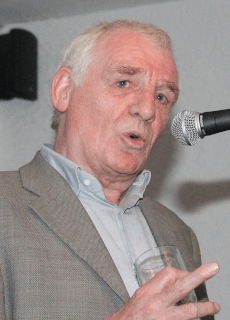
(Pictured: Éamon Dunphy at the Sinn Féin Summer School, 2013)


Leave a comment

Birth of Michael McCarthy, Professional Football Player & Manager

Michael Joseph “Mick” McCarthy, professional football manager, pundit and former player, is born on February 7, 1959, in Barnsley, South Yorkshire, England. He is most recently the head coach of Blackpool.

McCarthy makes his league debut for then-Fourth Division Barnsley on August 20, 1977, in a 4–0 win over Rochdale. He spends two years in the basement league, before the club wins promotion. A strong central defender, he is a virtual ever-present for his hometown club, but departs in December 1983 for fellow Division 2 club Manchester City.

Manchester City wins promotion in McCarthy’s first full season, and he finally has the chance to play at the highest level. His first season in the topflight is steady enough as the club reaches mid-table, but relegation strikes the following year. However, he does not face the drop as he signs for Celtic in May 1987 in a surprise £500,000 move.

McCarthy is brought to Parkhead by David Hay but within days of the signing the Celtic boss is sacked. Fortunately for McCarthy, Hay’s replacement is the returning Parkhead legend Billy McNeill, who quickly recognises that McCarthy’s strength and aggression are qualities desperately required by a notoriously leaky Celtic defence. He picks up his first silverware with Celtic as they win the league and cup double in his first season. The following season he again wins a Scottish Cup winners medal, although the club has to settle for third place in the league.

If ever an example is needed to reflect McCarthy’s values, it cannot be bettered than that on the day of the 1998 Scottish Cup Final. Celtic wins 2-1, but to the disgust of many, the unpopular Conservative Prime Minister Margaret Thatcher is in attendance and to present the trophy to the winners. The players are under pressure from the Scottish Football Association (SFA) to meet her, but a few refuse. According to fellow Celtic player Andy Walker, McCarthy refuses point-blank, as he is from Barnsley and the son of a miner. Shaking hands with her is an impossibility for him.

In the summer of 1988, McCarthy joins fellow Celtic players Packie Bonner and Chris Morris in Germany as part of the Republic of Ireland European Championship squad and gives a fine account of himself particularly in the historic 1-0 win over England. He, like Bonner and Morris, also star in the Republic’s 1990 FIFA World Cup squad which makes it to the quarterfinals in Italy.

In terms of his Celtic career, McCarthy never repeats the achievements or level of performance of his debut season.

McCarthy signs for Lyon in the summer of 1989 for £350,000. Afflicted by injuries and mindful of his spot in Ireland’s World Cup team, he finishes that season on loan to Millwall. After a captain’s showing in Italy for the Ireland national side, Millwall signs him full-time and later he becomes manager at The Den in 1992. In February 1996, he follows Jack Charlton into the Ireland manager’s job and experiences various highs and lows over his nearly seven years in charge. He has since managed Sunderland and Wolverhampton Wanderers.

In later years McCarthy becomes a low-key candidate for the Celtic manager’s job after the departures of Martin O’Neill and Gordon Strachan but is never favoured by the board or the general support for the role. Ironically then in 2018, he takes over from Martin O’Neill following his second stint as the Ireland manager. Notably, Roy Keane is Martin O’Neill’s assistant and has to step down also. On April 4, 2020, amid the global coronavirus pandemic, he stands down as manager and is immediately replaced by Stephen Kenny.

McCarthy joins Cypriot First Division club APOEL as manager on November 2, 2020, signing a contract until 2022. He is sacked by the club on January 5, 2021, following a run of 2 wins, 1 draw and 5 defeats in his eight games in charge.

On January 22, 2021, McCarthy is appointed as manager of Cardiff City, following the sacking of Neil Harris. He signs a contract until the end of the season. After making an unbeaten start to his reign at the club, a run that includes a six-game winning streak, he signs a new two-year deal with the club on March 4, 2021. Cardiff finishes the season in 8th place. Despite losing one of their opening six matches at the start of the following season, a run of results follows which sees Cardiff drop as low as 21st in the table. On October 23, 2021, after suffering a club-record eighth successive loss of the season at the hands of Middlesbrough, McCarthy leaves the club by mutual consent.

On January 19, 2023, McCarthy is appointed head coach of the Championship’s second-bottom placed club Blackpool on a short-term contract until the end of the season. On April 8, 2023, he leaves Blackpool by mutual consent, following a 3–1 home defeat to Cardiff the previous day. He achieves two wins in his 14 games in charge, losing nine of them, which leaves the club in 23rd position. “With results on the pitch not improving in recent weeks, the decision has been agreed by both parties that a change is needed,” the club says in a statement.


Leave a comment

Birth of Reg Ryan, Irish Footballer

Reginald Alphonso Ryan, Irish footballer also referred to as Paddy Ryan, is born in Dublin, County Dublin, on October 30, 1925. He plays for West Bromwich Albion F.C., Derby County F.C. and Coventry City F.C. He is also a dual international, playing for both Ireland teams – the FAI XI and the IFA XI. He is the last player to represent both teams. He is considered more of a goal creator then a goalscorer.

Ryan initially plays Gaelic football for the Marino School in Dublin while growing up, but then switches to soccer after moving to Blackpool, Lancashire, England, during the early years of World War II. He then plays with Claremount School, Blackpool Boys, various factory teams and has trials with both Sheffield United F.C. and Nottingham Forest F.C. before joining Nuneaton Borough F.C.

Ryan has two spells with Coventry City. In April 1943, he signs for the club as an amateur and during the 1942–43 season he plays two games in wartime regional leagues. He then turns professional in August 1944 and makes a further four appearances for the club during the 1944–45 wartime season. After playing for West Bromwich Albion and Derby County, he returns to City in September 1958. He then helps the club win promotion from the newly formed Football League Fourth Division, after they finish as runners-up in 1959. During his second spell with City he plays 70 times in all competitions.

In April 1945, Ryan signs for West Bromwich Albion and, during the 1945–46 season, makes 17 appearances in the Football League South. He makes his debut for the club against Millwall F.C. in November 1945. Together with Davy Walsh and Jackie Vernon, he helps West Brom gain promotion to the Football League First Division in 1949. In 1954, together with Ronnie Allen and Frank Griffin, he is also a member of the West Brom team that finishes as First Division runners-up and FA Cup winners. He also helps West Brom gain a share of the FA Charity Shield when he scores in a 4–4 draw against Wolverhampton Wanderers F.C.

Ryan signs for Derby County in June 1955 for a fee of £3,000. He is appointed team captain by manager Harry Storer, Jr., and during his three seasons with the club misses only three matches – two because of injury and one because of international duty. He is a member of the side promoted as champions of the Third Division North to the Football League Second Division in 1956–57. In 1955 he also plays for an English Division Three North XI against an English Division Three South XI. He plays 133 league games for County, scoring 30 goals. He also plays a further six games for the club in the FA Cup, scoring a further goal.

When Ryan begins his international career in 1949 there are, in effect, two Ireland teams, chosen by two rival associations. Both associations, the Northern Ireland–based Irish Football Association (IFA) and the Republic of Ireland–based Football Association of Ireland (FAI) claim jurisdiction over the whole of Ireland and select players from the whole island. As a result, several notable Irish players from this era, including Ryan, play for both teams.

Between 1949 and 1955 Ryan makes 16 appearances and scores 3 goals for the FAI XI. He makes his debut in a 3–1 defeat to Sweden on November 13, 1949, in a qualifier for the 1950 FIFA World Cup. He scores his first two goals for the FAI XI in October 1953 during the qualifiers for the 1954 FIFA World Cup, one against France in a 5–3 defeat and the second, a penalty, against Luxembourg in 4–0 win. On November 7, 1954, in a friendly against Norway, he scores his third goal, again from the penalty spot, and earns the FAI XI a 2–1 victory. He makes his last appearance for the FAI XI on November 27, 1955, in a 2–2 draw with Spain.

Ryan makes his one and only appearance for the IFA XI in a 0–0 draw with Wales on March 8, 1950. As well as being part of the 1950 British Home Championship, the game also doubles up as a qualifier for the 1950 FIFA World Cup. Ryan, together with Con Martin, Davy Walsh and Tom Aherne, is one of four players born in the Irish Free State, included in the IFA XI that day. He earlier plays for the FAI XI in the same competition, and as a result, plays for two different teams in the same FIFA World Cup tournament. This situation eventually leads to intervention by FIFA and, as a result, Ryan becomes one of the last four Irish Free State–born players to play for the IFA XI.

After retiring as a player in November 1960, Ryan works as a pools supervisor for both Coventry City (1960–1961) and West Bromwich Albion (1961–1962). Between September 1962 and October 1976, he is chief scout for West Brom. He later works as a scout for various clubs including Aston Villa F.C., Derby County F.C., Hereford United F.C. and Leeds United F.C. before retiring in 1994.

Ryan dies at the age of 71 on February 13, 1997, at Sheldon, West Midlands, England.