seamus dubhghaill

Promoting Irish Culture and History from Little Rock, Arkansas, USA


Leave a comment

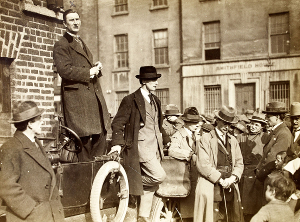
Oscar Traynor Leads Anti-Treaty IRA Occupation of O’Connell Street

On June 29, 1922, during the Irish Civil War, Oscar Traynor leads Anti-Treaty members of the Irish Republican Army‘s (IRA) 1st Dublin Brigade to occupy O’Connell Street in order to help the Four Courts garrison. His men also take up positions in York Street, South Circular Road, Capel Street, Parnell Square, and Dolphin’s Barn.

Traynor is an Irish politician and republican born into a strongly nationalist family in Dublin on March 21, 1886. He serves in a number of cabinet positions, most notably as the country’s longest-serving Minister for Defence. He is educated by the Christian Brothers in Dublin. In 1899 he is apprenticed to John Long, a famous woodcarver. As a young man he is a noted footballer and tours Europe as a goalkeeper with Belfast Celtic F.C. whom he plays with from 1910 to 1912.

Traynor joins the Irish Volunteers and takes part in the Easter Rising in 1916, following which he is interned in Wales. During the Irish War of Independence, he is brigadier of the Dublin Brigade of the Irish Republican Army. He leads the attack on The Custom House in 1921 and an ambush on the West Kent Regiment at Claude Road, Drumcondra on June 16, 1921, when the Thompson submachine gun is fired for the first time in action. When the Irish Civil War breaks out in June 1922, Traynor takes the republican side.

The Dublin Brigade is split however, with many of its members following Michael Collins in taking the pro-Treaty side. On June 29, 1922, Traynor and his supporters occupy O’Connell Street in an attempt to help the republicans who have occupied the Four Courts but are under attack by Free State forces. Traynor and his men hold out for a week of street fighting before making their escape. He organises guerilla activity in south Dublin and County Wicklow, before being captured by Free State troops in September. He is then imprisoned for the remainder of the war.

On March 11, 1925, Traynor is elected to Dáil Éireann in a by-election as a Sinn Féin Teachta Dála (TD) for the Dublin North constituency, though he does not take his seat due to the abstentionist policy of Sinn Féin. He is re-elected as one of eight members for Dublin North in the June 1927 Irish general election but just one of six Sinn Féin TDs. Once again, he does not take his seat. He does not contest the second general election called that year but declares his support for Fianna Fáil. He stands again in the 1932 general election and is elected as a Fianna Fáil TD for Dublin North.

In 1936 Traynor is first appointed to the Cabinet as Minister for Posts and Telegraphs. In September 1939 he is appointed Minister for Defence and holds the portfolio until February 1948. In 1948 he becomes President of the Football Association of Ireland, a position he holds until his death. He serves as Minister for Defence in several Fianna Fáil governments and as Minister for Justice, where he is undermined by his junior minister, and later Taoiseach, Charles Haughey, before he retires in 1961.

Oscar Traynor dies on December 15, 1963, in Dublin at the age of seventy-seven. He has a road named in his memory on the Coolock to Santry stretch in North Dublin.

(Pictured: Oscar Traynor in Dublin in July 1922)


Leave a comment

Mary Robinson Elected First Woman President of the Republic

mary-robinson-1

Mary Robinson becomes the first woman to be elected President of the Republic of Ireland on November 7, 1990. She becomes the first Labour Party candidate, the first woman, and the first non-Fianna Fáil candidate in the history of contested presidential elections to win the presidency.

Brian Lenihan, the Tánaiste and Minister for Defence is chosen by Fianna Fáil as their candidate, though he faces a late challenge for the party nomination from another senior minister, John P. Wilson, TD. Lenihan is popular and widely seen as humorous and intelligent. He has delivered liberal policy reform (relaxed censorship in the 1960s) and is seen as a near certainty to win the presidency.

Fine Gael, after trying and failing to get former Taoiseach Garret FitzGerald and former Tánaiste Peter Barry to run, ultimately nominate the former civil rights campaigner and Social Democratic and Labour Party (SDLP) member Austin Currie. Currie is elected to Dáil Éireann in the 1989 general election and has been a minister in Brian Faulkner‘s power-sharing executive in Northern Ireland from 1973–1974. However, Currie has little experience in the politics of the Republic and is widely seen as the party’s last choice, nominated only when no one else is available.

The Labour Party lets it be known that it would for the first time run a candidate. Along with the Workers’ Party, Labour nominates the independent candidate Mary Robinson, SC, a former Labour Party member and senator, and liberal campaigner. Robinson is a former Reid Professor of Law in the Trinity College, Dublin. She is previously involved in the Campaign for Homosexual Law Reform and the campaign to save Wood Quay.

Lenihan enters the race as odds-on favourite. No Fianna Fáil candidate has ever lost a presidential election. However, Lenihan is derailed when he confirms in an on-the-record interview with freelance journalist and academic researcher Jim Duffy that he has been involved in controversial attempts to pressurise the President, Patrick Hillery, over a controversial parliamentary dissolution in 1982. As a result of the contrast between his public denials during the campaign and his confirmation during an earlier interview recorded in May, he is dismissed from the Irish government.

At this point a cabinet colleague, Pádraig Flynn, launches a controversial personal attack on Mary Robinson “as a wife and mother,” an attack that is itself attacked in response as “disgraceful” on live radio by Michael McDowell, a senior member of the Progressive Democrats, then in coalition with Fianna Fáil and up to that point supporting Lenihan’s campaign. Flynn’s attack is a fatal blow to Lenihan’s campaign, causing many female supporters of Lenihan to vote for Robinson in a gesture of support.

Lenihan nonetheless receives a plurality of first-choice votes. Mary Robinson beats Austin Currie, forcing Fine Gael’s candidate into third place. Under Ireland’s system of single transferable vote, Robinson receives over 75% of the transfers when Austin Currie is eliminated, beating Lenihan into second place and becoming the seventh President of Ireland.

While the role of the presidency in day-to-day politics is a very limited one, the Robinson presidency is regarded by many observers as a watershed in Irish society, symbolising the shift away from the conservative ultra-Catholic male-dominated Ireland which existed up until the end of the 1980s to the more liberal society symbolised by Robinson.

Robinson is generally credited with raising the profile of the office of president, which has been considered little more than an honorary figurehead position under her predecessors. Prior to Mary Robinson’s presidency it was not unusual to hear commentators advocating the abolition of the office of president, a viewpoint that is almost never advanced nowadays.