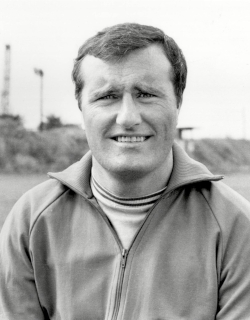
While at West Ham, Cantwell features in the London XI side that competes in the 1955–58 Inter-Cities Fairs Cup final on May 1, 1958. He captains the Hammers to winning the Division Two championship in the 1957–58 season thereby leading the club into the topflight for the first time since 1932.
In November 1960, Cantwell joins Manchester United for £29,500 which at the time is a record for a full-back. He helps the club win the 1965 and 1967 league titles and captains United when winning the 1963 FA Cup Final – just as his fellow countryman Johnny Carey had done in United’s previous FA Cup win fifteen years earlier.
During his International career (1953-67), Cantwell wins 36 full International caps for the Republic of Ireland, typically playing at left full-back and on several occasions at centre-forward. He makes his debut against Luxembourg in October 1953, with his final appearance coming away to Turkey in February 1967. He scores fourteen goals including five from penalties and also captains the Republic on several occasions including a match against England at Wembley Stadium.
In his first managerial role at Coventry City, Cantwell has the onerous task of following Jimmy Hill who had taken the club into the First Division for the first time in their history. He narrowly keeps the Sky Blues in the top in his first two seasons before taking them to a sixth-place finish in 1969–70, earning them qualification for the Inter-Cities Fairs Cup (a year before it is replaced by the UEFA Cup).
Cantwell returns to Peterborough on November 19, 1986, for a second stint as manager, remaining in this role until he becomes general manager on July 12, 1988. He is general manager at London Road for a year until he quits football to become licensee of the New Inn at Peterborough, where he remains for ten years until he retires in 1999. He also is landlord of the Bull and Swan in Stamford, Lincolnshire.
Cantwell also plays cricket for Cork Bohemians Cricket Club and Ireland as a left-handed batsman and a right-arm medium bowler. He plays five times for Ireland, making his debut in what is his sole first-class match versus Scotland at Edinburgh in 1956, scoring 31 and 17. His last match for Ireland is against Lancashire in July 1959.
Cantwell dies from cancer at Addenbrooke’s Hospital, Cambridge, not far from his home in Peterborough, on September 8, 2005. He is survived by his wife Maggie, a native of Belfast, and two daughters, Liz and Kate. A 22-year-old son, John Robert, is killed in a car crash thirteen years earlier.
Cantwell’s former teams each hold a moment of silence for him before their next matches.
Margaret Brady is born to Patrick Brady, a coal merchant whose family are from County Meath, and Brigid Brady (née Savage) of Oldtown, Dublin. She is baptised in St. Lawrence O’Toole’s parish. At the time, her parents are living at 1 Clarence Street. She has three known siblings and is educated by the Sisters of St. Vincent de Paul. She is employed as a stationery shop assistant where she meets her future husband, James Pearse.
In 1877, she marries James Pearse at St. Agatha’s Church, off the North Strand. James is born in Bloomsbury, Middlesex, on December 8, 1839, and later lives in Birmingham. He comes to Ireland to work as a sculptor in the late 1850s with his first wife, Emily Susanna Fox, who dies in 1876. They have four children together. The first three children are Margaret Mary (born on August 4, 1878), Patrick (born on November 10, 1879) and William (born on November 15, 1881). All three children are born while the family lives in 27 Great Brunswick Street. Their youngest child, Mary Brigid, is born on September 29, 1888, by which time the family has moved to Newbridge Avenue, Sandymount. Pearse’s aunt, Margaret Brady, an Irish speaker, is a frequent visitor to the family home and encourages the children’s interest in the Irish language and culture. Her husband dies in 1900. Pearse does not permit her children to play with other children, however, she supports her children in all their aspirations. She has a very strong relationship and consequent effect on her eldest son, Patrick, who founds St. Enda’s School in 1908 and is the headmaster up until the time of his execution. She takes over the responsibility of Housekeeper at the school.
Pearse supports her sons’ political beliefs. After their execution, she wishes to maintain their legacy and becomes involved in political life. She joins Sinn Féin after the Rising and gives support and endorsement to candidates during the 1918 Westminster election. During the 1920 Poor Law Elections for the Rathmines area of Dublin, she stands as a Sinn Féin candidate and is elected on the first count. She is elected to Dáil Éireann as a Sinn Féin Teachta Dála (TD) for the Dublin County constituency at the 1921 Irish elections.
Pearse strongly opposes the Anglo-Irish Treaty, as do all the female TDs. She states during the Treaty debate that:
“I rise to support the motion of our President for the rejection of the Treaty. My reasons for doing so are various, but my first reason for doing so I would like to explain here today is my son’s account. It has been said here on several occasions that Patrick Pearse would have accepted this Treaty. I deny it. As his mother I deny it, and on his account, I will not accept it.”
Later she continues in a similar vein:
“Always we had to be on the alert. But even the Black and Tans alone would not frighten me as much as if I accepted this Treaty; because I feel in my heart – and I would not say it only I feel it – that the ghosts of my sons would haunt me.”
Following the ratification of the Treaty Pearse leaves the Dáil with the other anti-Treaty deputies. She is defeated at the 1922 Irish general election. She supports those who oppose the Treaty during the Irish Civil War and continues to be a member of Sinn Féin until 1926. In 1926 she leaves the party conference with Éamon de Valera and becomes a founder member of Fianna Fáil. She never stands for election again.
At the launch of The Irish Press newspaper, Pearse is asked to press the button to start the printers rolling. At many public occasions she states that were her sons alive they too would have joined Fianna Fáil. Accordingly, Patrick Pearse is recognised as the spiritual figurehead of the party to this day.
After Patrick’s death, the responsibility for running the school falls to Pearse and her two daughters. As Patrick Pearse had died without a will, the school is left in a precarious financial position. In May 1924, when she is aged 70, she undertakes a trip to the United States to raise funds for the school, alongside showing support for Éamon de Valera and the Irish Republic. At an event in Brooklyn on May 19, 1924, when referencing the execution of her two sons, she declares herself the “proudest mother in Ireland.” She also states that Michael Collins had attempted to “bribe” her with an offer to subsidise the school, which she refused. During a meeting in Seattle on August 11, 1924, she again discusses her sons and how she believes “the best way to honour their memory was to carry on their work for Ireland.” She raises over $10,000 in donations for the school during the trip. Notwithstanding her fundraising activities, St. Enda’s continues to decline and eventually closes in 1935. Great Brunswick Street, where she and the Pearse family originally lived, is renamed Pearse Street in 1920 by a resolution passed at the Dublin City Council meeting.
Pearse dies on April 22, 1932. She is honoured with a large state funeral and a motion is passed at the meeting of Dublin City Council expressing sympathy with the Pearse family. On April 26, 1932, sizeable crowds pay their respects as her funeral procession makes its way through the streets of Dublin. At the General Post Office (GPO), where Patrick and William fought during the Easter Rising, the funeral cortege pauses for a minute of silence before proceeding to Glasnevin Cemetery. Éamon de Valera gives an oration as she is laid to rest, which praises her inspiring courage, charity and cheerfulness during the years after her son’s death.
After Pearse’s death, her daughter, Mary Margaret, continues to reside at St. Enda’s. She also joins Fianna Fáil, and serves as a TD from 1933 to 1937 and later serves in Seanad Éireann as a Senator from 1938 until her death in 1968. Upon her death, as per her mother’s request, she passes St. Enda’s on to the people of Ireland.


 seamus dubhghaill