seamus dubhghaill

Promoting Irish Culture and History from Little Rock, Arkansas, USA


Leave a comment

Birth of Patrick Guiney, Irish Nationalist Politician

Patrick Guiney, Irish Nationalist politician, agrarian agitator and Member of Parliament (MP) in the House of Commons of the United Kingdom of Great Britain and Ireland, is born in NewmarketCounty Cork, on March 16, 1867.

Guiney is the eldest son of Timothy Guiney, a shopkeeper and later clerk of Kanturk poor law union, and Ellen Carver. He is educated at St. Patrick’s Monastery, MountrathCounty Laois. He serves three terms of imprisonment for activity in the Land War and later Plan of Campaign movement during the 1880s under the Coercion Act. He becomes a farmer and serves as councillor for Newmarket and on the Cork County Council (1908–11) as well as Chair of Newmarket Agricultural Society, Newmarket Gaelic League and Newmarket Old-Age Pensions Committee.

With strong family connection in the North Cork area, Guiney builds a personal political base as a Land and Labour Association activist, skilled in organising land agitation and deploying it at a local level to make landlords agree to sales terms under the Land Purchase (Ireland) Act 1903. A supporter of William O’Brien‘s All-for-Ireland League, he is elected MP for North Cork in the January 1910 United Kingdom general election. He is re-elected in the following December 1910 United Kingdom general election, when he also contests (unsuccessfully) for East Kerry.

Guiney marries Nanette O’Connor of BallycloghMallow, County Cork, in 1895.

Guiney dies at his home in Newmarket on October 12, 1913, after contracting pneumonia and is buried in Clonfert Cemetery, Newmarket.

Guiney’s brother, John, a solicitor in Kanturk, is returned unopposed for his seat in the resulting 1913 North Cork by-election. They are uncles of Philip BurtonFine Gael TD for Cork North-East from 1961 to 1969, and member of the Seanad from 1973 to 1977.

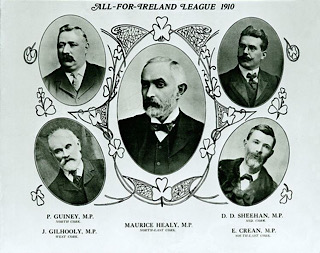
(Pictured: All-for-Ireland League group portrait of five of its Members of Parliament, in the “Cork Free Press”, 30 July 1910. These are: Patrick Guiney (North Cork), James Gilhooly (West Cork), Maurice Healy (North-east Cork), D. D. Sheehan (Mid Cork), and Eugene Crean (South-east Cork))


Leave a comment

Death of Helen Maybury Roe, Librarian & Antiquarian

Helen Maybury Roe, Irish librarian and antiquarian and a champion of medieval Irish art and iconography, dies on May 28, 1988, at Grove Nursing Home in Killiney, County Dublin.

Born on December 18, 1895, Roe is the daughter of William Ernest Roe and Anne Lambert Sheilds of Mountrath, County Laois. Her grandfather is Francis Henry Sheilds of Parsonstown (now Birr, County Offaly), owner of the King’s County Chronicle. She is sent first to the local primary school and then to the Preston School in Abbeyleix. Although she attends Trinity College Dublin (TCD), she does not begin her career due to the outbreak of World War I. She joins the St. John’s Ambulance Brigade and serves at the Cambridge Military Hospital and at Aldershot Barracks. In the immediate aftermath, she continues her medical career with the Military Hospital in Bray, County Wicklow. She also spends time touring in Europe visiting museums and beginning her appreciation for medieval art. She is raised Protestant and has done her duty as part of the aristocracy by serving in the war. But the soldiers treat her as Irish and abuse her especially during the Easter Rising of 1916. The result is that she supports nationalism from that point forward. She goes back to TCD and completes her degree in modern languages in 1921. She finally completes her MA in 1924 and begins a teaching career. She spends time working in the Royal School, Dungannon, and Alexandra College, Milltown, Dublin.

In 1926, Roe’s parents need her, and she returns home. She then becomes the County Librarian in Laois. While working as a librarian she is able to study further and, as a rare person with a car, she tours sites and visits schools. One result of her presentations to schools is to inspire Ireland’s first female archaeologist, Ellen Prendergast. In 1940, she retires from the library and moves to Dublin where she is able to buy a house and garden. Apart from her antiquarian work, she is a regular supporter of charities and is honorary secretary of The Queen’s County Protestant Orphan’s Society and actively involved in The Dublin University Mission to Chota Nagpur, India.

Roe becomes a regular contributor to various journals and newspapers including Journal of the Royal Society of Antiquaries of Ireland, An Leabharlann, Béaloideas, Seanchas Ard Mhacha, Carloviana, the The Irish Press and the Leinster Express. From 1965 until 1968 she serves as the president of the Royal Society of Antiquaries of Ireland, the first woman to be elected to the position. She is elected to be a member of the Royal Irish Academy in 1984. She continues touring and lecturing into her nineties.

Roe lives at Santry, Dublin, and later at Oak House, Sussex Road, Dublin. She dies on May 28, 1988, at Grove Nursing Home, Killiney, County Dublin, and is buried beside her parents at St. Peter’s Churchyard, Mountrath, County Laois.

The Royal Society of Antiquaries of Ireland have an annual lecture in her honour and have named one of their lecture rooms after her.