seamus dubhghaill

Promoting Irish Culture and History from Little Rock, Arkansas, USA


Leave a comment

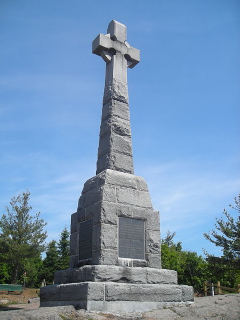
Great Famine Monument Dedicated at Grosse Île, Quebec

On August 15, 1909, the Ancient Order of Hibernians dedicate a monument to victims of the Great Famine at Grosse Île, Quebec, Canada.

Grosse Île, in the Gulf of Saint Lawrence, acts as a quarantine station for Irish people fleeing the Great Famine between 1845 and 1849. It is believed that over 3,000 Irish people died on the island and over 5,000 are buried in the cemetery there.

In 1847, 100,000 Irish people travel to Grosse Île to escape starvation, unaware of the hardships they would encounter upon arrival. The first coffin ship – named for their crowded and deadly conditions – arrives on May 17, 1847, the ice still an inch thick on the river. Of that ship’s 241 passengers, 84 are stricken with fever and 9 have died on board. With the hospital only equipped for 150 cases of fever, the situation quickly spins out of control. More and more ships arrive at Grosse Île each day, sometimes lining up for miles down the St. Lawrence River throughout the summer. On these coffin ships the number of passengers stricken by fever increases exponentially.

Between 1832 and 1937, Grosse Île’s term of operation, the official register lists 7,480 burials on the island. In 1847 alone, 5,424 burials take place, the majority being Irish immigrants. In that same year, over 5,000 Irish people on ships bound for Canada are listed as having been buried at sea.

When the monument is unveiled in 1909, more than 60 years have passed since the more than 5,000 Irish men, women, and children were buried on the island, but the ancestors and relatives of those victims have not forgotten them. Through the hard work of the Ancient Order of Hibernians, thousands of dollars are collected to erect a fitting memorial to those innocent victims of man’s inhumanity to man. The symbol they choose to use is a Celtic cross. Designed by Jeremiah Gallagher, a member of the Ancient Order of Hibernians in Quebec, the cross is carved from granite and stands 48 feet high atop its pedestal.

The monument bears an inscription in Irish commemorating the victims of the epidemic and condemning colonial rule. In English, it reads: “Children of the Gael died in their thousands on this island having fled from the laws of foreign tyrants and an artificial famine in the years 1847-48. God’s blessing on them. Let this monument be a token and honor from the Gaels of America. God Save Ireland.”

To ensure that no one traveling up or down the St. Lawrence River fails to see the monument, it is placed on Telegraph Hill, the highest point on the island. The monument is unveiled by the Papal Legate before a crowd of 9,000, including several hundred French Canadians, some perhaps from families that had adopted one or more of the over 600 Irish orphans whose parents were left behind on Gross Île. The cross stands as a beacon to those who pass up and down the busy waterway, reminding them not only of the tragedy that once happened on that island but also of the ultimate triumph of those who survived.

Today, the island is a National Historic Site that serves as a Famine memorial. It is dedicated in 1996 after a four-year-long campaign to protect the mass gravesite.


Leave a comment

The Battle of Ridgeway

battle-of-ridgeway

The Battle of Ridgeway, sometimes called the Battle of Lime Ridge or Limestone Ridge, is fought on June 2, 1866, in the vicinity of the town of Fort Erie across the Niagara River from Buffalo, New York between Canadian troops and an irregular army of Irish American invaders, the Fenians.

The Fenian insurgents, led by Brigadier General John O’Neill, a former Union cavalry commander who had specialized in anti-guerrilla warfare in Ohio, secures boats and transfers some 800 men across the Niagara River, landing above Fort Erie, before dawn on June 1, 1866. An additional 200–400 Fenians and supplies cross later in the morning and early afternoon until the U.S. Navy gunboat, the USS Michigan, begins intercepting Fenian barges at 2:20 PM.

O’Neill spends the first day trying to rally the local citizenry to the Fenian cause and to commandeer supplies for his mission, but his force is plagued by desertions almost from the outset. An additional column of 200 Fenians join his group, bringing his total strength at Ridgeway to at least 650 men.

Meanwhile, the British are mobilizing both local Canadian militia and British garrison troops to defend against the impending invasion of Canada. The Fenians night-march north across Black Creek through a cedar swamp, then turn inland on Ridge Road on the morning of June 2, taking up a defensive position on Limestone Ridge near the present Canadian town of Ridgeway. There, they clash with 850 advancing Canadian militia commanded by Lieutenant-Colonel Alfred Booker of the 13th Battalion.

In the first hour of the battle, the Canadians appear to prevail, driving Fenian skirmishers back across Bertie Road. Then the tide turns, and to this day, it is not clear what causes the impending chaos. O’Neill, observing the chaos breaking out in the Canadian ranks, quickly orders a bayonet charge that completely routs the inexperienced Canadians. The Fenians take and briefly hold the town of Ridgeway. Then, expecting to be overwhelmed by British reinforcements, they quickly turn back to Fort Erie where they fight a second battle, the Battle of Fort Erie, against a small but determined detachment of Canadians holding the town.

The Canadian loss is nine killed on the field, four dying of wounds in the immediate days following the battle, 22 dying of wounds or disease later and 37 are wounded, some severely enough to require amputation of their limbs. O’Neill says that four or five of his men are killed, but Canadians claim to have found six Fenian bodies on the field. The relatively low casualty figures make this an interesting battle for proponents of theories about soldiers’ reluctance to shoot to kill but might also be accounted for by the fact that the Fenians had deployed only their skirmishers in an attempt to lure the Canadians towards their main force which did not advance until the last minutes of the battle when they launched a bayonet attack that broke Canadian lines.

The battlefield is designated a National Historic Site of Canada in 1921 and is the last battle fought in the province of Ontario against a foreign invasion. The action at Ridgeway has the distinction of being the only armed victory for the cause of Irish independence between the Irish Rebellion of 1798 and the Irish War of Independence (1919).

(Pictured: An 1869 illustration of the battle: Charge of General O’Neill’s Fenians upon the Canadian troops, causing their rout.)