seamus dubhghaill

Promoting Irish Culture and History from Little Rock, Arkansas, USA


Leave a comment

Birth of Valentine Browne Lawless, 2nd Baron Cloncurry

Valentine Browne Lawless, 2nd Baron Cloncurry, Irish peer, politician and landowner, is born in Merrion Square in Dublin on August 19, 1773.

Lawless is the only surviving son of Nicholas Lawless, wool merchant, brewer, and banker, who becomes 1st Baron Cloncurry in 1789, and Margaret Lawless (née Browne), only daughter and heiress of Valentine Browne of Mount Browne, County Limerick. He is educated privately at Portarlington, Queen’s County (now County Laois), and at Blackrock, County Dublin. He enters Trinity College Dublin (TCD) in 1789, graduating BA in 1792. After completing a tour of Europe (1792–95) he returns to Ireland, where he joins the Society of United Irishmen and the loyalist yeomanry. Pressurized by his father, he decides to study law, and is at Middle Temple from 1795 to 1798. He later claims that at a dinner party in the spring of 1797 he hears the prime minister, William Pitt, discuss his plans for a legislative union with Ireland, prompting him to write an anti-union pamphlet in response. Like many of the claims in his published recollections, the story is unreliable.

During 1797 Lawless helps Arthur O’Connor form his United Irishman newspaper The Press, and Leonard McNally informs Dublin Castle that Lawless is its principal shareholder. In October 1797 Lawless attends a meeting of the executive directory of the United Irishmen, of which he is elected a member. Throughout this period and after his return to London he is carefully watched by the British secret service. His friendship with O’Connor, and the fact that he provides funds for Fr. James Coigly, arouse deep suspicion. After the outbreak of open rebellion in Ireland he is arrested at his lodgings in Pall Mall on May 31, 1798, on suspicion of high treason, and imprisoned for six weeks in the Tower of London. Arabella Jefferyes, sister of the Earl of Clare, apparently tries to extort money from Lawless in return for pleading his case to the Duke of Portland. He refuses the offer. On his release he tours England on horseback but is rearrested on April 14, 1799, and held until March 1801. His father votes for the Act of Union, hoping to secure his son’s release, and dies on August 28, 1799. Lawless succeeds him as 2nd Baron Cloncurry. His grandfather and his fiancée, Mary Ryal, also die while he is imprisoned.

Embittered by his experience, Lawless tours the Continent from 1801 to 1805 before returning to his family estate at Lyons Hill, Ardclough, County Kildare. Throwing himself into improving his estates and into local concerns, he founds the County Kildare Farming Society in 1814. He is also involved in canal developments and agricultural improvements in the country. Opposed to the rural constabulary bill of 1822, he supports Catholic emancipation and the attempts of Daniel O’Connell to repeal the Act of Union. He breaks with O’Connell in the 1830s when his friend, Henry Paget, 1st Marquess of Anglesey, is viceroy, because he believes repeal can now be achieved through official means. The rift is never healed.

In 1831, Lawless is admitted to the Privy Council of Ireland (PC) and an English peer but rarely attends the House of Lords. Involved in anti-tithe campaigns, he retires from politics in 1840. Travelling on the Continent in 1841 and 1842, he returns to defend O’Connell’s planned Clontarf meeting in the privy council but refuses to attend any further meetings after his advice on dealing with the Great Famine is ignored in 1846. In 1849 he publishes his personal reminiscences, which appear to have been ghost-written.

Lawless’s health begins to fail in 1851. He dies at the older family home, Maretimo House, Blackrock, on October 28, 1853, and is buried in the family vault at Lyons Hill.

Lawless first marries Elizabeth Georgiana, youngest daughter of Lieutenant-General Charles Morgan, at Rome on April 16, 1803. They have one son and one daughter. The marriage ends in divorce in 1811 after her adultery with Sir John Piers. In 1811, he then marries Emily, daughter of Archibald Douglas of England, and widow of Joseph Leeson. They have two sons and a daughter. The elder son, Edward, succeeds as 3rd Baron Cloncurry. He commits suicide in 1869 by throwing himself out of a third-floor window at Lyons Hill. The younger, Cecil-John, is an MP, but catches a chill at his father’s funeral and dies on November 5, 1853.

(From: “Lawless, Valentine Browne” by Patrick M. Geoghegan, Dictionary of Irish Biography, http://www.dib.ie, October 2009 | Pictured: Lyons House, Lyons Hill, Ardclough, County Kildare)
Leave a comment

Birth of Robert Boyle, Philosopher, Writer & Chemist

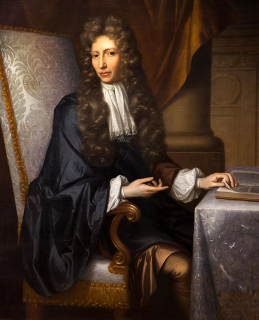
Robert Boyle, Anglo-Irish natural philosopher, theological writer, chemist, physicist, inventor and a preeminent figure of 17th-century intellectual culture, is born on January 25, 1627, at Lismore Castle, in County Waterford.

At age eight, Boyle begins his formal education at Eton College, where his studious nature quickly becomes apparent. In 1639 he and his brother Francis embark on a grand tour of the continent together with their tutor Isaac Marcombes. In 1642, owing to the Irish rebellion, Francis returns home while Robert remains with his tutor in Geneva and pursues further studies.

Boyle returns to England in 1644, where he takes up residence at his hereditary estate of Stalbridge in Dorset. There he begins a literary career writing ethical and devotional tracts, some of which employ stylistic and rhetorical models drawn from French popular literature, especially romance writings. In 1649 he begins investigating nature via scientific experimentation. From 1647 until the mid-1650s, he remains in close contact with a group of natural philosophers and social reformers gathered around the intelligencer Samuel Hartlib. This group, the Hartlib Circle, includes several chemists who heighten his interest in experimental chemistry.

Boyle spends much of 1652–1654 in Ireland overseeing his hereditary lands and performing some anatomic dissections. In 1654 he is invited to Oxford, and he takes up residence at the university until 1668. In Oxford he is exposed to the latest developments in natural philosophy and becomes associated with a group of notable natural philosophers and physicians, including John Wilkins, Christopher Wren, and John Locke. These individuals, together with a few others, form the “Experimental Philosophy Club.” Much of Boyle’s best known work dates from this period.

In 1659 Boyle and Robert Hooke, the clever inventor and subsequent curator of experiments for the Royal Society, complete the construction of their famous air pump and use it to study pneumatics. Their resultant discoveries regarding air pressure and the vacuum appear in Boyle’s first scientific publication, New Experiments Physico-Mechanicall, Touching the Spring of the Air and Its Effects (1660). Boyle and Hooke discover several physical characteristics of air, including its role in combustion, respiration, and the transmission of sound. One of their findings, published in 1662, later becomes known as “Boyle’s law.” This law expresses the inverse relationship that exists between the pressure and volume of a gas, and it is determined by measuring the volume occupied by a constant quantity of air when compressed by differing weights of mercury.

Among Boyle’s most influential writings are The Sceptical Chymist (1661), which assails the then-current Aristotelian and especially Paracelsian notions about the composition of matter and methods of chemical analysis, and the Origine of Formes and Qualities (1666), which uses chemical phenomena to support the corpuscularian hypothesis. He argues so strongly for the need of applying the principles and methods of chemistry to the study of the natural world and to medicine that he later gains the appellation of the “father of chemistry.”

Boyle is a devout and pious Anglican who keenly champions his faith. He sponsors educational and missionary activities and writes a number of theological treatises. He is deeply concerned about the widespread perception that irreligion and atheism are on the rise, and he strives to demonstrate ways in which science and religion are mutually supportive. For Boyle, studying nature as a product of God’s handiwork is an inherently religious duty. He argues that this method of study would, in return, illuminate God’s omnipresence and goodness, thereby enhancing a scientist’s understanding of the divine. The Christian Virtuoso (1690) summarizes these views and may be seen as a manifesto of his own life as the model of a Christian scientist.

In 1668 Boyle leaves Oxford and takes up residence with his sister Katherine Jones, Vicountess Ranelagh, in her house on Pall Mall in London. There he sets up an active laboratory, employs assistants, receives visitors, and publishes at least one book nearly every year. Living in London also provides him the opportunity to participate actively in the Royal Society.

Boyle is a genial man who achieves both national and international renown during his lifetime. He is offered the presidency of the Royal Society and the episcopacy but declines both. Throughout his adult life, he is sickly, suffering from weak eyes and hands, recurring illnesses, and one or more strokes. He dies in London at age 64 on December 31, 1691, after a short illness exacerbated by his grief over Katherine’s death a week earlier. He leaves his papers to the Royal Society and a bequest for establishing a series of lectures in defense of Christianity. These lectures, now known as the Boyle Lectures, continue to this day.


Leave a comment

Death of Robert Boyle, Philosopher & Writer

robert-boyle

Robert Boyle, Anglo-Irish natural philosopher, theological writer, chemist, physicist, inventor and a preeminent figure of 17th-century intellectual culture, dies on December 31, 1691, in London.

Boyle is born on January 25, 1627, at Lismore Castle, in County Waterford. At age eight, he begins his formal education at Eton College, where his studious nature quickly becomes apparent. In 1639 he and his brother Francis embark on a grand tour of the continent together with their tutor Isaac Marcombes. In 1642, owing to the Irish rebellion, Francis returns home while Robert remains with his tutor in Geneva and pursues further studies.

Boyle returns to England in 1644, where he takes up residence at his hereditary estate of Stalbridge in Dorset. There he begins a literary career writing ethical and devotional tracts, some of which employ stylistic and rhetorical models drawn from French popular literature, especially romance writings. In 1649 he begins investigating nature via scientific experimentation. From 1647 until the mid-1650s, he remains in close contact with a group of natural philosophers and social reformers gathered around the intelligencer Samuel Hartlib. This group, the Hartlib Circle, includes several chemists who heighten his interest in experimental chemistry.

Boyle spends much of 1652–1654 in Ireland overseeing his hereditary lands and performing some anatomic dissections. In 1654 he is invited to Oxford, and he takes up residence at the university until 1668. In Oxford he is exposed to the latest developments in natural philosophy and becomes associated with a group of notable natural philosophers and physicians, including John Wilkins, Christopher Wren, and John Locke. These individuals, together with a few others, form the “Experimental Philosophy Club.” Much of Boyle’s best known work dates from this period.

In 1659 Boyle and Robert Hooke, the clever inventor and subsequent curator of experiments for the Royal Society, complete the construction of their famous air pump and use it to study pneumatics. Their resultant discoveries regarding air pressure and the vacuum appear in Boyle’s first scientific publication, New Experiments Physico-Mechanicall, Touching the Spring of the Air and Its Effects (1660). Boyle and Hooke discover several physical characteristics of air, including its role in combustion, respiration, and the transmission of sound. One of their findings, published in 1662, later becomes known as “Boyle’s law.” This law expresses the inverse relationship that exists between the pressure and volume of a gas, and it is determined by measuring the volume occupied by a constant quantity of air when compressed by differing weights of mercury.

Among Boyle’s most influential writings are The Sceptical Chymist (1661), which assails the then-current Aristotelian and especially Paracelsian notions about the composition of matter and methods of chemical analysis, and the Origine of Formes and Qualities (1666), which uses chemical phenomena to support the corpuscularian hypothesis. He argues so strongly for the need of applying the principles and methods of chemistry to the study of the natural world and to medicine that he later gains the appellation of the “father of chemistry.”

Boyle is a devout and pious Anglican who keenly champions his faith. He sponsors educational and missionary activities and writes a number of theological treatises. He is deeply concerned about the widespread perception that irreligion and atheism are on the rise, and he strives to demonstrate ways in which science and religion are mutually supportive. For Boyle, studying nature as a product of God’s handiwork is an inherently religious duty. He argues that this method of study would, in return, illuminate God’s omnipresence and goodness, thereby enhancing a scientist’s understanding of the divine. The Christian Virtuoso (1690) summarizes these views and may be seen as a manifesto of his own life as the model of a Christian scientist.

In 1668 Boyle leaves Oxford and takes up residence with his sister Katherine Jones, Vicountess Ranelagh, in her house on Pall Mall in London. There he sets up an active laboratory, employs assistants, receives visitors, and publishes at least one book nearly every year. Living in London also provides him the opportunity to participate actively in the Royal Society.

Boyle is a genial man who achieves both national and international renown during his lifetime. He is offered the presidency of the Royal Society and the episcopacy but declines both. Throughout his adult life, he is sickly, suffering from weak eyes and hands, recurring illnesses, and one or more strokes. He dies at age 64 on December 31, 1691, after a short illness exacerbated by his grief over Katherine’s death a week earlier. He leaves his papers to the Royal Society and a bequest for establishing a series of lectures in defense of Christianity. These lectures, now known as the Boyle Lectures, continue to this day.