seamus dubhghaill

Promoting Irish Culture and History from Little Rock, Arkansas, USA


Leave a comment

Irish Battalion of St. Patrick Fights Piedmontese Force at Spoleto

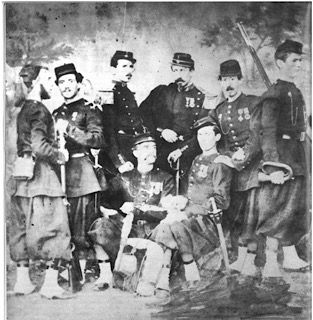
On September 17, 1860, units of the Irish Battalion of St. Patrick of the Papal army, commanded by Captain Myles O’Reilly from County Louth, fights a Piedmontese force under General Brignone at Spoleto, Italy.

By 1860, the Papal States are under threat from King Victor Emmanuel II of Piedmont and Giuseppe Garibaldi’s “Redshirts” during the Wars of Italian Unification. Pope Pius IX has called for Catholic volunteers from Europe, and within weeks over 1,000 Irishmen have enlisted, forming the Irish Battalion. They are poorly equipped and inexperienced, but their morale is high.

The Irish are stationed at Spoleto, a walled city south of Florence with the fortress of Rocca on a hill. On September 16, Brignone’s forces arrive and demand surrender. O’Reilly refuses, and on the following day the Piedmontese launch an assault.

The Irish are tasked with defending the North Wall and the Gate House of the Castle Albornozian. The attackers endure prolonged artillery fire from the fortress walls. When the famed Bersaglieri advance, they are met with a withering musket and rifle fire from the Irish, halting the attack. The Irish hold their ground for fourteen hours under constant bombardment.

Despite their resistance, the bishop of Spoleto, alarmed by the destruction and loss of life, arranges a ceasefire. O’Reilly, nearly out of ammunition, sends a Papal representative to Brignone. Terms are agreed: the Irish can march out as prisoners, with officers retaining their swords.

Brignone praises O’Reilly as “both honourable and brave.” Each officer and enlisted man receives a Medaglia di Pro Petri Sede (“Medal for the Seat of Saint Peter”), and all are declared “meritorious of the Catholic Church, the Holy See and all human society.”

The battle is part of the short 1860 war in which the Papal army, including the Irish Battalion, fight at Ancona, Perugia, Spoleto, and Castelfidardo. Though ultimately defeated, the Irish earn high praise for their courage and discipline.

(Pictured: The Company of Saint Patrick in the Papal Army, 1860)


Leave a comment

Birth of Thomas Burke, Irish Dominican Preacher

thomas-nicholas-burke-statue

Thomas Nicholas Burke, Irish Dominican preacher, is born in Galway, County Galway on September 8, 1830.

Burke’s parents, though in moderate circumstances, gave him a good education. He studies at first under the care of the Patrician Brothers and is afterwards sent to a private school. An attack of typhoid fever when he is fourteen years old, and the famine year of 1847 have a sobering effect. Toward the end of that year, he asks to be received into the Order of Preachers and is sent to Perugia in Italy to make his novitiate. On December 29, he is clothed there in the habit of St. Dominic and receives the name of Thomas.

Shortly afterward Burke is sent to Rome to begin his studies at the College of St. Thomas, the future Pontifical University of Saint Thomas Aquinas, where he is a student of philosophy and theology. He passes thence to the Roman convent of Santa Sabina. His superiors send him, while yet a student, as novice-master to Woodchester, the novitiate of the resuscitated English Province. He is ordained into the priesthood on March 26, 1853. On August 3, 1854, he defends publicly the theses in universâ theologiâ. He is made lector at the College of St. Thomas in 1854.

Early in the following year Burke is recalled to Ireland to found the novitiate of the Irish Province at Tallaght, near Dublin. In 1859 he preaches his first notable sermon on “Church Music.” It immediately lifts him into fame.

Elected Prior of Tallaght in 1863, Burke goes to Rome the following year as Rector of the Dominican Convent of San Clemente and attracts great attention by his preaching. He returns to Ireland in 1867 and delivers his oration on Daniel O’Connell at Glasnevin before fifty thousand people.

Bishop Leahy takes him as his theologian to the First Vatican Council in 1870, and the following year he is sent as Visitor to the Dominican convents in America. He is besieged with invitations to preach and lecture. The seats are filled hours before he appears, and his audiences overflow the churches and halls in which he lectures. In New York City he delivers the discourses in refutation of the English historian James Anthony Froude.

In an eighteen-month period Burke gives four hundred lectures, exclusive of sermons, with the proceeds amounting to nearly $400,000. His mission is a triumph, but the triumph is dearly won. When he arrives in Ireland on March 7, 1873, he is spent and broken.

During the next decade Burke preaches in Ireland, England, and Scotland. He begins the erection of the church in Tallaght in 1883, and the following May preaches a series of sermons in the new Dominican church, London. In June he returns to Tallaght in a dying condition and preaches his last sermon in the Jesuit church, Dublin, in aid of the starving children of Donegal. A few days afterwards, on July 2, 1882, he dies. He is buried in the church of Tallaght, now a memorial to him.

(Pictured: Statue of Thomas Nicholas Burke by John Francis Kavanagh by Nimmo’s Pier in Galway)