seamus dubhghaill

Promoting Irish Culture and History from Little Rock, Arkansas, USA


Leave a comment

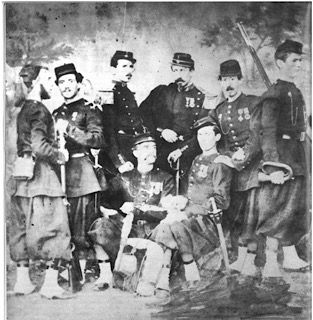
Irish Battalion of St. Patrick Fights Piedmontese Force at Spoleto

On September 17, 1860, units of the Irish Battalion of St. Patrick of the Papal army, commanded by Captain Myles O’Reilly from County Louth, fights a Piedmontese force under General Brignone at Spoleto, Italy.

By 1860, the Papal States are under threat from King Victor Emmanuel II of Piedmont and Giuseppe Garibaldi’s “Redshirts” during the Wars of Italian Unification. Pope Pius IX has called for Catholic volunteers from Europe, and within weeks over 1,000 Irishmen have enlisted, forming the Irish Battalion. They are poorly equipped and inexperienced, but their morale is high.

The Irish are stationed at Spoleto, a walled city south of Florence with the fortress of Rocca on a hill. On September 16, Brignone’s forces arrive and demand surrender. O’Reilly refuses, and on the following day the Piedmontese launch an assault.

The Irish are tasked with defending the North Wall and the Gate House of the Castle Albornozian. The attackers endure prolonged artillery fire from the fortress walls. When the famed Bersaglieri advance, they are met with a withering musket and rifle fire from the Irish, halting the attack. The Irish hold their ground for fourteen hours under constant bombardment.

Despite their resistance, the bishop of Spoleto, alarmed by the destruction and loss of life, arranges a ceasefire. O’Reilly, nearly out of ammunition, sends a Papal representative to Brignone. Terms are agreed: the Irish can march out as prisoners, with officers retaining their swords.

Brignone praises O’Reilly as “both honourable and brave.” Each officer and enlisted man receives a Medaglia di Pro Petri Sede (“Medal for the Seat of Saint Peter”), and all are declared “meritorious of the Catholic Church, the Holy See and all human society.”

The battle is part of the short 1860 war in which the Papal army, including the Irish Battalion, fight at Ancona, Perugia, Spoleto, and Castelfidardo. Though ultimately defeated, the Irish earn high praise for their courage and discipline.

(Pictured: The Company of Saint Patrick in the Papal Army, 1860)


Leave a comment

The Irish Brigade of France Fight in the Battle of Marsaglia

Units of the Irish Brigade of France fight in Italy at the Battle of Marsaglia, a battle in the Nine Years’ War, on October 4, 1693. The battle involves the French army of Marshal Nicolas Catinat against the army of the Grand Alliance, allies of William of Orange, under the Duke of Savoy, Victor Amadeus II of Sardinia.

Catinat, advancing from Fenestrelle and Susa to the relief Pinerolo, defended by René de Froulay, Comte de Tessé, and which the Duke of Savoy is besieging, takes up a position in formal order of battle north of the village of Marsaglia, near Orbassano. Here, on October 4, the Duke of Savoy attacks him with his entire army, front to front, but the greatly superior regimental efficiency of the French, and Catinat’s minute attention to details in arraying them, gives the new marshal a victory that is a worthy pendant to Neerwinden.

During the battle, Irish dragoons are reported to have “overthrown squadrons, sword in hand,” but elsewhere on the battlefield, Prince Eugene of Savoy overruns a French line and advances to the second line, held by Irish regiments. There Eugene’s advance is broken, and his troops are soon put to rout. The impetuous Irish then pursue without orders. Seeing this development, the French commander orders a general advance and the allied army breaks and runs. Official French reports speak of the “extreme valor” of the Irish that day.

The Piedmontese and their allies lose approximately 12,000 killed, wounded and prisoners, as against Catinat’s 1,800. Among the Irish killed in this great victory are Brigadier Francis O’Carroll of the dragoons and Colonel Daniel O’Brien, 4th Viscount Clare. One very young officer of the Irish Brigade who survives the fight is Lieutenant Peter Lacy.

Marsaglia is, if not the first, at any rate, one of the first, instances of a bayonet charge by a long deployed line of infantry. Hussars figure here for the first time in Western Europe. A regiment of them had been raised in 1692 from deserters from the Austrian service. It is also notable as one of the first major battles to see the new Irish Brigade in action for the French army.

(Pictured: Marshal Nicholas Catinat at the Battle of Marsaglia, October 4, 1693, painting by Eugène Devéria, 1837, Museum of the History of France)