seamus dubhghaill

Promoting Irish Culture and History from Little Rock, Arkansas, USA


Leave a comment

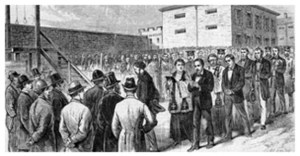
Execution of John Kehoe, the Last of the Molly Maguires

John “Black Jack” Kehoe, the last of the Molly Maguires, is hanged in Pottsville, Pennsylvania, on December 18, 1878.

The Molly Maguires is an Irish secret society that is allegedly responsible for some incidents of vigilante justice in the coalfields of eastern Pennsylvania. They defend their actions as attempts to protect exploited Irish American workers. They are, in fact, often regarded as one of the first organized labor groups.

In the first five years of the Great Famine in Ireland that begins in 1845, 500,000 immigrants come to the United States from Ireland — nearly half of all immigrants to the United States during these years. The tough economic circumstances facing the immigrants lead many Irish men to the anthracite fields in the mountains of eastern Pennsylvania. Miners work under dangerous conditions and are severely underpaid. Small towns owned by the mining companies further exploit workers by charging rent for company housing. In response to these abuses, secret societies like the Molly Maguires spring up, leading sporadic terrorist campaigns to settle worker/owner disputes.

Members of the Molly Maguires are accused of murder, arson, kidnapping, and other crimes. Industry owners become increasingly concerned about the threat posed by the Molly Maguires. Franklin B. Gowen, president of the Philadelphia and Reading Railroad, hires the Pinkerton Detective Agency to infiltrate the secret society and find evidence that can be used against them. James McParland, who later becomes the most celebrated private detective of the era, takes the high-risk assignment and goes undercover within the organization. For more than two years, he establishes his place in the Molly Maguires and builds trust among his fellow members.

Eventually, several Molly Maguires confess their roles in a murder to McParland. When he is finally pulled out of the society in February 1876, his information leads to the arrest and conviction of nineteen men.

In June 1877, ten Molly Maguires are hanged on a single day in what becomes known as “Pennsylvania’s Day of the Rope.” In December of the following year, Kehoe is arrested and hanged for the 1862 murder of Frank W. S. Langdon, a mine foreman, despite the fact that it is widely believed he is wrongly accused and not actually responsible for anyone’s death. Although the governor of Pennsylvania, John F. Hartranft, believes Kehoe’s innocence, he signs the death warrant anyway. Kehoe’s hanging at the gallows is officially hailed as “the Death of Molly-ism.”

Though the deaths of the vigilante Molly Maguires help quell the activity of the secret society, the increased assimilation of the Irish into mainstream society and their upward mobility out of the coal jobs is the real reason that protective secret societies like the Molly Maguires eventually fade into obscurity.

In 1979, Pennsylvania Governor Milton Shapp grants a posthumous pardon to Kehoe after an investigation by the Pennsylvania Board of Pardons. The request for a pardon is made by one of Kehoe’s descendants. Kehoe proclaims his innocence until his death. The Board recommends the pardon after investigating Kehoe’s trial and the circumstances surrounding it. Shapp praises Kehoe, saying the men called “Molly Maguires” are “martyrs to labour” and heroes in the struggle to establish a union and fair treatment for workers.

Leave a comment

Founding of the Ancient Order of Hibernians in America

The Ancient Order of Hibernians (AOH) is founded in the United States on May 4, 1836, at St. James’ Roman Catholic Church in New York City, near the old Five Points neighbourhood. A branch is formed the same year at Pottsville, Pennsylvania. The existence and activities of the Order are concealed for some years.

During the late 1860s and early 1870s many of the lodges of the order in Pennsylvania are infiltrated by the Molly Maguires. However, the Molly Maguires and their criminal activities are condemned at the 1876 national convention of the AOH, and the Order is reorganised in the Pennsylvania coal areas.

In 1884 there is a split in the organisation. The Order has previously been governed by the Board of Erin, which has governed the order in Ireland, Great Britain and the United States, but is composed of officers selected exclusively by the organisations in Ireland and Great Britain. The majority leave in 1884 and become the Ancient Order of Hibernians of America, while the small group calls itself Ancient Order of Hibernians, Board of Erin. In 1897 the Ancient Order of Hibernians, Board of Erin, has approximately 40,000 members concentrated in New YorkNew JerseyOhioIllinois, and Michigan, while the Ancient Order of Hibernians of America has nearly 125,000 members scattered throughout nearly every state in the union. The two groups reunite in 1898.

female auxiliary, the Daughters of Erin, is formed in 1894, and has 20,000 members in 1897. It is attached to the larger, “American” version of the order. The AOH has 181,000 members in 1965 and 171,000 in 736 local units of “Divisions” in 1979. John F. Kennedy joins the AOH in 1947.

The Ladies Ancient Order of Hibernians (LAOH) raises $50,000 to build the Nuns of the Battlefield sculpture in Washington, D.C., which the United States Congress authorises in 1918. The Irish American sculptor, Jerome Connor, ends up suing the Order for non-payment.

In 1982, in a revival of Hibernianism, the Thomas Francis Meagher Division No. 1 forms in Helena, Montana, dedicated to the principles of the Order and to restoring a historically accurate record of Brigadier General Meagher’s contributions to Montana. Soon after, six additional divisions form in Montana.

The Order organises the New York City St. Patrick’s Day Parade for 150 years, emphasising a conservative Catholic interpretation of the Irish holiday. In 1993 control is transferred to an independent committee amid controversy over the exclusion of Irish American gay and lesbian groups.

The Brothers of St. Patrick Division of the Ancient Order of Hibernians in America is established at Brother’s of St. Patrick in Midway City, California, in 1995.

In 2013, The Ancient Order of Hibernians raises and distributes over $200,000 to aid victims of Hurricane Sandy.

In 2014, the AOH calls for a boycott of Spencer’s Gifts, for selling products the AOH says promote anti-Irish stereotypes and irresponsible drinking.

On May 10, 2014, a memorial to Commodore John Barry, an immigrant from Wexford who is a naval hero of the American Revolution and who holds commission number one in the subsequent United States Navy, is dedicated on the grounds of the United States Naval Academy. The memorial and associated “Barry Gate” are presented to the Academy by the members of the Ancient Order of Hibernians.

Several buildings of the Ancient Order of Hibernians are listed on the U.S. National Register of Historic Places or are otherwise notable.


2 Comments

Black Thursday – The Molly Maguire Executions

molly-maquires-gallows

On June 21, 1877, a day that will long be remembered as Black Thursday, ten members of the Molly Maguires, an Irish labor organization, are executed in Pennsylvania, the first of twenty executions that make up the largest mass execution of any group by the U.S. federal government in history.

The Molly Maguires is an Irish 19th-century secret society active in Ireland, Liverpool, and parts of the eastern United States, best known for their activism among Irish American and Irish immigrant coal miners in Pennsylvania. The Mollies are believed to have been present in the anthracite coal fields of Pennsylvania in the United States since at least the Panic of 1873.

Members of the Mollies are accused of murder, arson, kidnapping and other crimes, in part based on allegations by Franklin B. Gowen and the testimony of a Pinkerton detective, James McParland, a native of County Armagh. Fellow prisoners testified against the defendants, who were arrested by the Coal and Iron Police. Gowen acts as a prosecutor in some of the trials. The Molly Maguires become largely inactive following the executions of 1877 and 1878.

On June 21, 1877, the first ten executions take place. Six Mollies – James Carroll, James Roarity, Hugh McGehan, James Boyle, Thomas Munley, and Thomas Duffy – are hanged in the prison at Pottsville, Pennsylvania. The sheriff hangs them successively two-by-two rather than build special gallows to accommodate six. An immense crowd gathers covering the surrounding hills. Boyle carries a blood-red rose and McGehan has two roses in his lapel. Carrol and Roarity declare their innocence from the scaffold. In County Donegal, McGehan’s relatives meet in the kitchen and, it is said, the sky blackens at the moment of hanging.

On the same date, Alexander Campbell, John “Yellow Jack” Donohue, Michael J. Doyle, and Edward J. Kelly are hanged at a Carbon County prison in Mauch Chunk for the murders of John P. Jones and Morgan Powell, both mine bosses. Here gallows have been erected to accommodate four hangings and the four are hung at the same instant. Campbell, just before his execution, allegedly slaps a muddy handprint on his cell wall stating, “There is proof of my words. That mark of mine will never be wiped out. It will remain forever to shame the county for hanging an innocent man.” The handprint remains to this day.

Ten more condemned, Thomas Fisher, John “Black Jack” Kehoe, Patrick Hester, Peter McHugh, Patrick Tully, Peter McManus, Dennis Donnelly, Martin Bergan, James McDonnell, and Charles Sharpe, are hanged at Mauch Chunk, Pottsville, Bloomsburg, and Sunbury over the next year. Peter McManus is the last Molly Maguire to be tried and convicted for murder at the Northumberland County Courthouse in 1878.