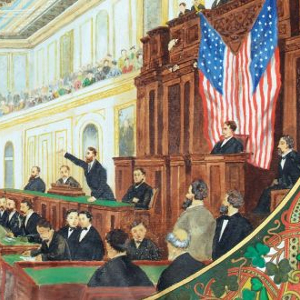
Only the fourth international leader to be invited to address the House, Parnell reports on the conditions of the Irish potato famine and its causes. “The present famine, as all other famines in Ireland, has been the direct result of the system of land tenure which is maintained there,” Parnell said, “And while we have been compelled by the frightful condition of our people . . . I feel it to be equally my duty to point out to you the cause which keeps Ireland in a condition of chronic poverty.”
After his 32-minute speech, the House adjourns for the evening. The Tribune judges Parnell’s address to be lackluster stating “the whole affair was tame and spiritless.” One Representative tells the Tribune reporter that the address failed because it lacked substance by “not going [even] skin deep into the subject of the Irish question.”
During Parnell’s highly successful tour, in addition to speaking before the House of Representatives, he has an audience with American PresidentRutherford B. Hayes and speaks in 62 cities in the United States and Canada, where he is so well received in Toronto that Timothy Healy dubs him “the uncrowned king of Ireland.”
House Receptions are not associated with other informal, social receptions and lunches provided for foreign leaders on behalf of congressional leadership or individual committees. In the post-World War II era, the practice of using one-chamber receptions is eventually discontinued. The last House Reception of a foreign leader is held for Mexican PresidentJosé López Portillo in 1977.
Dublin Zoo, located in Phoenix Park, Dublin, opens on September 1, 1831. It is the largest zoo in Ireland and one of Dublin’s most popular attractions. The zoo describes its role as conservation, study, and education. Its stated mission is to “work in partnership with zoos worldwide to make a significant contribution to the conservation of the endangered species on Earth.”
Covering over 28 hectares (69 acres) of Phoenix Park, the Dublin Zoo is divided into areas named Asian Forests, Orangutan Forest, The Kaziranga Forest Trail, Fringes of the Arctic, Sea Lion Cove, African Plains, Roberts House, House of Reptiles, City Farm and South American House.
The Royal Zoological Society of Ireland is established at a meeting held at the Rotunda Hospital on May 10, 1830. The zoo, then called the Zoological Gardens Dublin, initially opens to the public with 46 mammals and 72 birds, all donated by London Zoo.
The initial entry charge per person is sixpence, which is a sizable sum at the time and limits admission to relatively wealthy middle-class people. What makes Dublin Zoo very different from some of its contemporaries is a decision to reduce the charge to one penny on Sundays. This makes a day at the zoo something that nearly every Dubliner can afford once in a while and it becomes very popular.
In 1833, the original cottage-style entrance lodge to the zoo is built at a cost of £30. The thatch-roofed building is still visible to the right of the current entrance. In 1838, to celebrate Queen Victoria‘s coronation, the zoo holds an open day on which 20,000 people visit. This remains the highest number of visitors in one day. President of the United StatesUlysses S. Grant, after leaving office, is among the celebrities who come to see Dublin’s world-famous lions in the 19th century. In 1844 the zoo receives its first giraffe, and in 1855 it purchases its first pair of lions.
In 2015, Dublin Zoo is the third most popular visitor attraction in Ireland with 1,105,005 visitors.
Dublin Zoo is part of a worldwide programme to breed endangered species. It is a member of the European Endangered Species Programme (EEP), which helps the conservation of endangered species in Europe. Each species supervised by the EEP has a single coordinator that is responsible for the building of breeding groups with the aim of obtaining a genetically balanced population.
Dublin Zoo manages the EEP for the golden lion tamarin and the Moluccan cockatoo. It also houses members of the species Goeldi’s monkey and the white-faced saki monkey which are part of EEPs coordinated by other zoos. The focus is on conservation, which includes breeding and protecting endangered species, as well as research, study and education.
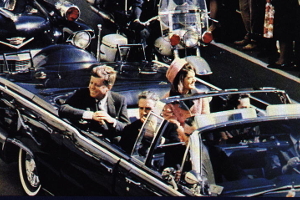
At 12:30 PM CST, as Kennedy’s uncovered 1961 Lincoln Continental four-door convertible limousine enters Dealey Plaza, Nellie Connally, the First Lady of Texas, turns around to President Kennedy, who is sitting behind her, and comments, “Mr. President, you can’t say Dallas doesn’t love you,” to which President Kennedy acknowledges by saying “No, you certainly can’t.” These are the last words ever spoken by John F. Kennedy.
From Houston Street, the presidential limousine makes the planned left turn onto Elm Street, allowing it access to the Stemmons Freeway exit. As it turns onto Elm, the motorcade passes the Texas School Book Depository. Shots are fired at Kennedy as the motorcade continues down Elm Street. About 80% of the witnesses recall hearing three shots.
A minority of the witnesses recognize the first gunshot they hear as weapon fire, but there is hardly any reaction to the first shot from a majority of the people in the crowd or those riding in the motorcade. Many later say they heard what they first thought to be a firecracker, or the backfire of a vehicle, just after the President started waving.
Within one second of each other, Kennedy, Texas Governor John Connally, and First Lady Jacqueline Kennedy, all turn abruptly from looking to their left to looking to their right. Connally, like the President a World War II military veteran, testifies that he immediately recognizes the sound of a high-powered rifle. He also testifies that when his head is facing about 20 degrees left of center, he is hit in his upper right back by a bullet he does not hear fired. After Connally is hit he shouts, “Oh, no, no, no. My God. They’re going to kill us all!”
Mrs. Connally testifies that just after hearing a loud, frightening noise that comes from somewhere behind her and to her right, she turns toward President Kennedy and sees him with his arms and elbows raised high, with his hands in front of his face and throat. She then hears another gunshot and then Governor Connally yelling. Mrs. Connally then turns away from Kennedy toward her husband, at which point another gunshot sounds and she and the limousine’s rear interior are covered with fragments of skull, blood, and brain.
According to the Warren Commission and the House Select Committee on Assassinations, as President Kennedy waves to the crowds on his right with his right arm upraised on the side of the limo, a shot enters his upper back, penetrates his neck, slightly damages a spinal vertebra and the top of his right lung, and exits his throat nearly centerline just beneath his larynx, nicking the left side of his suit tie knot. He raises his elbows and clenches his fists in front of his face and neck, then leans forward and left. Mrs. Kennedy, facing him, then puts her arms around him in concern.
A second shot strikes the President as the presidential limousine is passing in front of the John Neely Bryan north pergola concrete structure. Both the Warren Commission and the House Select Committee on Assassinations concludes that the second shot to hit the president enters the rear of his head and passing in fragments through his head, created a large, roughly oval hole on the rear, right side. The president’s blood and fragments of his scalp, brain, and skull land on the interior of the car, the inner and outer surfaces of the front glass windshield and raised sun visors, the front engine hood, the rear trunk lid, the follow-up Secret Service car and its driver’s left arm, and motorcycle officers riding on both sides of the President behind him.
After the President has been shot in the head, Mrs. Kennedy begins to climb out onto the back of the limousine, though she later has no recollection of doing so. United States Secret ServiceSpecial AgentClint Hill, who is riding on the left front running board of the follow-up car, believes she is reaching for something, perhaps a piece of the President’s skull. He jumps onto the back of the limousine while at the same time Mrs. Kennedy returns to her seat. He clings to the car as it exits Dealey Plaza and accelerates, speeding to Parkland Memorial Hospital.
After Mrs. Kennedy crawls back into her limousine seat, both Governor Connally and Mrs. Connally hear her say more than once, “They have killed my husband,” and “I have his brains in my hand.”
The staff at Parkland Hospital’s Trauma Room 1 who treat President Kennedy observe that his condition is “moribund,” meaning that he has no chance of survival upon arriving at the hospital. George Burkley, the President’s personal physician, states that a gunshot wound to the skull is the cause of death. Burkley signs President Kennedy’s death certificate.
At 1:00 PM, CST (19:00 UTC), after all heart activity has ceased and after Father Oscar Huber has administered last rites, the President is pronounced dead.
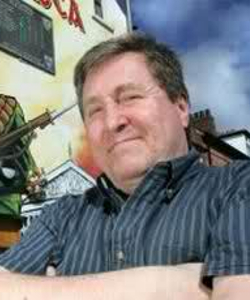
The IRA sends telephone warnings about 90 minutes before the bomb is detonated. The area is evacuated but the bomb squad, using a remote-controlled device, is unable to defuse the bomb in time. More than 200 people are injured, but there are no fatalities. At the time, England is hosting the UEFA Euro ’96 football championships and a match between Russia and Germany is to take place in Manchester the following day.
The Marks & Spencer store, the sky bridge connecting it with the Arndale Centre, and neighbouring buildings are destroyed. The blast creates a mushroom cloud which rises 1,000 feet into the sky. Glass and masonry are thrown into the air and people are showered by falling debris behind the police cordon a half mile away. A search of the area for casualties is confused by mannequins blasted from shop windows, which are sometimes mistaken for bodies.
Since 1970 the Provisional IRA has been waging a campaign aimed at forcing the British government to negotiate a withdrawal from Northern Ireland. Although Manchester has been the target of IRA bombs before 1996, it has not been subjected to an attack of this scale. The IRA had ended its seventeen-month ceasefire in February 1996 with a similarly large truck bomb attack on the London Docklands.
The bombing is condemned by John Major‘s government, the opposition, and by individual members of parliament (MPs) as a “sickening”, “callous,” and “barbaric” terrorist attack. Early on, Major states that, “This explosion looks like the work of the IRA. It is the work of a few fanatics and…causes absolute revulsion in Ireland as it does here.” Sinn Féin is criticised by TaoiseachJohn Bruton for being “struck mute” on the issue in the immediate aftermath. The President of the United States, Bill Clinton, states he is “deeply outraged by the bomb explosion” and joins Bruton and Major in “utterly condemning this brutal and cowardly act of terrorism.” On June 20, 1996, the IRA claims responsibility for the bombing and states that it “sincerely regretted” causing injury to civilians.
Several buildings near the explosion are damaged beyond repair and have to be demolished, while many more are closed for months for structural repairs. Most of the rebuilding work is completed by the end of 1999, at a cost of £1.2 billion, although redevelopment continues until 2005. The perpetrators of the attack have not been caught and Greater Manchester Police concede it is unlikely that anyone will ever be charged in connection with the bombing.
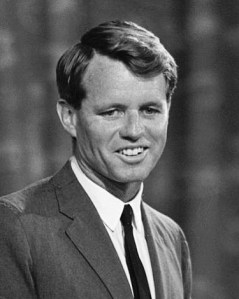
After winning the California and South Dakota primary elections for the Democratic nomination for President of the United States and speaking to supporters in a ballroom at the Ambassador Hotel, Kennedy walks through the kitchen area frequently shaking hands with those he encounters. Kennedy starts down a passageway narrowed by an ice machine against the right wall and a steam table to the left. He turns to his left and shakes hands with busboy Juan Romero just as Sirhan Sirhan, a 24-year-old Palestinian/Jordanian immigrant, steps down from a low tray-stacker beside the ice machine and repeatedly fires what is later identified as a .22 caliber Iver-Johnson Cadet revolver.
After Kennedy had falls to the floor, former FBI agent William Barry sees Sirhan holding a gun and hits him twice in the face while others force Sirhan against the steam table and disarmed him as he continues firing his gun in random directions. Five other people are also wounded.
Kennedy is transferred several blocks to Good Samaritan Hospital for surgery. Surgery begins at 3:12 AM PDT and lasts three hours and 40 minutes. Despite extensive neurosurgery to remove bullet and bone fragments from his brain, his condition remains extremely critical until he dies at 1:44 AM PDT on June 6, nearly 26 hours after the shooting.
Sirhan pleads guilty on April 17, 1969, and is sentenced to death. The sentence is commuted to life in prison in 1972 after the California Supreme Court, in its decision in California v. Anderson, invalidates all pending death sentences imposed in California prior to 1972. Since that time, Sirhan has been denied parole fifteen times and is currently confined at the Richard J. Donovan Correctional Facility in southern San Diego County.
As with his brother’s death, Kennedy’s assassination and the circumstances surrounding it have spawned a variety of conspiracy theories. Kennedy remains one of only two sitting United States Senators to be assassinated, the other being Huey Long.