seamus dubhghaill

Promoting Irish Culture and History from Little Rock, Arkansas, USA


Leave a comment

“Public Safety Bill” Passed by Dáil Éireann

The Free State’s Provisional Government puts the “Public Safety Bill” before Dáil Éireann on September 27, 1922, which passes by 41 votes to 18. This is emergency legislation which allows for the execution of those captured bearing arms against the State. The legislation passes to the National Army powers of punishment for anyone “taking part in or aiding and abetting attacks on the National Forces,” having possession of arms or explosives “without the proper authority” or disobeying an Army General Order.

The legislation gives the Military Courts the right to impose the sentence of death, imprisonment or penal servitude on those found to be guilty of such offences, the sentence only requiring the signatures of two officers. By time the bill is a year old, 81 men are executed under its terms and over 12,000 men and women imprisoned.

The reason for such punitive legislation is the dragging on of the Irish Civil War caused by the Anglo-Irish Treaty. A pro-Treaty offensive against the anti-Treaty Irish Republican Army (IRA) in the summer of 1922 appears to have won the war for the government but the anti-Treatyites or republicans subsequently fall back on guerrilla tactics which the newly formed Free State or National Army have great difficulty in suppressing. Ernest Blythe, the Minister for Finance in the Provisional Government, later recalls, “there was for some time a feeling that the Civil War would speedily end as major resistance was broken, but actually it began to assume a chronic character.”

In the week preceding the Dáil’s motion, on September 21, six National Army soldiers are killed in a prolonged engagement with Republican fighters near Ballina, County Mayo. On the same day, the Free State barracks in Drumshambo, County Leitrim, is attacked and taken and one soldier is killed. On September 22, a National Army soldier is killed and several soldiers and three civilians injured in a gun and grenade attack by Republicans on Free State troops on Eden Quay in central Dublin. And on the day of the Bill itself coming before the Dáil, in County Kerry several hundred anti-Treaty IRA guerrillas attack the town of Killorglin and are only repulsed after 24 hours of fighting, when Free State troops arrive from Tralee.

At the time and since, the legislation passed in 1922 is known as the Public Safety Bill. However, no such Bill or Act can be found in the records of the Irish state. The Provisional Government have no legal right under the Treaty to enact new legislation without royal assent, the King being represented in the person of the Governor-General. And in theory the Provisional Government’s powers do not apply after the Treaty formally passes into law on December 6, 1922.

So technically speaking the Public Safety Bill is not a law but simply a resolution passed in the Dáil. However, since there was, as yet no Governor-General who could give his assent and as the government felt the situation was too grave for legal niceties, the legislation setting up military courts was passed anyway. It is not until August 1923, when the Free State passes an Act of Indemnity for all actions committed during the Irish Civil War and also pass new, formal special powers legislation – The Emergency Powers Act – that retrospectively legalises what it had enacted in the autumn of 1922.

After an amnesty of two weeks, in which anti-Treaty fighters could surrender without consequences, the legislation comes into force in mid-October. Republicans at first do not believe that the government is serious about enforcing what its foes term “the Murder Bill.” It is in practice nearly two months before it is used in earnest.

On November 17, 1922, four IRA men who had been captured in Dublin are shot by firing squad. By the end of the week, Erskine Childers, who had served as secretary to the delegation which signed the Treaty but later organized Republican propaganda against it, is also dead. He had been captured at his home in County Wicklow on November 11 in possession of a small pistol Michael Collins had given him before he departed for Treaty negotiations in London. He is sentenced and shot on November 24. On November 30 another three Republican prisoners are executed in Dublin.

Liam Lynch, IRA Chief of Staff, issues a general order that Teachtaí Dála (TDs) who had voted for the Bill be shot on sight. On December 6, in retaliation for the executions, IRA members assassinate the TD Sean Hales in Dublin. In reprisal for that four senior republicans, Rory O’Connor, Liam Mellows, Richard Barrett and Joe McKelvey, who had been captured long before the Public Safety legislation is passed are summarily shot.

The legislation passed on September 27, 1922, may well have helped, as its supporters claimed, to break anti-Treaty resistance and to bring the Irish Civil War to an end. However, it also helped to convert the conflict into a feud as bitter and as personal as a vendetta.

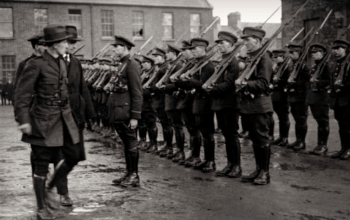
(From: “The passing of legislation allowing for executions during the Irish Civil War” by John Dorney, The Irish Story (www.theirishstory.com), September 27, 2013 | Photo: Richard Mulcahy, shown inspecting soldiers in Dublin, argued that permitting official executions would prevent National Army troops from carrying out unofficial killings)

Leave a comment

Founding of the Irish National Army

irish-national-army-cap-badge

The first regiment of the Irish National Army, sometimes unofficially referred to as the Free State army or the Regulars, is set up in Dublin on January 31, 1922.

The National Army is the army of the Irish Free State from January 1922 until October 1924. Its role in this period is defined by its service in the Irish Civil War, in defence of the institutions established by the Anglo-Irish Treaty. Michael Collins is the army’s first chief of staff from its establishment until his death in an ambush at Béal na mBláth on August 22, 1922.

The National Army is constituted from the revolutionary Irish Republican Army (IRA), which emerges from the successful Irish War of Independence fought as a guerrilla campaign against the British Army and Royal Irish Constabulary. Its first troops are those IRA volunteers who support the Anglo-Irish Treaty and the Provisional Government of Ireland formed there under. The army makes its first public appearance on January 31, 1922, when command of Beggars Bush Barracks is handed over from the British Army.

Conflict arises between the National Army and the anti-Treaty components of the IRA, which does not support the government of the Irish Free State. On June 28, 1922, the National Army commences an artillery bombardment of anti-Treaty IRA forces who are occupying the Four Courts in Dublin, thus beginning the Irish Civil War.

The National Army is greatly expanded in size to fight the civil war against the anti-Treaty IRA, in a mostly counter-insurgency campaign that is brought to a successful conclusion in May 1923. From October 1, 1924, the Army is reorganised into a smaller, better regulated force. The term “National Army” is superseded by the legal establishment of the Defence Forces as the Irish Free State’s military force.


Leave a comment

Formation of the Provisional Government of Ireland

provisional-government-of ireland

A meeting of the members elected to the House of Commons of Southern Ireland is held at the Mansion House in Dublin on January 14, 1922. At the meeting the Anglo-Irish Treaty is ratified by the Irish side in accordance with the Treaty and a Provisional Government is elected for the purposes of Article 17 of the Treaty.

Under the Irish Republic‘s Dáil Constitution adopted in 1919, Dáil Éireann continues to exist after it has ratified the Anglo-Irish Treaty. In protest at the ratification, Éamon de Valera resigns the presidency of the Dáil then seeks re-election from among its members in order to clarify his mandate, but Arthur Griffith defeats him in the vote and assumes the presidency.

Most of the Dáil Ministers become concurrently Ministers of this Provisional Government. Michael Collins becomes Chairman of the Provisional Government (i.e. prime minister). He also remains Minister for Finance of Griffith’s republican administration.

The Provisional Government takes office two days later on January 16, 1922, when British administration hands over Dublin Castle to Collins in person. At this time, Westminster has not formally appointed the new Irish ministers or conferred their government with any powers.

The handover of Dublin Castle to the Provisional Government is one of the earliest and most remarkable events in the short life of the Provisional Government. For centuries Dublin Castle is the symbol, as well as the citadel, of British rule in Ireland. The transfer of its Castle administration to the representatives of the Irish people is greatly welcomed in Dublin. It is regarded as a significant outward and visible sign that British rule is ending.

Following the general election on June 16, 1922, held just before the outbreak of the Irish Civil War, the Second Provisional Government takes power until the creation of the Irish Free State on December 6, 1922.

By mid-1922, Collins in effect lays down his responsibilities as Chairman of the Provisional Government to become Commander-in-Chief of the Irish Army, a formal structured uniformed army that forms around the pro-Treaty Irish Republican Army (IRA). As part of those duties, he travels to his native County Cork. En route home on August 22, 1922, at Béal na Bláth, he is killed in an ambush. Arthur Griffith dies of a cerebral haemorrhage ten days prior to Collins’ assassination. After Collins’ and Griffith’s deaths in August 1922, W. T. Cosgrave becomes both Chairman of the Provisional Government and President of Dáil Éireann, and the distinction between the two posts becomes irrelevant.

On December 6, 1922, the Irish Free State comes into being, and the Provisional Government becomes the Executive Council of the Irish Free State, presided over by a prime minister called the President of the Executive Council. On December 7 the House of Commons of Northern Ireland unanimously exercises its right under the Treaty to opt out of the Free State.

(Pictured: The Provisional Government of Ireland with President Arthur Griffith (front row center) and his cabinet and party includng Michael Collins (to Griffith’s right) likely taken at the Mansion House in February 1922)


Leave a comment

Reopening of General Post Office, Dublin

general-post-office

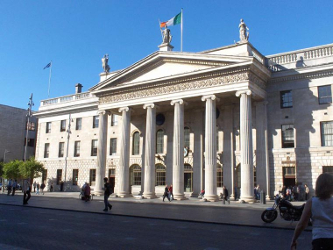
The restored General Post Office, Dublin, which had been destroyed during the 1916 Easter Rising, is opened by President W. T. Cosgrave on July 11, 1929.

The General Post Office (GPO) is the headquarters of the Irish postal service. The offices are first located at College Green, but in August 1814, construction of a purpose-built headquarters begins. The building on Sackville Street is completed in January 1818 at a cost of £50,000.

According to An Post “The statues on the roof are of Hibernia, a classical representation in female form of the island of Ireland, with Fidelity to one side and Mercury, the messenger of the gods, to the other.”

Five members of the Provisional GovernmentPatrick Pearse, James Connolly, Tom Clarke, Seán MacDiarmada, and Joseph Plunkett — are located at the GPO during the Easter Rising in a 350-strong garrison which also includes Cumann na mBan and Irish Citizen Army members. James Connolly is in charge of the defence of the GPO and directs operations. The GPO garrison barricades surrounding streets and occupies adjoining buildings.

On Monday afternoon the garrison repulses a cavalry attack while, with the breakdown of law and order, many of the stores in Sackville Street are looted. From Wednesday, the GPO and other buildings in Sackville Street come under artillery fire, mostly from the Helga gunboat at anchor in the River Liffey. Connolly believes the British will not use artillery in city areas. By Friday night the GPO is on fire, at which point it is evacuated.

At a Dublin Corporation meeting in 1884 a motion is called to change the name of Sackville Street to O’Connell Street. After forty years of argument, it is changed to O’Connell Street in May 1924.