seamus dubhghaill

Promoting Irish Culture and History from Little Rock, Arkansas, USA


Leave a comment

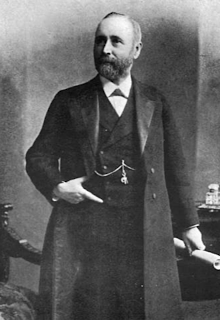
Birth of William Pirrie, 1st Viscount Pirrie

William James Pirrie, 1st Viscount PirrieKPPCPC (Ire), a leading British shipbuilder and businessman, is born on May 31, 1847, in Quebec City, Canada East, Province of Canada. He is chairman of Harland & Wolff, shipbuilders, between 1895 and 1924, and also serves as Lord Mayor of Belfast between 1896 and 1898.

Pirrie is taken back to Ireland when he is two years old and spends his childhood at Conlig House, also known as Little Clandeboye ConligCounty Down. Belonging to a prominent family, his nephews included J. M. Andrews, who later becomes Prime Minister of Northern IrelandThomas Andrews, builder of RMS Titanic, and Sir James Andrews, 1st Baronet, the Lord Chief Justice of Northern Ireland.

Pirrie is educated at the Royal Belfast Academical Institution before entering Harland & Wolff shipyard as a gentleman apprentice in 1862. Twelve years later he is made a partner in the firm, and on the death of Sir Edward Harland in 1895, he becomes its chairman, a position he holds until his death. As well as overseeing the world’s largest shipyard, he is elected Lord Mayor of Belfast in 1896, and is re-elected to the office as well as made an Irish Privy Counsellor the following year. He becomes Belfast’s first honorary freeman in 1898, and serves in the same year as High Sheriff of Antrim and subsequently of County Down. In February 1900, he is elected President of the UK Chamber of Shipping, where he had been vice-president the previous year. He helps finance the Liberals in Ulster in the 1906 United Kingdom general election, and that same year, at the height of Harland & Wolff’s success, he is raised to the peerage as Baron Pirrie, of the City of Belfast.

In 1907, Pirrie is appointed Comptroller of the Household to the Lord Lieutenant of Ireland, and in 1908 is appointed Knight of St Patrick (KP). Pro-Chancellor of Queen’s University of Belfast (QUB) from 1908 to 1914, he is also in the years before World War I a member of the Committee on Irish Finance as well as Lord Lieutenant of Belfast.

In February 1912, after chairing a famous meeting of the Ulster Liberal Association at which Winston Churchill defends the government’s policy of Home Rule for Ireland, Pirrie is jeered on the streets of Belfast, and assaulted as he boards a steamer in Larne: pelted with rotten eggs, herrings, and bags of flour. In 1910, the Ulster Liberal Association, an overwhelmingly Protestant body, with a weekly newspaper, and branch network throughout Ulster, adopts (in opposition to the Ulster Liberal Unionist Association) an explicitly pro-home rule position.

In the months leading up to the 1912 sinking of the RMS Titanic, Pirrie is questioned about the number of life boats aboard the Olympic-class ocean liners. He responds that the great ships are unsinkable and the rafts are to save others. This haunts him for the rest of his life. In April 1912, Pirrie is to travel aboard RMS Titanic, but illness prevents him.

During the war Pirrie is a member of the War Office Supply Board, and in 1918 becomes Comptroller-General of Merchant Shipbuilding, organising British production of merchant ships.

In 1921, Pirrie is elected to the Senate of Northern Ireland, and that same year is created Viscount Pirrie of the City of Belfast, in the honours for the opening of the Parliament of Northern Ireland in July 1921, for his war work and charity work. In Belfast he is, on other grounds, already a controversial figure: a Protestant employer associated as a leading Liberal with a policy of Home Rule for Ireland.

In March 1924, Pirrie, his wife, and her sister sail on a Royal Mail Steam Packet Company liner from Southampton on a business trip to South America. They travel overland from Buenos Aires to Chile, where they embark aboard the Pacific Steam Navigation Company‘s Ebro. Pirrie comes down with pneumonia in Antofagasta, and his condition worsens when the ship reaches Iquique. At Panama City two nurses embark to care for him. By then he is very weak, but insists on being brought on deck to see the canal. He admires how Ebro is handled through the locks.

Pirrie dies at sea off Cuba on June 7, 1924. His body is embalmed. On June 13, Ebro reaches Pier 42 on the North River in New York City, where Pirrie’s friend Andrew Weir, 1st Baron Inverforth and his wife meet Viscountess Pirrie and her sister. UK ships in the port of New York lower their flags to half-mast, and Pirrie’s body is transferred to Pier 59, where it is embarked on White Star Line‘s RMS Olympic, one of the largest ships Pirrie ever built, to be repatriated to the UK. He is buried in Belfast City Cemetery. The barony and viscountcy die with him. Lady Pirrie dies on June 19, 1935. A memorial to Pirrie in the grounds of Belfast City Hall is unveiled in 2006.


Leave a comment

The First Famine Ship Arrives at Grosse Île

The Syria, the first ship to arrive during what Québécois call the “Summer of Sorrow,” lands at the Canadian quarantine station in the St. Lawrence River, just north of Quebec on May 15, 1847.

When the authorities in Quebec hear the news of ships arriving with sick passengers, they quickly set up Grosse Île as a port of entry and quarantine station at which all ships are required to dock before moving on to the mainland. The island had dealt with epidemics before. In 1830, about 30,000 immigrants arrived in Quebec, and two-thirds were Irish. These huge waves of immigration were concurrent with cholera epidemics in Great Britain and Europe.

Areas in the west of Ireland – mostly Mayo, Donegal, and Galway – are experiencing potato crop failure. In fact, the crop fails to various degrees all over the country throughout the 1830s, though no one is sure exactly when the blight that caused the successive crop failures of 1845-49 arrived in Ireland. In 1847, 100,000 Irish people travel to Grosse Île to escape starvation, unaware of the hardships they will encounter upon arrival.

The Syria, the first “coffin ship,” named for their crowded and deadly conditions, arrives on May 17, 1847, the ice still an inch thick on the river. Of the ship’s 241 passengers, 84 are stricken with fever and 9 died on board during the Atlantic crossing. The first victim dies on the day the Syria arrives. Her name is Ellen Kane, a four-year-old from Kilmore, County Mayo.

With the hospital equipped for only 150 cases of fever, the situation quickly spins out of control. More and more ships arrive at Grosse Île each day, sometimes lining up for miles down the St. Lawrence River throughout the summer. On these coffin ships the number of passengers stricken by fever increases exponentially.

The island is ill-equipped, to say the least. Hastily built, the quarantine hospitals lack proper sanitation, supplies, and space to accommodate all the sick patients. Many of the doctors dispatched to Grosse Île have never even seen the effects of cholera let alone treated it, and all are overworked. Being taken to a quarantine hospital is soon viewed as more of a death sentence than an opportunity to get better.

Between 1832 and 1937, Grosse Île’s term of operation, the official register lists 7,480 burials on the island. In 1847 alone, 5,424 burials take place, the majority are Irish immigrants. In that same year, over 5,000 Irish people on ships bound for Canada are listed as having been buried at sea.

Today, the island is a National Historic Site that serves as a Famine memorial. It is dedicated in 1996 after a four-year-long campaign to protect the mass gravesite.

The Grosse Île Celtic Cross, erected by the Ancient Order of Hibernians in 1909, bears an inscription in Irish commemorating the victims of the epidemic and condemning colonial rule. In English, it reads: “Children of the Gael died in their thousands on this island having fled from the laws of foreign tyrants and an artificial famine in the years 1847-48. God’s blessing on them. Let this monument be a token and honor from the Gaels of America. God Save Ireland.”

(From: “When 40 Irish Famine ships anchored at Grosse Île quarantine station in 1847” by Aliah O’Neill, IrishCentral, http://www.irishcentral.com, May 31, 2023)


Leave a comment

Death of Richard Montgomery, General of the Continental Army

Richard Montgomery, Irish-born major general of the Continental Army, is killed at the Battle of Quebec on December 31, 1776, during the American Revolutionary War.

Montgomery is born into a wealthy family in Swords, Dublin, on December 2, 1738. He attends Trinity College Dublin before dropping out to become a Junior Non-Commissioned Officer (NCO) in the British Army. He serves with distinction during the Seven Years’ War, more commonly known as the French and Indian War, and is promoted several times, finally attaining the rank of captain before the end of the war. He is released from duty due to his health and returns to Great Britain to recover. In Britain, he discusses politics and affiliates with the Whigs political party in Parliament, who later supports American independence. When his health finally recovers, he resigns his commission from the British Army and moves to New York, settling into the life of a farmer. On July 24, 1773, he marries Janet Livingston, who is from an anti-British patriot family. He continues to cement his beliefs and begins to identify as an “American” rather than a “Briton.”

Eventually, Montgomery’s political beliefs turn into political action. In May 1775, he is elected as one of the ten deputies to represent Dutchess County in the New York Provincial Congress and is chosen to organize the militias and defenses of New York. After George Washington is chosen to be the commander of the Continental Army in June of the same year, the New York Provincial Congress is asked to choose two people for the rank major general and brigadier general for service in the new army. Philip Schuyler is appointed to the rank of major general. Montgomery protests the promotion, arguing that Schuyler does not have enough combat experience to be an effective leader. Later, the New York Provincial Congress appoints Montgomery as brigadier general because of his military experience. General Washington personally appoints the reluctant Montgomery to be Schuyler’s second in command. This move is just in time as Schuyler falls ill during at the start of the invasion of Canada, thus giving Montgomery control of the campaign.

Once in command, Montgomery begins a successful campaign in Canada as General Benedict Arnold is marching through the wilderness of modern-day Maine to meet him in Quebec. He captures numerous strongpoints and eventually the city of Montreal falls to the Patriots. His numerous victories and kind treatment of British prisoners take a toll on the Patriot militias under his command, who demand rest and the same provisions given to the British prisoners. The commanding general is reluctant to lead his soldiers, who he has seen as undisciplined. It takes a personal letter from General Washington to reassure him that there is insubordination and lack of discipline all throughout the Continental Army and that resignation is not the answer. Nevertheless, he continues to Quebec to meet Arnold and his army.

When Montgomery and his men arrive outside Quebec, his force consists of some 300 men compared to Arnold’s 1,000 men. Now a major general, he establishes siege lines around the city of Quebec and demands the surrender of the defenders within. The terms of surrender are rejected numerous times, leaving him and Arnold with no other choice but to assault the city. He hopes that snow will hide the movement of his troops, thus, he plans on waiting for snowfall in order to attack. General Arnold, however, is worried about his men. A December 31 enlistment expiration is looming, that could drastically reduce the size of the assaulting force. Montgomery discovers waiting for the right time is not an option and coordinates an attack for the early hours of December 31, 1775. That morning, Montgomery leads a group of his men toward the interior of Quebec. With sword drawn and lantern out, the Patriots advance toward a blockhouse where the British and Canadian defenders notice this movement and let loose a volley of grapeshot and muskets, which instantly kills Montgomery and the men close to him.

Montgomery’s body is discovered after the failed attacks by the Continentals. The British defenders of Quebec bring his body to General Guy Carleton, who orders it be buried with respect and dignity. He is laid to rest in Quebec on January 4, 1776. News of his death causes widespread mourning, both in America and in the British Isles. Many Patriots elevate his status to a hero and martyr for independence and the American cause, while British members of parliament, especially the Whigs, use his death to mark the failures in the British response to the insurrection in their colonies. In July 1818 his remains are reinterred in New York.

(From: “Richard Montgemery,” American Battlefield Trust, http://www.battlefields.org)