
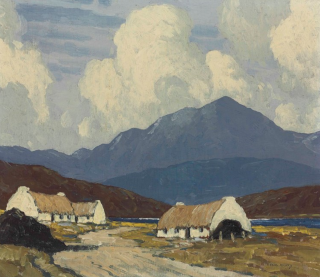
Paul Henry, Irish artist noted for depicting the Connacht province landscape in the west of Ireland in a spare Post-Impressionist style, is born at 61 University Road, Belfast, on April 11, 1876.
Henry is the third of four sons of the Rev. Robert Mitchell Henry, minister of the Reformed Presbyterian Church, and his wife Kate Ann Berry, eldest of four daughters of Thomas Berry, minister of the Baptist church, Athlone. His father becomes a Baptist in 1858 and pastor of Great Victoria Street Baptist Church, Belfast, resigning in 1875 to join the Plymouth Brethren.
Henry begins to draw in pencil and watercolours at the age of four, even before entering the kindergarten at Methodist College Belfast (MCB), in 1882 where he first begins drawing regularly. At the age of fifteen he moves to the Royal Belfast Academical Institution. He studies art at the Belfast School of Art before going to Paris in 1898 to study at the Académie Julian and at James McNeill Whistler‘s Académie Carmen.
Henry marries the painter Emily Grace Mitchell on September 17, 1903, in London at St Peter’s Anglican church, Bayswater. He returns to Ireland in 1910. From then until 1919 he lives on Achill Island, where he learns to capture the peculiar interplay of light and landscape specific to the west of Ireland. In 1919, he moves to Dublin and in 1920 he is one of the founders of the Society of Dublin Painters, originally a group of ten artists. He designs several railway posters, some of which, notably Connemara Landscape, achieves considerable sales. He separates from his wife in 1929. His second wife is the artist Mabel Young.
In the 1920s and 1930s, Henry is Ireland’s best-known artist, one who has a considerable influence on the popular image of the west of Ireland. Although he seems to cease experimenting with his technique after leaving Achill and his range is limited, he creates a large body of fine images whose familiarity is a testament to its influence.
Henry’s use of colour is affected by his red-green colour blindness. He loses his sight in 1945 and does not regain his vision before his death.
Henry dies on August 24, 1958, at his home at 1 Sidmonton Square, Bray, County Wicklow, and is buried at St. Patrick’s Church, Enniskerry, County Wicklow. He is survived by his wife, Mabel. His papers and sketchbooks are in the libraries of the National Gallery of Ireland and Trinity College Dublin.
A commemorative exhibition of Henry’s work is held at Trinity College, Dublin, in 1973 and the National Gallery of Ireland holds a major exhibition of his work in 2004.
A painting by Henry is featured on an episode of the BBC‘s Antiques Roadshow, broadcast on November 12, 2006. The painting is given a value of approximately £40,000–60,000 by the Roadshow. However, due to the buoyancy of the Irish art market at the time, it sells for €260,000 on December 5, 2006, in James Adams’ and Bonhams’ joint Important Irish Art sale.
Pictured: “Roadside Cottages, below Mweelrea Mountain” by Paul Henry, RHA, oil on panel, 1940)

 seamus dubhghaill