Patrick Pollen, a British stained glass artist who spends most of his life working in Ireland, is born Patrick La Primaudaye Pollen in London on January 12, 1928.
In 1952, Pollen’s father takes him to see Evie Hone‘s “Crucifixion and Last Supper” window in Eton College Chapel. Upon seeing it he announces, “That’s what I want to do.” He moves to Dublin to study with the stained glass cooperative Evie Hone is a member of, An Túr Gloine, which is run by Catherine O’Brien and she and Hone become his mentors. When Hone dies in 1955, she leaves him her brushes.
Following the Second Vatican Council, newly designed churches feature less stained glass, and Pollen finds he is receiving less commissions. As a consequence he and his family move to the United States in 1981. They settle in Winston-Salem, North Carolina but there is very little work there and in 1997 they return in Ireland, living in his wife’s native County Wexford.
Pollen marries sculptor Nell Murphy in 1963, with the couple buying a house in Dublin in which Pollen had his studio. Murphy works in plaster, clay and stone, her works often featured in churches with those of her husband. They hav four sons, Peter, Ciaran, Laurence and Christopher, and a daughter, Brid.
Pollen dies on November 30, 2010, in Enniscorthy, County Wexford. His remains are cremated and the location of his ashes is unknown.
Henry is the third of four sons of the Rev. Robert Mitchell Henry, minister of the Reformed Presbyterian Church, and his wife Kate Ann Berry, eldest of four daughters of Thomas Berry, minister of the Baptist church, Athlone. His father becomes a Baptist in 1858 and pastor of Great Victoria Street Baptist Church, Belfast, resigning in 1875 to join the Plymouth Brethren.
Henry marries the painter Emily Grace Mitchell on September 17, 1903, in London at St Peter’s Anglican church, Bayswater. He returns to Ireland in 1910. From then until 1919 he lives on Achill Island, where he learns to capture the peculiar interplay of light and landscape specific to the west of Ireland. In 1919, he moves to Dublin and in 1920 he is one of the founders of the Society of Dublin Painters, originally a group of ten artists. He designs several railway posters, some of which, notably Connemara Landscape, achieves considerable sales. He separates from his wife in 1929. His second wife is the artist Mabel Young.
In the 1920s and 1930s, Henry is Ireland’s best-known artist, one who has a considerable influence on the popular image of the west of Ireland. Although he seems to cease experimenting with his technique after leaving Achill and his range is limited, he creates a large body of fine images whose familiarity is a testament to its influence.
Henry’s use of colour is affected by his red-green colour blindness. He loses his sight in 1945 and does not regain his vision before his death.
A commemorative exhibition of Henry’s work is held at Trinity College, Dublin, in 1973 and the National Gallery of Ireland holds a major exhibition of his work in 2004.
A painting by Henry is featured on an episode of the BBC‘s Antiques Roadshow, broadcast on November 12, 2006. The painting is given a value of approximately £40,000–60,000 by the Roadshow. However, due to the buoyancy of the Irish art market at the time, it sells for €260,000 on December 5, 2006, in James Adams’ and Bonhams’ joint Important Irish Art sale.
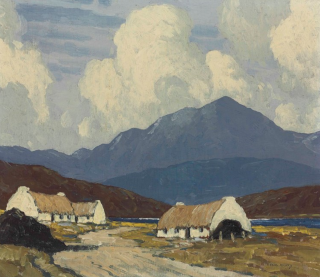
Pictured: “Roadside Cottages, below Mweelrea Mountain” by Paul Henry, RHA, oil on panel, 1940)
O’Brien marries Mabel Emmeline Smyly, daughter of Sir Philip Crampton Smyly, on March 8, 1902. Together they have five children. His son Brendan, a surgeon in Dublin, marries artist Kitty Wilmer O’Brien. His daughter Rosaleen Brigid becomes an artist, also known as Brigid Ganly after her marriage to Andrew Ganly. Another artistic relative is Geraldine O’Brien.
Unlike many of his Irish contemporaries, after graduating from Cambridge O’Brien does not study art in Dublin, opting instead to travel to Paris, where he studies the paintings at the Louvre. In 1887, he visits galleries in Italy and then enrolls at the Royal Academy of Fine Arts in Antwerp, Belgium. At the Academy he is a fellow student of Walter Osborne. He leaves Antwerp in 1891 and returns to Paris, where he studies at Académie Julian. He relocates to London in 1893 and then Dublin in 1901.
O’Brien is designated an associate of the Royal Hibernian Academy in 1906, a member in 1907, and is later president between 1910 and 1945. He is made an honorary member of the Royal Academy of Arts, London in 1912.
The Purser family had come to Ireland from Gloucestershire in the eighteenth century. Purser is born in Kingstown (now Dún Laoghaire) in County Dublin on March 22, 1848. She is raised in Dungarvan, County Waterford, one of the numerous children of Benjamin Purser, a prosperous flour miller and brewer, and his wife Anne Mallet. She is related to Sir Frederic William Burton, RHA (1816-1900), who is a son of Hannah Mallet. Two of her brothers, John and Louis, become professors at Trinity College Dublin. Her niece Olive Purser, daughter of her brother Alfred, is the first woman scholar at Trinity.
At thirteen Purser attends the Moravian school, Institution Evangélique de Montmirail, Switzerland where she learns to speak fluent French and begins painting. In 1873 her father’s business fails and she decides to become a full-time painter. She attends classes at the Dublin Metropolitan School of Art and joins the Dublin Sketching Club, where she is later appointed an honorary member. In 1874 she distinguishes herself in the National Competition. In 1878 she again contributes to the Royal Hibernian Academy (RHA), and for the next fifty years becomes a regular exhibitor, mainly portraits, and shows an average of three works per show.
Purser becomes wealthy through astute investments, particularly in Guinness, for which several of her male relatives have worked over the years. She is very active in the art world in Dublin and is involved in the setting up of the Municipal Gallery of Modern Art, persuading the Irish government to provide Charlemont House in Parnell Square to house the gallery.
Purser works mostly as a portraitist. Through her talent and energy and owing to her friendship with the Gore-Booths, she is very successful in obtaining commissions. When the Lord Lieutenant of Ireland commissions her to portray his children in 1888, his choice reflects her position as the country’s foremost portraitist. Various portraits painted by Purser are held in the National Gallery of Ireland.
Purser finances An Túr Gloine (The Tower of Glass), a stained-glass cooperative, at 24 Upper Pembroke and runs it from its inauguration in 1903 until her retirement in 1940. Michael Healy is the first of a number of distinguished recruits, such as Catherine O’Brien, Evie Hone, Wilhelmina Geddes, Beatrice Elvery and Ethel Rhind. She is determined the stained-glass workshop should adhere to true Arts and Crafts philosophy. An Túr Gloine archive is held in the Centre for the Study of Irish Art, National Gallery of Ireland.
Purser does not produce many items of stained glass herself. Most of the stained-glass works are painted by other members of the co-operative, presumably under her direction. Two early works are St. Ita (1904) for St. Brendan’s Cathedral, Loughrea and The Good Shepard (1904) for St. Columba’s College, Dublin. Her last stained-glass work is believed to be The Good Shepard and the Good Samaritan (1926) for the Church of Ireland at Killucan, County Westmeath.
Until her death Purser lives for many years in Mespil House, a Georgian mansion with beautiful plaster ceilings on Mespil Road, on the banks of the Grand Canal. Here she is “at home” every Tuesday afternoon to Dublin’s writers and artists. Her afternoon parties are a fixture of Dublin literary life.
Purser dies in Dublin on August 7, 1943, and is buried in Mount Jerome Cemetery beside her brothers John and Louis. Mespil House is demolished after her death and developed into apartments.
Purser is the second woman to sit on the Board of Governors and Guardians, National Gallery of Ireland, 1914-1943. She is made an Honorary Member of the Royal Hibernian Academy in 1890, becoming the first female Associate Member in 1923 and the first female Member in 1924. Also, in 1924 she initiates the movement for the launching of the Friends of the National Collection of Ireland. Archives relating to Sarah Purser are housed in the Centre for the Study of Irish Art, National Gallery of Ireland.
(Pictured: Portrait of Sarah Purser by John Butler Yeats, c. 1880–1885)
Like William Orpen, Lavery is appointed an official artist in World War I. Ill-health, however, prevents him from travelling to the Western Front. A serious car crash during a Zeppelin bombing raid also keeps him from fulfilling this role as war artist. He remains in Britain and mostly paints boats, aeroplanes, and airships. During the war years he is a close friend of H.H. Asquith‘s family and spends time with them at their Sutton Courtenay Thames-side residence, painting their portraits and idyllic pictures like Summer on the River (Hugh Lane Gallery).
After the war Lavery is knighted and in 1921 he is elected to the Royal Academy of Arts.
During this time, he and his wife, Hazel, are tangentially involved in the Irish War of Independence and the Irish Civil War. They give the use of their London home to the Irish negotiators during the negotiations leading to the Anglo-Irish Treaty. After Michael Collins is assassinated, Lavery paints Michael Collins, Love of Ireland, now in the Hugh Lane Gallery. In 1929, Lavery makes substantial donations of his work to both the Ulster Museum and the Hugh Lane Gallery and in the 1930s he returns to Ireland. He receives honorary degrees from the University of Dublin and Queen’s University Belfast. He is also made a free man of both Dublin and Belfast. A long-standing member of Glasgow Art Club, Lavery exhibits at the club’s annual exhibitions, including its exhibition in 1939 in which his The Lake at Ranelagh is included.
Purser works mostly as a portraitist. She is also associated with the stained-glass movement, founding a stained-glass workshop, An Túr Gloine, in 1903. Some of her stained-glass work is commissioned from as far as New York City, including a window at Christ Church, Pelham dedicated to the memory of Katharine Temple Emmet and Richard Stockton Emmet, grandson of the Irish patriot, Thomas Addis Emmet. Through her talent and energy and owing to her friendship with the Gore-Booths, she is very successful in obtaining commissions, famously commenting, “I went through the British aristocracy like the measles.”
In 1977 Bruce Arnold noted, “some of her finest and most sensitive work was not strictly portraiture, for example, An Irish Idyll in the Ulster Museum, and Le Petit Déjeuner (in the National Gallery of Ireland).”
Sarah Purser becomes wealthy through astute investments, particularly in Guinness. She is very active in the art world in Dublin and is involved in the setting up of the Hugh Lane Municipal Gallery, persuading the Irish government to provide Charlemont House to house the gallery. In 1923 she becomes the first female member of the Royal Hibernian Academy (RHA).
Until her death she lives for years in Mespil House, a Georgian mansion with beautiful plaster ceilings on Mespil Road, on the banks of the Grand Canal. After her death in Dublin on August 7, 1943, it is demolished and is developed into apartments. She is buried in Mount Jerome Cemetery in Dublin.
Sir John Lavery, Irish painter best known for his portraits and wartime depictions, dies of natural causes at the age of 84 in Kilmoganny, County Kilkenny, on January 10, 1941.
Like William Orpen, Lavery is appointed an official artist in World War I. Ill-health, however, prevents him from travelling to the Western Front. A serious car crash during a Zeppelin bombing raid also keeps him from fulfilling this role as war artist. He remains in Britain and mostly paints boats, aeroplanes, and airships. During the war years he is a close friend of H.H. Asquith‘s family and spends time with them at their Sutton Courtenay Thames-side residence, painting their portraits and idyllic pictures like Summer on the River (Hugh Lane Gallery).
After the war Lavery is knighted and in 1921 he is elected to the Royal Academy of Arts.
During this time, he and his wife, Hazel, are tangentially involved in the Irish War of Independence and the Irish Civil War. They give the use of their London home to the Irish negotiators during the negotiations leading to the Anglo-Irish Treaty. After Michael Collins is assassinated, Lavery paints Michael Collins, Love of Ireland, now in the Hugh Lane Gallery. In 1929, Lavery makes substantial donations of his work to both the Ulster Museum and the Hugh Lane Gallery and in the 1930s he returns to Ireland. He receives honorary degrees from the University of Dublin and Queen’s University Belfast. He is also made a free man of both Dublin and Belfast. A long-standing member of Glasgow Art Club, Lavery exhibits at the club’s annual exhibitions, including its exhibition in 1939 in which his The Lake at Ranelagh is included.