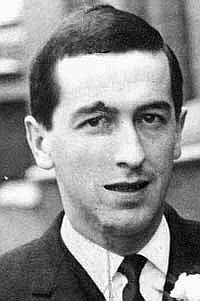
Charlie Kerins, a physical force Irish Republican and Chief of Staff of the Irish Republican Army (IRA), is hanged on December 1, 1944 at Mountjoy Prison in Dublin by the English hangman Albert Pierrepoint.
Kerins is born in Caherina, Tralee, County Kerry and attends Balloonagh Mercy Convent School and then the CBS, Edward Street. At the age of 13, he wins a Kerry County Council scholarship and completes his secondary education at the Green Christian Brothers and the Jeffers Institute. In 1930, he passes the Intermediate Certificate with honours and the matriculation examination to the National University of Ireland (NUI). He later does a commercial course and takes up employment in a radio business in Tralee.
In 1940, Kerins is sworn into the IRA and is appointed to the GHQ staff in May 1942. At the time, the Fianna Fáil government of Éamon de Valera is determined to preserve Irish neutrality during World War II. Therefore, the IRA’s bombing campaign in England, its attacks against targets in Northern Ireland, and its ties to the intelligence services of Nazi Germany are regarded as severe threats to Ireland’s national security. IRA men who are captured by the Gardaí are interned for the duration of the war by the Irish Army in the Curragh Camp in County Kildare.
On the morning of September 9, 1942, Garda Detective Sergeant Denis O’Brien is leaving his home in Ballyboden, Dublin. He is between his front gate and his car when he is cut down with Thompson submachine guns. O’Brien, an Anti-Treaty veteran of the Irish Civil War, had enlisted in the Garda Síochána in 1933. He is one of the most effective Detectives of the Special Branch division, which has its headquarters at Dublin Castle. The shooting greatly increases public feeling against the IRA, particularly as the murder is carried out in full view of his wife.
Following the arrest of Hugh McAteer in October 1942, Kerins is named Chief of Staff of the IRA. Despite a massive manhunt by Gardaí, he remains at large for two years. He stays at a County Waterford home for two weeks while he is on the run, having given his name as Pat Carney. He is captured several months after he leaves the home.
Kerins had previously left papers and guns hidden at Kathleen Farrell’s house in the Dublin suburb of Rathmines. He telephones the house, as he intends to retrieve them. However, Farrell’s telephone had been tapped by the Gardaí. On June 15, 1944, he is arrested in an early morning raid. He is sleeping when the Gardaí enter his bedroom and does not have an opportunity to reach the Thompson submachine gun which is hidden under his bed.
At a trial before the Special Criminal Court in Collins Barracks, Dublin, Kerins is formally charged on October 2, 1944 for the “shooting at Rathfarnham of Detective Dinny O’Brien.” At the end of his trial, the president of the Military Court delays sentence until later in the day to allow Kerins, if he wishes, to make an application whereby he might avoid a capital sentence. When the court resumes, he says, “You could have adjourned it for six years as far as I am concerned, as my attitude towards this Court will always be the same.” He thus deprives himself of the right to give evidence, to face cross-examination, or to call witnesses.
Despite legal moves initiated by Seán MacBride, public protests, and parliamentary intervention by TDs from Clann na Talmhan, Labour, and Independent Oliver J. Flanagan in Leinster House, the Fianna Fáil government of Éamon de Valera refuses to issue a reprieve. On December 1, 1944 in Mountjoy Prison, Kerins is hanged by British chief executioner Albert Pierrepoint, who is employed by the Irish Government for such occasions.
Kerins is the last IRA member to be executed in the Republic of Ireland. He is buried in the prison yard. In September 1948, his remains are exhumed and released to his family. He is buried in the Republican plot at Rath Cemetery, Tralee, County Kerry.