
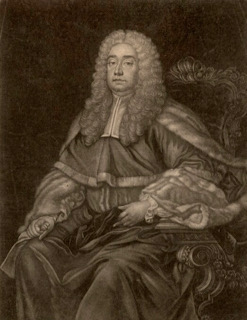
John Bowes, 1st Baron Bowes, PC (I), Anglo-Irish peer, politician and judge, dies in Dublin on July 22, 1767. He is noted for his great legal ability, but also for his implacable hostility to Roman Catholics.
Bowes is born in London, the second son of Thomas Bowes, a merchant and member of the Worshipful Company of Turners, and his wife, a Miss North, and is called to the Bar in 1712. He comes to Ireland as a member of the staff of Richard West, the Lord Chancellor of Ireland, in 1723. He builds up a large practice at the Irish Bar and is appointed Solicitor-General for Ireland in 1730, and Attorney-General for Ireland in 1739. He is raised to the Bench as Lord Chief Baron of the Irish Exchequer in 1741, having previously failed to become third Baron (which is a surprisingly lucrative office, as the Baron receives several extra fees). He is appointed Lord Chancellor of Ireland by King George II in 1757, despite the chronic ill-health which afflicts him. In his last years, his legs are so swollen that he can scarcely walk.
Bowes epitomizes the severity of the 18th century Penal Laws against Irish Catholics when he rules, in about 1759, that: “The law does not suppose any such person to exist as an Irish Roman Catholic, nor could such a person draw breath without the Crown’s permission”. Such views, given that Roman Catholics make up more than 90% of the Irish population at the time, inevitably make him bitterly unpopular, and in 1760 he is assaulted during a riot outside the House of Commons.
In spite of his religious bigotry, Bowes is considered one of the outstanding judges of his time. In particular, he is a reforming Lord Chancellor, who is praised for making the Court of Chancery “a terror for fraud, and a comfort and protection for honest men”. As Attorney-General he shows considerable courage in going on assize during the Irish Famine (1740–1741) despite the infectious fever which is raging at the time, and which claims the lives of three other judges who decide to brave the dangers.
Between 1731 and 1742, Bowes represents Taghmon in the Irish House of Commons.
Bowes is considered one of the finest speakers of his time. His speech for the prosecution at the trial of Henry Barry, 4th Baron Barry of Santry, who is charged with murder in 1739, is described by those who hear it as a masterpiece of eloquence and logic, and leads to the Irish House of Lords bringing in a unanimous verdict of guilty against Santry.
Bowes is raised to the peerage of Ireland in 1758 as Baron Bowes, of Clonlyon in the County of Meath.
Bowes dies in Dublin on July 22, 1767, his mental faculties fully intact despite his bodily infirmities. He is buried in Christ Church Cathedral, Dublin, where his brother raises a memorial to him. He never marries, and his title becomes extinct on his death. He lives at Belvedere House, Drumcondra. His estates passes to his brother Rumsey Bowes of Binfield, Berkshire.
 seamus dubhghaill