seamus dubhghaill

Promoting Irish Culture and History from Little Rock, Arkansas, USA


Leave a comment

The Drummuckavall Ambush

The Drummuckavall ambush, an attack by the South Armagh Brigade of the Provisional Irish Republican Army (IRA) on a British Army observation post in Drummuckavall, southeast of Crossmaglen, County Armagh, takes place on November 22, 1975. The attack, which occurs along the border with the Republic of Ireland, results in the deaths of three British soldiers and underlines the inefficiency of conventional military skills to deal with the situation in South Armagh, prompting the deployment of the Special Air Service (SAS) in this area.

During the mid-1970s, the most violent decade of the Troubles in Northern Ireland, the monitoring of the border between south County Armagh and the Republic of Ireland by the British Army is carried out from several static observation posts. The main goal of these observation posts is to prevent attacks launched from beyond the border. These part-time manned positions are highly vulnerable to attack, as proved by a 1974 bomb attack which claims the lives of two Royal Marines at the outpost of Drummuckavall, a townland 3 kilometers southeast of Crossmaglen close to the border.

It is not until 1986, when the first surveillance watchtowers are erected in operations Condor and Magistrate that the British Army tries to regain the initiative in the region from the IRA.

The intelligence and control over the area relies until then, and for a lapse of ten years, mostly on mobile posts comprising small, uncovered infantry sections.

A section of four soldiers from the Royal Regiment of Fusiliers, coming from Crossmaglen, mount an observation post at 2:00 a.m. on November 21, 1975. The observation post is on a slope at Drummuckavall behind bushes overlooking a small stream that runs along the border. Unknown to them, locals had spotted their position and informed the IRA. At 4:20 p.m. the next day, an IRA unit of up to twelve members attacks the observation post. Heavy gunfire kills three of the Fusiliers and disables their communications equipment. A later inquest finds that the IRA unit had fired from two positions inside the Republic. Those killed are James Duncan (19), Peter McDonald (19), and Michael Sampson (20). The only fusilier on guard duty is McDonald, who is manning a light machine gun. The other soldiers are resting or taking a meal. The lance corporal in charge of the party, Paul Johnson, survives the first burst unscathed. He remains flat on the ground but is seriously injured on the wrist, side and back by a second burst of automatic fire after the IRA unit calls on him to surrender. A second call to surrender is made, followed by more gunfire. The IRA unit then withdraws across the border. According to Johnson, they were shouting “Up the ‘RA!” and laughing. Johnson manages to slip away by crawling 25 yards toward a nearby road, where British troops eventually airlift him to safety in a helicopter.

One of the AR-15 rifles used in the attack is found to have been used by the South Armagh Republican Action Force in an attack on the Tullyvallen Orange Hall on September 1, 1975, that killed five civilians.

Shortly after the attack, Merlyn Rees, Secretary of State for Northern Ireland, issues a famous statement dubbing South Armagh Bandit Country. The next year, the British Government declares it is deploying the Special Air Service (SAS) in Northern Ireland, although they had already been deployed unofficially for a number of years. The secretive and undercover nature of this elite force means they are considered the best choice to infiltrate the South Armagh area, after the official report on the action exposes several flaws in the layout of the observation post.

As a complement to the SAS operations, the British Army also changes tactics. Major General Richard Trant establishes small teams of troops, called COPs (Close Observation Platoons), to gather information, often in plain clothes or camouflaged in the landscape. They are also able to set up ambushes, like the ill-fated Operation Conservation on May 6, 1990.

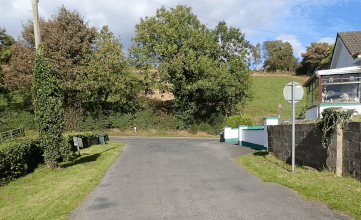
(Pictured: The Drummuckavall border crossing as viewed from the Irish Republic side of the border. At the border the unnamed road crosses a culverted stream to join the Dundalk Road. Photo by Eric Jones and licensed for reuse under Creative Commons License)


Leave a comment

The Ballygawley Barracks Attack

The Provisional Irish Republican Army (IRA) launches an assault on the Royal Ulster Constabulary (RUC) barracks in Ballygawley, County Tyrone, on December 7, 1985. Two RUC officers are shot dead, and the barracks are raked with gunfire before being completely destroyed by a bomb, which wounds an additional three officers.

In 1985, Patrick Kelly becomes leader of the Provisional IRA East Tyrone Brigade. He, along with East Tyrone Brigade members Jim Lynagh and Pádraig McKearney, advocate using flying columns to destroy isolated British Army and RUC bases and stop them from being repaired. The goal is to create and hold “liberated zones” under IRA control that will be gradually enlarged. Although IRA Chief of Staff Kevin McKenna turns down the flying column idea, IRA Northern Command approves the plan to destroy bases and prevent their repair. In 1985 alone there are 44 such attacks. Among the most devastating is the mortar attack on Newry RUC barracks in March.

The Ballygawley attack involves two IRA active service units from the East Tyrone Brigade: an armed assault unit and a bomb unit. There are also several teams of IRA observers in the area. The assault team is armed with AK-47 and AR-15 rifles, while the bombing unit is responsible for planting and detonating a 100-pound (45 kg) bomb. Both units are commanded by Patrick Kelly.

The assault is launched on Saturday, December 7, at 6:55 PM, when the handful of RUC officers manning the base are getting ready to hand over to the next shift. In the first burst of automatic fire, the two guards at the entrance are killed, Constable George Gilliland and Reserve Constable William Clements. Constable Clements’s Ruger Security-Six revolver is taken by the attackers. The base is then raked with gunfire. Another three RUC officers who are inside run out to the back of the base, where they hope the walls might offer some cover. IRA members go into the building and take documents and weapons. The bomb is placed inside and, upon detonation, destroys the entire base, injuring three officers.

The republican IRIS Magazine (#11, October 1987) describes the attack as follows:

“One volunteer took up a position close to the front gate. Two RUC men opened the gate and the volunteer calmly stepped forward, shooting them both dead at point blank range. Volunteers firing AK-47 and Armalite rifles moved into the barracks, raking it with gunfire. Having secured the building, they planted a 100-lb. bomb inside. The bomb exploded, totally destroying the building after the volunteers had withdrawn to safety.”

The first British Army unit to arrive at the base in the wake of the attack is X Company, 1st Battalion, Royal Regiment of Fusiliers.

The attack is one of the Provisional IRA’s biggest during this period. Twelve days later the same IRA brigade mortar the RUC station at Castlederg badly damaging the base and injuring four people. The Ballygawley base is rebuilt by the Royal Engineers in 1986.

The East Tyrone IRA launches two similar attacks in the following years: the successful attack on the Birches base in 1986, and the ill-fated attack on the Loughgall base in 1987, in which eight IRA members are killed. Ballygawley itself had seen conflict before with the Ballygawley land mine attack in 1983 and would see more violence in 1988 with the Ballygawley bus bombing, that cost the lives of eight British soldiers. The gun taken from Constable Clements is found by security forces after the SAS ambush at Loughgall.

The RUC base at Ballygawley is once again targeted by the East Tyrone Brigade on December 7, 1992, in what becomes the debut of the IRA’s brand-new Mark-15 improvised mortar, better known as “Barrack Buster.” Another attack with a horizontal mortar occurs on April 30, 1993, when a RUC mobile patrol leaving Ballygawley compound is targeted. According to an IRA statement, the projectile misses one of the vehicles, hits a wall and explodes.

(Pictured: A Provisional Irish Republican Army badge, with the phoenix symbolising the origins of the Provisional IRA)


Leave a comment

The M62 Coach Bombing

m62-coach-bombing

The M62 coach bombing occurs on February 4, 1974, on the M62 motorway in Northern England, when a Provisional Irish Republican Army (IRA) bomb explodes in a coach carrying off-duty British Armed Forces personnel and their family members. Twelve people, nine soldiers and three civilians, are killed by the bomb, which consists of 25 pounds of high explosive hidden in a luggage locker on the coach.

The coach has been specially commissioned to carry British Army and Royal Air Force personnel on leave with their families from and to the bases at Catterick and Darlington during a period of railway strike action. The vehicle departs from Manchester and is making good progress along the motorway. Shortly after midnight, when the bus is between junction 26 and 27, near Oakwell Hall, there is a large explosion on board. Most of those aboard are sleeping at the time. The blast, which can be heard several miles away, reduces the coach to a “tangle of twisted metal” and throws body parts up to 250 yards.

The explosion kills eleven people outright and wounds over fifty others, one of whom dies four days later. Amongst the dead are nine soldiers – two from the Royal Artillery, three from the Royal Corps of Signals, and four from the 2nd battalion Royal Regiment of Fusiliers. One of the latter is Corporal Clifford Haughton, whose entire family, consisting of his wife Linda and his sons Lee (5) and Robert (2), also die. Numerous others suffer severe injuries, including a six-year-old boy, who is badly burned.

The driver of the coach, Roland Handley, is injured by flying glass, but is hailed as a hero for bringing the coach safely to a halt. Handley dies at the age of 76 after a short illness in January 2011.

Suspicions immediately fall upon the IRA, which is in the midst of an armed campaign in Britain involving numerous operations, later including the Guildford pub bombing and the Birmingham pub bombings.

Reactions in Britain are furious, with senior politicians from all parties calling for immediate action against the perpetrators and the IRA in general. The British media are equally condemnatory. According to The Guardian, it is “the worst IRA outrage on the British mainland” at that time, whilst the BBC describes it as “one of the IRA’s worst mainland terror attacks.” The Irish newspaper The Sunday Business Post later describes it as the “worst” of the “awful atrocities perpetrated by the IRA” during this period.

IRA Army Council member Dáithí Ó Conaill is challenged over the bombing and the death of civilians during an interview and replies that the coach had been bombed because IRA intelligence indicated that it was carrying military personnel only.

Following the explosion, the British public and politicians from all three major parties call for “swift justice.” The ensuing police investigation led by Detective Chief Superintendent George Oldfield is rushed, careless, and ultimately forged, resulting in the arrest of the mentally ill Judith Ward who claims to have conducted a string of bombings in Britain in 1973 and 1974 and to have married and had a baby with two separate IRA members. Despite her retraction of these claims, the lack of any corroborating evidence against her, and serious gaps in her testimony – which is frequently rambling, incoherent, and “improbable” – she is wrongfully convicted in November 1974.

The case against Ward is almost completely based on inaccurate scientific evidence using the Griess test and deliberate manipulation of her confession by some members of the investigating team. The case is similar to those of the Guildford Four, the Birmingham Six, and the Maguire Seven, which occur at the same time and involve similar forged confessions and inaccurate scientific analysis. Ward is finally released in 1992, when three Appeal Court judges hold unanimously that her conviction was “a grave miscarriage of justice,” and that it had been “secured by ambush.”