seamus dubhghaill

Promoting Irish Culture and History from Little Rock, Arkansas, USA


Leave a comment

The Fianna Fáil Government Fires the RTÉ Authority

On November 24, 1972, the Fianna Fáil government fires the RTÉ Authority after it broadcast a recorded radio interview on November 19 by Kevin O’Kelly with Seán Mac Stíofáin, then Chief of Staff of the Provisional Irish Republican Army, on the RTÉ This Week radio programme. Mac Stíofáin is arrested on the same day, charged with IRA membership, and the interview is used as evidence against him. He is sentenced to six months imprisonment on November 25 by the Special Criminal Court in Dublin.

The announcement of dismissal comes shortly before 10:00 p.m. in a statement from Gerry Collins, Minister for Posts and Telegraphs. It is an abrupt but not unexpected climax to a week of conflict and speculation after the broadcast of the Mac Stíofáin interview.

Collins reads the announcement on RTÉ but does not make any further comments. He also announces the appointment of the new Authority. The Taoiseach, Jack Lynch, who is in London for his meeting with British Prime Minister Edward Heath, is kept fully informed of developments during the day.

Lynch says at the London airport before his departure for Dublin that the dismissal is an exercise in democracy. The action is taken because the Government sees the need for “protecting our community.”

Lynch speaks to reporters just after midnight after arriving at the airport from his dinner with the Prime Minister at 10 Downing Street. He says that the Cabinet had decided its course of action in regard to RTÉ on Tuesday, November 21, and that he had been in touch by phone throughout the day with his colleagues in Dublin.

The RTÉ Authority, the Taoiseach says, is controlled by Acts of Parliament and is subject to the democratic process.

It is the obligation of the Government to ensure that their terms of reference are adhered to. The Authority breached a directive given under the Broadcasting Act, ordering them “not to project people who put forward violent means for achieving their purpose.”

In the opinion of the Government, the interview with Mac Stíofáin is a breach of that directive. When Lynch is asked by a reporter how the Government knew that the RTÉ interview with Mac Stíofáin was taking place, he says that they have their own way of knowing things.

The comments of the members of the dismissed Authority reflect indignation, hurt and relief.

Phyllis O’Kelly, widow of the late Seán T. O’Kelly, former President of Ireland, says that it was “a strange thing to happen.” She does not accept that the station was deliberately trying to outwit the Government. The interviewer, Kevin O’Kelly, had listed various people that he wished to interview, and they seemed all right to her.

The Authority’s letter to the Minister makes it abundantly clear that the Authority appreciates his right to issue the direction. It also makes clear its anxiety to abide by that direction.

(From: The Irish Times Archives, http://www.irishtimes.com, November 25, 2010)

Leave a comment

Birth of Eamonn Andrews, Radio & Television Presenter

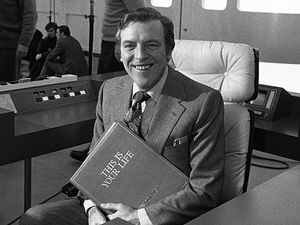
eamonn-andrewsEamonn Andrews, radio and television presenter considered to be Ireland’s first media superstar, is born in Synge Street, Dublin, on December 19, 1922.

Andrews is educated at Synge Street CBS and begans his career as a clerk in an insurance office. He is a keen amateur boxer and wins the Irish junior middleweight title in 1944.

In 1946, he becomes a full-time freelance sports commentator, working for Radio Éireann, Ireland’s national broadcaster. In 1950, he begins presenting programmes for the BBC, being particularly well known for boxing commentaries, and soon becomes one of television’s most popular presenters. He begins hosting the game show What’s My Line? in 1951.

Throughout the 1950s, he commentates on the major British heavyweight fights on the BBC Light Programme, with inter-round summaries by W. Barrington Dalby. On January 20, 1956, he reaches No. 18 in the UK Singles Chart with a “spoken narrative” recording named “The Shifting Whispering Sands (Parts 1 & 2),” which is produced by George Martin with musical backing by the Ron Goodwin Orchestra. The song later reappears on Kenny Everett‘s compilation album The World’s Worst Record Show, which is released in June 1978.

Between 1955 and 1964, Andrews presents the long-running Sports Report on BBC’s Light Programme, now Radio 2. In 1965, he leaves the BBC to join the ITV contractor ABC, where he pioneers the talk show format in the UK. He hosts a chat show on ITV, The Eamonn Andrews Show, for five years. He is known for coming up with off-the-cuff linkings that do not work such as, “Speaking of cheese sandwiches, have you come far?” This is parodied by the character Seamus Android on Round the Horne in the 1960s, performed by Bill Pertwee. In the 1960s he presents Thames Television‘s Today news magazine programme.

Andrews is probably best known as the presenter of the UK’s version of This Is Your Life, between its inception in 1955 and his death in 1987, when he is succeeded by Michael Aspel, who had also succeeded Andrews as host of Crackerjack more than two decades earlier. Andrews becomes the very first This Is Your Life subject on British television when he is surprised by the show’s creator, Ralph Edwards. Andrews also creates a long-running panel game called Whose Baby? that originally runs on the BBC and later on ITV. He is a regular presenter of the early Miss World pageants.

Andrews’ chairs the Radio Éireann Authority, now the RTÉ Board, between 1960 and 1964, overseeing the introduction of State television to Ireland and establishing the Irish State broadcaster as an independent semi-state body. About this time, he also acquires a number of business interests in Ireland, including recording studios and a dance hall.

After months of illness during 1987, originally caused by a virus contracted during an airline flight, but which is not recognised at the time, he dies from heart failure on November 5, 1987, at the age of 64, at Cromwell Hospital, London. He had recorded his last edition of This Is Your Life six days previously on October 30, 1987, surprising Crossroads actress Jane Rossington. After his death, the show, and two others that have yet to be broadcast, are postponed until, with his widow’s permission, they are broadcast in January 1988. His widow, Gráinne, whom he married in 1951, dies 18 months later. They had three adopted children.

His contribution to U.K. radio is commemorated in the The Radio Academy Hall of Fame. Andrews appears as the linking narrator who introduces the unrelated segments that comprise the portmanteau film, Three Cases of Murder (1955).