seamus dubhghaill

Promoting Irish Culture and History from Little Rock, Arkansas, USA


Leave a comment

Birth of Irish National Land League Founder Michael Davitt

michael-davitt

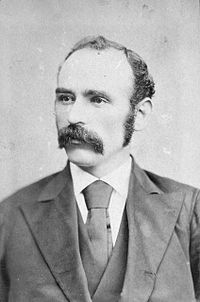
Michael Davitt, Irish republican and agrarian agitator, is born in Straide, County Mayo, on March 25, 1846. Davitt is the  founder of the Irish National Land League, which organizes resistance to absentee landlordism and seeks to relieve the poverty of the tenant farmers by securing fixity of tenure, fair rent, and free sale of the tenant’s interest.

Davitt is the son of an evicted tenant farmer. After their eviction, the family emigrates to England. In 1856, at the age of 10, he starts work in a cotton mill, where he loses an arm in a machinery accident a year later. In 1865, he joins the revolutionary Fenian Brotherhood, an international secret society that seeks to secure political freedom for Ireland. He becomes secretary of its Irish analogue, the Irish Republican Brotherhood (IRB), in 1868. Arrested  in Paddington Station in London for sending firearms to Ireland on May 14, 1870, he is sentenced to 15 years in Dartmoor Prison and there lays plans to link Charles Stewart Parnell’s constitutional reform with Fenian activism to achieve political-agrarian agitation.

Paroled from prison in 1877, Davitt rejoins the IRB and goes to the United States, where the Fenian movement originated. There he is deeply influenced by Henry George’s ideas about the relationship between land monopoly and poverty.

Back in Ireland, using funds raised by John Devoy and Clan na Gael in the United States, Davitt wins Parnell’s cooperation in organizing the Land League in 1879, which leads, however, to his expulsion from the supreme council of the IRB in 1880. He is elected member of Parliament for County Meath in 1882 but is disqualified as he is a convict. He is also imprisoned for seditious speeches in 1881 and 1883.

Because of his public championing of Henry George’s theories of land reform, Parnell repudiates him. Davitt actively defends the Nationalists before the Parnell Commission, which meets between 1887 and 1889. When the Irish party splits in 1890 over Parnell’s involvement in Capt. William Henry O’Shea’s divorce case, Davitt is among the first to oppose Parnell’s continuance as leader.

Davitt is elected to Parliament in 1892 and 1893 but is unseated in both cases. He is elected again, for South Mayo in 1895, but resigns in 1899 in protest against the Second Boer War.

Davitt dies in Elphis Hospital, Dublin on May 30, 1906, at the age of 60, from blood poisoning. The fact that the Lord Lieutenant of Ireland attends his funeral is a public indication of the dramatic political journey this former Fenian prisoner has taken. There is no plan for public funeral, and hence Davitt’s body is brought quietly to the Carmelite Friary, Clarendon Street, Dublin. However, the next day over 20,000 people file past his coffin. His remains are taken by train to Foxford, County Mayo, and buried in the grounds of Straide Abbey at Straide, near his place of birth.

Davitt’s book, The Fall of Feudalism in Ireland (1904), is a valuable record of his time.

Leave a comment

Birth of Edward J. Smith, Captain of the RMS Titanic

edward-john-smith

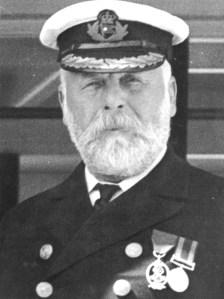
Edward John Smith, English naval reserve officer best known as the captain of the ill-fated RMS Titanic, is born on Well Street, Hanley, Staffordshire, England, on January 27, 1850.

Smith attends the Etruria British School until the age of 13, when he leaves school for a job at the Etruria Forge. In 1867, at the age of 17, he goes to Liverpool in the footsteps of his half-brother Joseph Hancock, a captain on a sailing ship. He begins his apprenticeship on Senator Weber, owned by A. Gibson & Co. of Liverpool.

Smith joins the White Star Line in March 1880 as Fourth Officer on the SS Celtic. He serves aboard the company’s liners to Australia and New York City, where he quickly rises in status. In 1887, shortly after his marriage to Sarah Eleanor Pennington, he receives his first White Star command on the SS Republic.

Beginning in 1895, Smith serves as captain of the SS Majestic for nine years. When the Second Boer War starts in 1899, Majestic is called upon to transport troops to Cape Colony. Smith makes two trips to South Africa, both without incident. From 1904 on, Smith commands the White Star Line’s newest ships on their maiden voyages, including RMS Baltic, RMS Adriatic, RMS Olympic, and RMS Titanic.

The RMS Titanic is built at the Harland & Wolff shipyard in Belfast. On April 10, 1912, Smith boards RMS Titanic at 7:00 AM to prepare for a noon departure. It’s final point of departure on the Atlantic crossing is Queenstown (now Cobh), County Cork, on April 11, 1912.

edward-john-smith-statue

The first four days of the voyage pass without incident, but shortly after 11:40 PM on April 14, Smith is informed by First Officer William McMaster Murdoch that the ship has just collided with an iceberg. It is soon apparent that the ship is seriously damaged with all of the first five watertight compartments having been breached. Smith, aware that there are not enough lifeboats for all of the passengers and crew, does everything in his power to prevent panic and assist in the evacuation. Just minutes before the ship sinks, Smith is still busy releasing Titanic‘s crew from their duties.

At 2:10 AM, Steward Edward Brown sees the captain approach with a megaphone in his hand. He is heard to say, “Well boys, do your best for the women and children, and look out for yourselves.” He then watches as Captain Smith walks onto the bridge alone. This is the last reliable sighting of Smith. Ten minutes later the ship disappears beneath the waves. His body is never recovered.

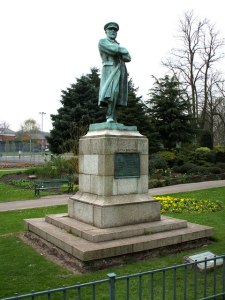
A statue, sculpted by Kathleen Scott, wife of Antarctic explorer Robert Falcon Scott, is unveiled in July 1914 at the western end of the Museum Gardens in Beacon Park, Lichfield. The pedestal is made from Cornish granite and the figure is bronze. Lichfield is chosen as the location for the monument because Smith was a Staffordshire man and Lichfield is the centre of the diocese.