seamus dubhghaill

Promoting Irish Culture and History from Little Rock, Arkansas, USA


Leave a comment

Executions of Èamonn Ceannt, Michael Mallin, Seán Heuston, & Con Colbert

colbert-ceannt-mallin-heuston

Irish patriots Èamonn Ceannt, Michael Mallin, Seán Heuston, and Cornelius “Con” Colbert are executed by firing squad in the Stonebreakers Yard at Kilmainham Gaol on May 8, 1916, as the executions following the 1916 Easter Rising continue.

Éamonn Ceannt, one of the seven signatories of the Proclamation of the Irish Republic, is born in Ballymoe, Glenamaddy in County Galway in 1881. Prior to the Rising, Ceannt is an employee of the Dublin Corporation. He is a co-founder of the Irish Volunteers, partaking in the successful Howth gun-running operation of 1914. His involvement in republican activities is complemented by his interest in Irish culture, specifically Irish language and history, although he is also an accomplished uilleann piper. Ceannt is appointed Director of Communications of the Provisional Government and is Commandant of the Fourth Battalion of the Irish Volunteers, who are stationed at the South Dublin Union, now the site of St. James’s Hospital. Ceannt has about 100 men with him, including his second-in-command Cathal Brugha, and W.T. Cosgrave who goes on later to become Taoiseach. Ceannt and his men at the South Dublin Union take part in some of the fiercest fighting in the rebellion and hold out against far superior numbers of British troops.

Michael Mallin, a silk weaver by trade, is born in Dublin on December 1, 1874. Mallin is the Chief of Staff of the Irish Citizen Army (ICA), second in command only to James Connolly. He trains and drills the ICA and is the Commandant of the St. Stephen’s Green Royal College of Surgeons garrison during the Rising. Countess Markievicz is his second in command. This location sees less action than some of the other sites chosen by the rebels because the British concentrate their efforts on the most strategically important targets such as the General Post Office (GPO) and Four Courts. Mallin surrenders on April 30.

Seán Heuston, born in Dublin on February 21, 1891, is responsible for the organisation of Fianna Éireann in Limerick. Along with Con Colbert, Heuston is involved in the education of the schoolboys at Scoil Éanna, organising drill and musketry exercises. Heuston is the Officer Commanding of the Volunteers in the Mendicity Institution on the south side of Dublin. With 26 Volunteers under his command, they hold their position for two days. With his position becoming untenable against considerable numbers, and the building almost completely surrounded, Heuston sends a dispatch to Connolly informing him of their position. It is soon after sending this dispatch that Heuston decides to surrender. Heuston Railway Station in Dublin is named after him.

Con Colbert is born on October 19, 1888, at Monalena in Limerick, and is one of the younger generations of Irish republicans who take part in the Easter Rising. Prior to the Easter Rising he is an active member of the republican movement. He is one of the founding members of Fianna Éireann. A dedicated pioneer, Colbert is known not to drink or smoke. During the Rising, Colbert is the commander of a group of Volunteers stationed at Watkin’s Brewery on Ardee Street, and later at Jameson’s Distillery on Marrowbone Lane. They hold their position until receiving the order to surrender from Patrick Pearse.

Leave a comment

Signing of the Good Friday Agreement

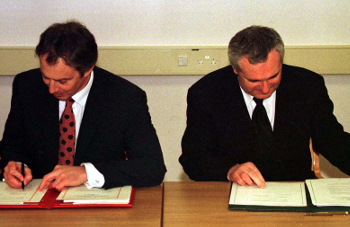
After nearly two years of talks, the Good Friday Agreement, a major political development in the Northern Ireland peace process of the 1990s, is signed by Irish Taoiseach Bertie Ahern and British Prime Minister Tony Blair on Good Friday, April 10, 1998 in Belfast, Northern Ireland.

The Good Friday Agreement brings to an end the 30 years of sectarian conflict in Northern Ireland known as “The Troubles.”  Northern Ireland’s present devolved system of government is based on the Agreement.

The Agreement is made up of two inter-related documents: (1) a multi-party agreement by most of Northern Ireland’s political parties and (2) an international agreement between the British and Irish governments called the British-Irish Agreement.

The Agreement sets out a complex series of provisions relating to a number of areas including the status and system of government of Northern Ireland within the United Kingdom (Strand 1), the relationship between Northern Ireland and the Republic of Ireland (Strand 2), and the relationship between the Republic of Ireland and the United Kingdom (Strand 3).

Issues relating to civil and cultural rights, decommissioning of weapons, justice and policing are central to the Agreement.

The Agreement is approved by voters across the island of Ireland in two referendums held on May 22, 1998. The people of both Northern Ireland and the Republic of Ireland need to approve the Agreement in order for it to come into effect. In Northern Ireland, voters are asked whether they support the multi-party agreement. In the Republic of Ireland, voters are asked whether they will allow the state to sign the agreement and allow necessary constitutional changes to facilitate it.

The British-Irish Agreement comes into force on December 2, 1999. The Democratic Unionist Party (DUP) is the only major political group in Northern Ireland to oppose the Good Friday Agreement.


Leave a comment

The Founding of Fianna Fáil

fianna-fail

Fianna Fáil, the centrist to centre-right and conservative political party in the Republic of Ireland, is founded on March 23, 1926, after a split with Sinn Féin on the issue of abstentionism. Historically, Fianna Fáil has been seen as to the left of Fine Gael and to the right of Sinn Féin and the Labour Party. It is generally seen as a “catch all” populist party, representing a broad range of people from all social classes.

When his motion calling for elected members to be allowed to take their seats in Dáil Éireann if and when the controversial Oath of Allegiance is removed fails to pass at the Sinn Féin Ardfheis in 1926, Éamon de Valera resigns from the presidency of the party and, with Seán Lemass, Constance Markievicz, and others, forms a new party, Fianna Fáil (The Warriors of Destiny), a party that is to dominate 20th-century Irish politics. The party adopts its name on April 2 of the same year.

Though the new party is also opposed to the Treaty settlement, it adopts a different approach of aiming to make the Irish Free State a republic. Fianna Fáil’s platform of economic autarky has appeal among the farmers, working-class people, and the poor, whilst alienating more affluent classes.

From the formation of the first Fianna Fáil government on March 9, 1932, until the election of 2011, the party is in power for 61 of 79 years. Its longest continuous period in office is 15 years and 11 months (March 1932 – February 1948). Its single longest period out of office in the 20th century, is four years and four months (March 1973 – July 1977). Seven of the party’s eight leaders, including de Valera, serve as Taoiseach.

Fianna Fáil joins the Alliance of Liberals and Democrats for Europe (ALDE) party on April 16, 2009, and the party’s Members of the European Parliament (MEPs) sit in the ALDE Group during the 7th European Parliament term from June 2009 until 1 July 1, 2014. The party is an observer affiliate of the Liberal International.

It is the largest party in the Dáil at every general election from the 1932 general election until the 2011 general election, when it suffers the worst defeat of a sitting government in the history of the Irish state. This loss is described as “historic” in its proportions, and “unthinkable.” The party moves from being the largest party to the third-largest party in the Dáil.


Leave a comment

Éamon de Valera Resigns as President of the Republic

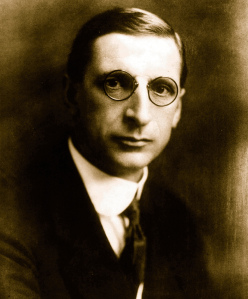
eamon-de-valeraThe Anglo-Irish Treaty is introduced to replace the Republic with a dominion of the British Commonwealth with the King represented by a Governor-General of the Irish Free State. The Treaty is finally signed on December 6, 1921.
Éamon de Valera does not join in on the negotiations. His opponents say that he does so because he knows that the British will only allow an Irish dominion, not a republic, and does not want to be blamed for giving up the idea of a republic. De Valera says he is angry because the delegates working out the treaty had not asked him before signing the treaty. But at a secret session of the Dáil during the Treaty debates and publicised in January 1922, de Valera’s ideas for a treaty include dominion status, the “Treaty Ports,” a veto by the parliament in Belfast, and the king as head of the Commonwealth. Ireland would pay a share of the imperial debt.

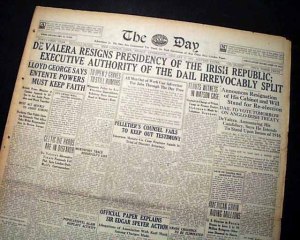
On January 9, 1922, when the Treaty is accepted by a vote of 64 to 57, de Valera resigns as President of the Republic and a large minority of Sinn Féin Teachta Dálas (TDs) leave Dáil Éireann. De Valera  states, “In view of the vote that was taken here on Saturday and which I had definitely to oppose as one that was tending to subvert the Republic which I was elected to my present position to defend and maintain; and as it appeared to me also to be a vote which would tend to subvert the independence of the country, I could no longer continue— as I was beaten in that — I could no longer continue in my present office feeling I did not have the confidence of the House. I therefore wish to place my resignation in the hands of the Assembly.”the-day-01-09-1922

A motion to re-elect De Valera as President is defeated along pro and anti-treaty lines by 60 votes to 58. Arthur Griffith, de Valera opponent and former colleague, is elected President of Dáil Éireann in his place.

Following the vote, Griffith says, “Before another word is spoken I want to say: I want the Deputies here to know, and all Ireland to know, that this vote is not to be taken as against President de Valera. It is a vote to help the Treaty, and I want to say now that there is scarcely a man I have ever met in my life that I have more love and respect for than President de Valera. I am thoroughly sorry to see him placed in such a position. We want him with us.”