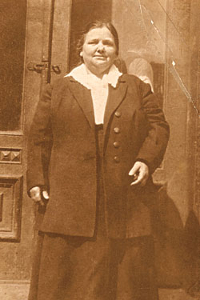
Her parents, Matthew and Julia Moore, had come to the United States in 1888 and are living at 32 Monroe Street in Manhattan. Moore departs from Queenstown aboard the S.S. Nevada, one of 148 steerage passengers. Accompanied by her brothers, Anthony and Philip, she spends twelve days at sea, including Christmas Day, arriving in New York City on Thursday evening, December 31. It is reported that her arrival is on her 15th birthday, but records in Ireland reveal that her birthday is in May, and she is actually seventeen.
Ellis Island officially opens on January 1, 1892, and, as the first person to be processed at the newly opened facility, Moore is presented with an American $10 gold piece from an American official. All three children are soon reunited with their parents in New York. From 1820 to 1920, more than 4 million people leave their native shores of Ireland bound for the Port of New York and a new life in America.
Moore marries a son of German immigrants, Joseph Augustus Schayer, an employee at Manhattan’s Fulton Fish Market, with whom she has at least eleven children. She dies of heart failure on December 6, 1924, and is buried in Calvary Cemetery, Queens. Her previously unmarked grave is identified in August 2006. On October 11, 2008, a dedication ceremony is held at Calvary which celebrates the unveiling of a marker for her grave, a Celtic cross made of Irish Blue Limestone.
A woman named “Annie Moore” who died near Fort Worth, Texas in 1924 had long been thought to be the one whose arrival marked the beginning of Ellis Island. Further research, however, established that the Annie Moore in Texas was born in Illinois.
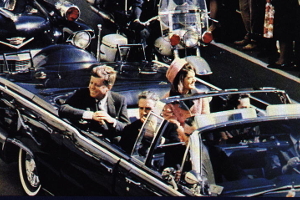
At 12:30 PM CST, as Kennedy’s uncovered 1961 Lincoln Continental four-door convertible limousine enters Dealey Plaza, Nellie Connally, the First Lady of Texas, turns around to President Kennedy, who is sitting behind her, and comments, “Mr. President, you can’t say Dallas doesn’t love you,” to which President Kennedy acknowledges by saying “No, you certainly can’t.” These are the last words ever spoken by John F. Kennedy.
From Houston Street, the presidential limousine makes the planned left turn onto Elm Street, allowing it access to the Stemmons Freeway exit. As it turns onto Elm, the motorcade passes the Texas School Book Depository. Shots are fired at Kennedy as the motorcade continues down Elm Street. About 80% of the witnesses recall hearing three shots.
A minority of the witnesses recognize the first gunshot they hear as weapon fire, but there is hardly any reaction to the first shot from a majority of the people in the crowd or those riding in the motorcade. Many later say they heard what they first thought to be a firecracker, or the backfire of a vehicle, just after the President started waving.
Within one second of each other, Kennedy, Texas Governor John Connally, and First Lady Jacqueline Kennedy, all turn abruptly from looking to their left to looking to their right. Connally, like the President a World War II military veteran, testifies that he immediately recognizes the sound of a high-powered rifle. He also testifies that when his head is facing about 20 degrees left of center, he is hit in his upper right back by a bullet he does not hear fired. After Connally is hit he shouts, “Oh, no, no, no. My God. They’re going to kill us all!”
Mrs. Connally testifies that just after hearing a loud, frightening noise that comes from somewhere behind her and to her right, she turns toward President Kennedy and sees him with his arms and elbows raised high, with his hands in front of his face and throat. She then hears another gunshot and then Governor Connally yelling. Mrs. Connally then turns away from Kennedy toward her husband, at which point another gunshot sounds and she and the limousine’s rear interior are covered with fragments of skull, blood, and brain.
According to the Warren Commission and the House Select Committee on Assassinations, as President Kennedy waves to the crowds on his right with his right arm upraised on the side of the limo, a shot enters his upper back, penetrates his neck, slightly damages a spinal vertebra and the top of his right lung, and exits his throat nearly centerline just beneath his larynx, nicking the left side of his suit tie knot. He raises his elbows and clenches his fists in front of his face and neck, then leans forward and left. Mrs. Kennedy, facing him, then puts her arms around him in concern.
A second shot strikes the President as the presidential limousine is passing in front of the John Neely Bryan north pergola concrete structure. Both the Warren Commission and the House Select Committee on Assassinations concludes that the second shot to hit the president enters the rear of his head and passing in fragments through his head, created a large, roughly oval hole on the rear, right side. The president’s blood and fragments of his scalp, brain, and skull land on the interior of the car, the inner and outer surfaces of the front glass windshield and raised sun visors, the front engine hood, the rear trunk lid, the follow-up Secret Service car and its driver’s left arm, and motorcycle officers riding on both sides of the President behind him.
After the President has been shot in the head, Mrs. Kennedy begins to climb out onto the back of the limousine, though she later has no recollection of doing so. United States Secret ServiceSpecial AgentClint Hill, who is riding on the left front running board of the follow-up car, believes she is reaching for something, perhaps a piece of the President’s skull. He jumps onto the back of the limousine while at the same time Mrs. Kennedy returns to her seat. He clings to the car as it exits Dealey Plaza and accelerates, speeding to Parkland Memorial Hospital.
After Mrs. Kennedy crawls back into her limousine seat, both Governor Connally and Mrs. Connally hear her say more than once, “They have killed my husband,” and “I have his brains in my hand.”
The staff at Parkland Hospital’s Trauma Room 1 who treat President Kennedy observe that his condition is “moribund,” meaning that he has no chance of survival upon arriving at the hospital. George Burkley, the President’s personal physician, states that a gunshot wound to the skull is the cause of death. Burkley signs President Kennedy’s death certificate.
At 1:00 PM, CST (19:00 UTC), after all heart activity has ceased and after Father Oscar Huber has administered last rites, the President is pronounced dead.
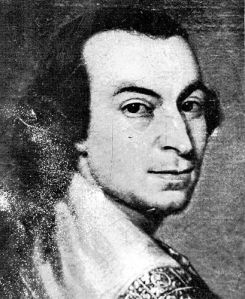
Don Hugo O’Conor is named Commandant Inspector of New Spain on January 20, 1773. O’Conor, a descendant of king of Ireland Turlough Mor O’Conor, is born in 1732 in Ireland but is raised in Spain. The O’Conor family is also related to two officers in the Spanish army, Colonel Don Domingo O’Reilly and Field Marshal Alejandro O’Reilly. Originally, it is believed that the family name is most likely spelled “O’Connor” but is changed as the result of frequent misspellings by Spanish speakers.
In 1751, O’Conor follows his two cousins to Spain where they are already serving as officers in the Spanish Royal Army. He immediately joins the Regiment of Hibernia.
O’Conor serves in Spain’s war against Portugal in the early 1760’s and is then sent to the New World, serving in Cuba under his cousin, Field Marshal O’Reilly. O’Conor rises steadily through the ranks and in 1763 is made a knight of the Order of Calatrava.
In 1765, O’Conor is transferred to Mexico and serves on the staff of Don Juan de Villalba and shortly thereafter, to temporarily command the northern presidio of San Sabá. He goes to Texas to investigate a dispute around San Agustín de Ahumada Presidio between Governor Ángel de Martos y Navarrete and Rafael Martínez Pacheco, a future governor of Texas. During this time he obtains the title of inspector general of the Provincias Internas. In 1767, he is appointed governor of Texas, replacing Martos y Navarrete. When he takes office, he finds that one of its major cities, San Antonio, is shattered by frequent attacks of several Indian tribes. As a result, the new governor set up a garrison at Los Adaes to protect the city.
In 1771, O’Conor becomes the commander of the Chihuahua frontier and on January 20, 1773 is appointed Commandant Inspector of New Spain. Utilizing a system of frontier presidios, O’Conor fights a constant battle with numerous Indian tribes, primarily the Apaches, while helping reorganize and unify New Spain’s northern borders. He becomes the founding father of the city of Tucson, Arizona when he authorizes the construction of a military fort in that location in 1775.
In October 1776, O’Conor returns from the frontier and is appointed governor of the Yucatán, however at his station in Mérida his health begins to fail. On March 8, 1779, Don Hugo O’Conor dies at Quinta de Miraflores, just east of Mérida. O’Conor is only 44-years-old when he dies but has already risen to the rank of brigadier general. Had he lived to old age, Don Hugo O’Conor may well have risen to the highest ranks of Spain’s army or government.

 seamus dubhghaill