seamus dubhghaill

Promoting Irish Culture and History from Little Rock, Arkansas, USA


Leave a comment

Birth of Reg Ryan, Irish Footballer

Reginald Alphonso Ryan, Irish footballer also referred to as Paddy Ryan, is born in Dublin, County Dublin, on October 30, 1925. He plays for West Bromwich Albion F.C., Derby County F.C. and Coventry City F.C. He is also a dual international, playing for both Ireland teams – the FAI XI and the IFA XI. He is the last player to represent both teams. He is considered more of a goal creator then a goalscorer.

Ryan initially plays Gaelic football for the Marino School in Dublin while growing up, but then switches to soccer after moving to Blackpool, Lancashire, England, during the early years of World War II. He then plays with Claremount School, Blackpool Boys, various factory teams and has trials with both Sheffield United F.C. and Nottingham Forest F.C. before joining Nuneaton Borough F.C.

Ryan has two spells with Coventry City. In April 1943, he signs for the club as an amateur and during the 1942–43 season he plays two games in wartime regional leagues. He then turns professional in August 1944 and makes a further four appearances for the club during the 1944–45 wartime season. After playing for West Bromwich Albion and Derby County, he returns to City in September 1958. He then helps the club win promotion from the newly formed Football League Fourth Division, after they finish as runners-up in 1959. During his second spell with City he plays 70 times in all competitions.

In April 1945, Ryan signs for West Bromwich Albion and, during the 1945–46 season, makes 17 appearances in the Football League South. He makes his debut for the club against Millwall F.C. in November 1945. Together with Davy Walsh and Jackie Vernon, he helps West Brom gain promotion to the Football League First Division in 1949. In 1954, together with Ronnie Allen and Frank Griffin, he is also a member of the West Brom team that finishes as First Division runners-up and FA Cup winners. He also helps West Brom gain a share of the FA Charity Shield when he scores in a 4–4 draw against Wolverhampton Wanderers F.C.

Ryan signs for Derby County in June 1955 for a fee of £3,000. He is appointed team captain by manager Harry Storer, Jr., and during his three seasons with the club misses only three matches – two because of injury and one because of international duty. He is a member of the side promoted as champions of the Third Division North to the Football League Second Division in 1956–57. In 1955 he also plays for an English Division Three North XI against an English Division Three South XI. He plays 133 league games for County, scoring 30 goals. He also plays a further six games for the club in the FA Cup, scoring a further goal.

When Ryan begins his international career in 1949 there are, in effect, two Ireland teams, chosen by two rival associations. Both associations, the Northern Ireland–based Irish Football Association (IFA) and the Republic of Ireland–based Football Association of Ireland (FAI) claim jurisdiction over the whole of Ireland and select players from the whole island. As a result, several notable Irish players from this era, including Ryan, play for both teams.

Between 1949 and 1955 Ryan makes 16 appearances and scores 3 goals for the FAI XI. He makes his debut in a 3–1 defeat to Sweden on November 13, 1949, in a qualifier for the 1950 FIFA World Cup. He scores his first two goals for the FAI XI in October 1953 during the qualifiers for the 1954 FIFA World Cup, one against France in a 5–3 defeat and the second, a penalty, against Luxembourg in 4–0 win. On November 7, 1954, in a friendly against Norway, he scores his third goal, again from the penalty spot, and earns the FAI XI a 2–1 victory. He makes his last appearance for the FAI XI on November 27, 1955, in a 2–2 draw with Spain.

Ryan makes his one and only appearance for the IFA XI in a 0–0 draw with Wales on March 8, 1950. As well as being part of the 1950 British Home Championship, the game also doubles up as a qualifier for the 1950 FIFA World Cup. Ryan, together with Con Martin, Davy Walsh and Tom Aherne, is one of four players born in the Irish Free State, included in the IFA XI that day. He earlier plays for the FAI XI in the same competition, and as a result, plays for two different teams in the same FIFA World Cup tournament. This situation eventually leads to intervention by FIFA and, as a result, Ryan becomes one of the last four Irish Free State–born players to play for the IFA XI.

After retiring as a player in November 1960, Ryan works as a pools supervisor for both Coventry City (1960–1961) and West Bromwich Albion (1961–1962). Between September 1962 and October 1976, he is chief scout for West Brom. He later works as a scout for various clubs including Aston Villa F.C., Derby County F.C., Hereford United F.C. and Leeds United F.C. before retiring in 1994.

Ryan dies at the age of 71 on February 13, 1997, at Sheldon, West Midlands, England.

Leave a comment

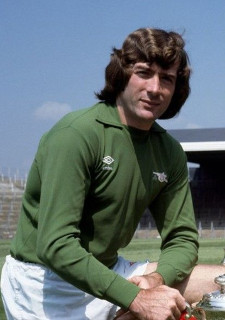
Pat Jennings Becomes First to Make 1,000 Senior Appearances

On February 26, 1983, Northern Irish footballer Pat Jennings becomes the first player in English football to make 1,000 senior appearances, celebrating this milestone with a clean sheet in a goalless league draw for Arsenal at West Bromwich Albion.

Jennings is born in Newry, County Down, Northern Ireland on June 12, 1945. After playing for Shamrock Rovers‘ under-18 side at the age of 11, he concentrates on Gaelic football until he is sixteen years old, when he makes his soccer comeback with his hometown side Newry Town. After impressing with the team, he moves to English Third Division side Watford in May 1963. He again impresses in his first season in England, playing every league game for his club. He makes his international debut with the Northern Ireland national football team at the age of eighteen while playing for Watford. This game, on April 15, 1964, is a British Home Championship match against Wales, with Northern Ireland winning the game 3–2. George Best makes his international debut in the same game. Jennings is signed by Tottenham Hotspur for £27,000 in June 1964.

Jennings spends thirteen years at White Hart Lane, where he plays in 472 league games for Spurs, and 591 in all competitions. He wins the FA Cup in 1967, the League Cup in 1971 and 1973, and the UEFA Cup in 1972. In the 1967 Charity Shield he scores once from his own area, kicking the ball from his hands and sending a large punt down the field that bounces over Manchester United goalkeeper Alex Stepney and into the net. In 1973 the Football Writers’ Association names him as its footballer of the year. Three years later he wins Professional Footballers’ Association‘s version of the award, the first goalkeeper to receive this accolade, and to this date remains only one of two, along with Peter Shilton.

In August 1977, he is transferred to Tottenham’s arch-rivals, Arsenal, with Tottenham thinking he is nearing the end of his career. However, he sees off rivals for the goalkeeper’s jersey to play for Arsenal for another eight years. While at Highbury, he helps Arsenal to four Cup finals in three successive years, the FA Cup final in 1978, 1979, and 1980, as well as the European Cup Winners’ Cup final that year. However, Arsenal only manages to win the second of these finals, a 3–2 victory against Manchester United. In total, he makes 327 appearances for Arsenal, 237 of them in the League, between 1977 and his eventual retirement from first-team club football in 1985.

Despite his retirement from club football in 1985, Jennings returns to Tottenham Hotspur, playing mostly in their reserve side to maintain his match sharpness for Northern Ireland’s 1986 FIFA World Cup campaign. He plays his final international game at the 1986 World Cup, on his 41st birthday, making him at the time the World Cup’s oldest-ever participant. The match is Northern Ireland’s final group game, a 3–0 defeat against Brazil. In total, he participates in the qualifying stages of six World Cups between 1966 and 1986.

Jennings final appearance for Tottenham is in the Football League Super Cup against Liverpool in January 1986. He is also briefly on Everton‘s books, having been signed as goalkeeping cover for the 1986 FA Cup Final against Liverpool, Neville Southall having been injured playing for Wales.

Jennings works as a goalkeeping coach at Tottenham since 1993. In 2003 he is inducted into the English Football Hall of Fame in recognition of the skills he demonstrated in the English league. He and his family have lived for many years in Broxbourne, Hertfordshire, where his son attended The Broxbourne School along with the sons of fellow Spurs players Chris Hughton, Osvaldo Ardiles and Ray Clemence. He is still associated with the Spurs and hosts Corporate Hospitality fans in the Pat Jennings Lounges at White Hart Lane and Windsor Park, Belfast.


Leave a comment

Birth of Pat Jennings, Northern Ireland Footballer

pat-jennings

Patrick Anthony Jennings, Northern Irish footballer, is born in Newry, County Down, Northern Ireland on June 12, 1945. He plays 119 games for Northern Ireland as a goalkeeper, a figure which at the time is a world record and is still a Northern Ireland record, in an international career which lasts for over 22 years.

After playing for the Shamrock Rovers F.C. under-18 squad at the age of 11, Jennings concentrates on Gaelic football until he is sixteen years old, when he makes his soccer comeback with his hometown Newry City F.C. After impressing with the team, he moves to English Third Division Watford F.C. in May 1963. He again impresses in his first season in England, playing every league game for his club, and making two international appearances that season. He is signed by Tottenham Hotspur F.C. for £27,000 in June 1964.

Jennings spends thirteen years at White Hart Lane, where he plays in 472 league games for the Spurs, and 591 in all competitions. He wins the FA Cup in 1967, the League Cup in 1971 and 1973, and the UEFA Cup in 1972. In 1973 the Football Writers’ Association name him as its footballer of the year. Three years later he wins the Professional Footballers’ Association‘s (PFA) version of the award, the first goalkeeper to receive this accolade.

In August 1977, Jennings is transferred to Tottenham’s arch-rivals, Arsenal F.C., with Tottenham thinking he is nearing the end of his career. However, Jennings plays for Arsenal for another eight years where he helps Arsenal to the FA Cup final in 1978, 1979, and 1980, as well as the UEFA Cup Winners’ Cup final that year. However, Arsenal only manages to win the second of these finals, a 3–2 victory against Manchester United F.C. In total, Jennings makes 327 appearances for Arsenal between 1977 and his eventual retirement from first-team club football in 1985. On February 26, 1983, he becomes the first player in English football to make 1,000 senior appearances, celebrating this milestone with a clean sheet in a goalless league draw for Arsenal at West Bromwich Albion F.C.

After his retirement, Jennings returns to Tottenham Hotspur, playing mostly in their reserve side to maintain his match sharpness for Northern Ireland’s 1986 FIFA World Cup campaign. His final appearance for Tottenham is in the Football League Super Cup against Liverpool F.C. in January 1986. He also plays briefly for Everton F.C., having been signed as goalkeeping cover for the 1986 FA Cup Final against Liverpool.

Despite retiring from club football in 1985, Jennings plays his final international game at the 1986 FIFA World Cup, on his 41st birthday, making him at the time the World Cup’s oldest ever participant. The match is Northern Ireland’s final group game, a 3–0 defeat against Brazil. In total, he participates in the qualifying stages of six World Cups between 1966 and 1986.

Following his retirement Jennings works as a goalkeeping coach. In 2003 he is inducted into the English Football Hall of Fame in recognition of the skills he demonstrated in the English league. His son, also named Pat, is also a goalkeeper. He has played for League of Ireland clubs University College Dublin A.F.C., Derry City F.C., Shamrock Rovers and NIFL Premiership club Glenavon F.C.

Jennings and his family have lived for many years in Broxbourne, Hertfordshire, where his son attended The Broxbourne School along with the sons of fellow Spurs players Chris Hughton, Osvaldo Ardiles and Ray Clemence. He is still associated with the Spurs and hosts Corporate Hospitality fans in the Pat Jennings Lounges at White Hart Lane and Windsor Park, Belfast.


Leave a comment

Death of Peter Doherty, Northern Ireland Footballer

peter-doherty

Peter Dermot Doherty, Northern Ireland international footballer and manager who played for several clubs, including Manchester City F.C. and Doncaster Rovers F.C., dies in Poulton-le-Fylde, Lancashire, England on April 6, 1990.

Born in Magherafelt, County Londonderry on June 5, 1913, Doherty begins his career with Glentoran F.C. in the Irish League. After helping Glentoran to the 1933 Irish Cup, early in the 1933–1934 season he joins English club Blackpool F.C., at the age of 19. He then joins Manchester City on February 19, 1936 for a then-club record of £10,000. Blackpool needs the money urgently, and Doherty is summoned from his lunch to report to Bloomfield Road. He tries hard to persuade Blackpool directors that he does not wish to leave the club, for he is due to marry a local girl and has just bought a new house in the town. The fee is an exceptionally high transfer fee for the period, coming within £1,000 of the British record. Doherty’s Manchester City debut, against Preston North End F.C., is not a successful one. Tightly man-marked by Bill Shankly throughout, he fails to make an impact. He later describes the remainder of his first Manchester City season as “uneventful,” however his second is anything but.

Manchester City starts the 1936–1937 season poorly and are in the bottom half of the table until December. Occasional big wins, including a 6–2 defeat of West Bromwich Albion F.C. and a 4–1 defeat of Everton F.C., are mixed with extended barren runs. At one point the club gains just one win in twelve matches. However, Doherty scores goals regularly. A goal in a 5–3 Christmas day loss to Grimsby Town F.C. is his twelfth of the season. Christmas proves to be a turning point for the club, as a win against Middlesbrough F.C. the following day is the start of a long unbeaten run. By April, Manchester City is second in the table and faces a fixture against Arsenal F.C., league leaders and the dominant club of the period. Doherty scores the first goal in a 2–0 win, and City reaches the top of the table. The unbeaten run continues until the end of the season, and City secures their first league championship with a 4–1 win over Sheffield Wednesday F.C.. Doherty, with 30 league goals, is the club’s leading scorer, helped by a run of eleven goals in seven games as the season draws to a close.

Doherty scores 79 goals in 130 appearances during his time at Maine Road. During the World War II years of 1939–1945, Doherty serves in the Royal Air Force. He remains registered as a Manchester City player, scoring 60 goals in 89 wartime matches, though wartime games are not generally included in official records. He also guests for numerous clubs across the country. During a guest appearance for Port Vale F.C. in 1945, he famously goes to take a penalty but instead of shooting he lays it off to a teammate who scores.

After the conclusion of the war, Doherty transfers to Derby County F.C., with whom he wins the FA Cup, scoring a goal in the final itself. He also goes on to play for Huddersfield Town A.F.C., scoring 33 goals in 83 league appearances.

Doherty makes his final move to Doncaster in 1949, where he assumes the role of player-manager. He later becomes manager of the Northern Ireland national football team (1951–1962), for whom he has 16 caps as a player. He leads the country to the 1958 FIFA World Cup, reaching the quarter-finals. He also manages Bristol City F.C..

Doherty’s coaching techniques are revolutionary at the time. He emphasises ball practice and instead of endless laps of the pitch, suggests volleyball “to promote jumping, timing and judgement,” basketball “to encourage split-second decision-making and finding space,” and walking football “to build up calf muscles.”

Later life sees Doherty become a scout for Liverpool F.C., helping to unearth such talents as Kevin Keegan. He is inducted into the English Football Hall of Fame in 2002.

Following Doherty’s death in 1990, a plaque to mark his birthplace is placed in Magherafelt. It can be found at what is now a barber shop.


Leave a comment

Birth of Footballer Johnny Giles

Michael John “Johnny” Giles, former association footballer and manager, is born in Ormond Square, Dublin, on November 6, 1940. He is best remembered for his time as a midfielder with Leeds United F.C. in the 1960s and 1970s. After retiring from management in 1985, Giles serves as the senior analyst on RTÉ Sport‘s coverage of association football from 1986 until 2016. The Football Association of Ireland (FAI) votes Giles as the greatest Irish player of the last 50 years at the UEFA Jubilee Awards in 2004.

After winning an FA Cup winner’s medal under Matt Busby at Manchester United F.C., Giles moves to Leeds in 1963 where he plays in midfield alongside captain Billy Bremner. The duo goes on to form a central midfield partnership which is one of the best in English club football. Their pairing helps yield several major trophies in the most successful era in Leeds’ history. By a strange coincidence, Giles and Bremner both score exactly 115 goals for the club.

In his later years in football, Giles pursues a managerial career which sees him installed as player-manager and manager of, among others, West Bromwich Albion F.C., the Republic of Ireland national football team, Vancouver Whitecaps F.C. and Shamrock Rovers F.C. Despite having an outstanding knowledge of the game, Giles personally never likes being a manager. He becomes disillusioned with aspects of the job, such as suffering at the hands of non-committal boardrooms and leaves management permanently in 1985. He later declares that he has no regrets about quitting managerial life.

Subsequently, after repeated encouragement from childhood friend Eamon Dunphy, Giles inadvertently enters the world of football punditry in 1986. He goes on to establish himself as the highly respected senior analyst on RTÉ Sport. In addition, he writes two columns per week for the Irish Evening Herald newspaper and offers his opinions about the game on radio station, Newstalk 106.

Giles resides in the Harborne area of the city of Birmingham, England. To coincide with his 70th birthday, Giles compiles a first ever autobiography chronicling his life in and outside of football which is released in November 2010. The autobiography, titled A Football Man, becomes the best-selling book in the Republic of Ireland.