seamus dubhghaill

Promoting Irish Culture and History from Little Rock, Arkansas, USA


Leave a comment

Birth of Clergyman Narcissus Marsh

narcissus-marsh

Narcissus Marsh, English clergyman who is successively Church of Ireland Bishop of Ferns and Leighlin, Archbishop of Cashel, Archbishop of Dublin and Archbishop of Armagh, is born on December 20, 1638, at Hannington, Wiltshire.

Marsh is educated at Magdalen Hall, Hertford College, Oxford. He later becomes a fellow of Exeter College, Oxford, in 1658. In 1662 he is ordained, and presented to the living of Swindon, which he resigns in the following year.

After acting as chaplain to Seth Ward, Bishop of Exeter and then Bishop of Salisbury, and Lord Chancellor Clarendon, he is elected principal of St. Alban Hall, Oxford, in 1673. In 1679 he is appointed provost of Trinity College, Dublin, where he does much to encourage the study of the Irish language. He helps to found the Dublin Philosophical Society and contributes to it a paper entitled Introductory Essay to the Doctrine of Sounds (printed in Philosophical Transactions, No. 156, Oxford, 1684).

In 1683 Marsh is consecrated Bishop of Ferns and Leighlin, but after the accession of James II he is compelled by the turbulent soldiery to flee to England in 1689, when he becomes Vicar of Gresford, Flintshire, and Canon of St. Asaph. Returning to Ireland in 1691 after the Battle of the Boyne, he is made Archbishop of Cashel, and three years later he becomes Archbishop of Dublin. About this time, he founds Marsh’s Library in Dublin, which is the oldest public library in Ireland. He becomes Archbishop of Armagh in 1703. Between 1699 and 1711 he is six times a Lord Justice of Ireland.

Narcissus Marsh dies on November 2, 1713. His funeral oration is pronounced by his successor at Dublin, Archbishop William King. A more acerbic account is provided by Jonathan Swift.

Many oriental manuscripts belonging to Narcissus Marsh are now in the Bodleian Library in Oxford.


Leave a comment

Birth of Thomas Henry Wyatt, Anglo-Irish Architect

Thomas Henry WyattAnglo-Irish architect, is born at Lough-Glin House, County Roscommon, on May 9, 1807.

Wyatt has a prolific and distinguished career, being elected President of the Royal Institute of British Architects (1870–1873) and being awarded its Royal Gold Medal for Architecture in 1873. His reputation during his lifetime is largely as a safe establishment figure, and critical assessment has been less favourable more recently, particularly in comparison with his younger brother, the better-known Matthew Digby Wyatt.

Wyatt’s father, Matthew Wyatt (1773–1831), is a barrister and police magistrate for Roscommon and Lambeth. Wyatt is presumed to have moved to Lambeth with his father in 1825 and then initially embarks on a career as a merchant sailing to the Mediterranean, particularly Malta.

Wyatt marries his first cousin Arabella Montagu Wyatt (1807–1875). She is the second daughter of his uncle Arthur who is agent to the Duke of Beaufort. This consolidates his practice in Wales. He lives at and practises from 77 Great Russell Street in BloomsburyLondon.

Wyatt’s early training is in the office of Philip Hardwick where he works until 1832, and is involved in work on Goldsmith’s HallEuston Station and the warehouses at St. Katharine Docks.

Wyatt begins practice on his own account in 1832 when he is appointed District Surveyor for Hackney, a post he holds until 1861. By 1838 he has acquired substantial patronage from the Duke of Beaufort, the Earl of Denbigh and Sidney Herbert and David Brandon join him as partner. This partnership lasts until 1851. Wyatt’s son Matthew (1840–1892) becomes his father’s partner in 1860.

Wyatt works in many styles ranging from the Italianate of Wilton through to the Gothic of many of his churches. His practice is extensive with a large amount of work in Wiltshire largely as a result of his official position and the patronage of the Herbert family and in Monmouthshire through the Beaufort connection.

Thomas Henry Wyatt dies at his Great Russell Street home on August 5, 1880, leaving an estate of £30,000. He is buried at St. Lawrence’s Church, Weston Patrick.


Leave a comment

Birth of Bryan Guinness, 2nd Baron Moyne

bryan-guinness

Bryan Walter Guinness, 2nd Baron Moyne, heir to part of the Guinness family brewing fortune, lawyer, poet, and novelist, is born on October 27, 1905.

Guinness is born in London to Walter Edward Guinness, 1st Baron Moyne, son of Edward Guinness, 1st Earl of Iveagh, and Lady Evelyn Stuart Erskine, daughter of Shipley Gordon Stuart Erskine, 14th Earl of Buchan. He attends Heatherdown School, near Ascot in Berkshire, followed by Eton College, and Christ Church, Oxford, and is called to the bar in 1931.

As an heir to the Guinness brewing fortune and a handsome, charming young man, Bryan is an eligible bachelor. One of London’s “Bright Young Things,” he is an organiser of the 1929 “Bruno Hat” hoax art exhibition held at his home in London. Also, in 1929 he marries the Hon. Diana Mitford, one of the Mitford sisters, and has two sons with her. The couple become leaders of the London artistic and social scene and are dedicatees of Evelyn Waugh‘s second novel Vile Bodies. However, they divorce in 1933 after Diana deserts him for British fascist leader Sir Oswald Mosley.

Guinness remarries happily in 1936 to Elisabeth Nelson, of the Nelson publishing family, with whom he has nine children.

During World War II, Guinness serves for three years in the Middle East with the Spears Mission to the Free French, being a fluent French speaker, with the rank of major. Then in November 1944 Guinness succeeds to the barony when his father, posted abroad as Resident Minister in the Middle East by his friend Winston Churchill, is assassinated in Cairo.

After the war, Lord Moyne serves on the board of the Guinness corporation as vice-chairman (1947-1979), as well as the Guinness Trust and the Iveagh Trust, sitting as a crossbencher in the House of Lords. He serves for 35 years as a trustee of the National Gallery of Ireland and donates several works to the gallery. He writes a number of critically applauded novels, memoirs, books of poetry, and plays. With Frank Pakenham he seeks the return of the “Lane Bequest” to Dublin, resulting in the 1959 compromise agreement. He is invested as a Fellow of the Royal Society of Literature.

Lord Moyne dies of a heart attack on July 6, 1992, at Biddesden House, his home in Wiltshire, and is succeeded by his eldest son Jonathan. He is buried at Ludgershall, Wiltshire, England.


Leave a comment

Death of Phil Lynott

phil-lynott

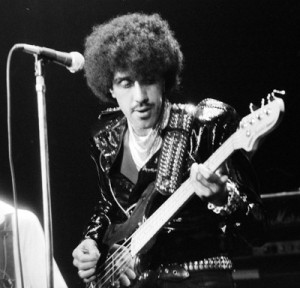
Philip Parris “Phil” Lynott, Irish musician, singer, songwriter, and a founding member, principal songwriter, lead vocalist, and bassist of Thin Lizzy, dies on January 4, 1986, in Salisbury, Wiltshire, England.

Born in West Bromwich, Staffordshire, England on August 20, 1949, Lynott goes to live with his grandmother, Sarah Lynott, in Crumlin, Dublin, when he is four years old. He is introduced to music through his uncle Timothy’s record collection and becomes influenced by Motown and The Mamas and the Papas.

Growing up in Dublin in the 1960s, Lynott fronts several bands as a lead vocalist, most notably teaming up with bassist Brendan ‘Brush’ Shiels to form Skid Row in early 1968. It is during this period that Lynott learns to play the bass guitar.

Toward the end of 1969, Lynott, now confident enough to play bass himself in a band, teams with Brian Downey, Eric Bell, and Eric Wrixon to form Thin Lizzy. The band’s first top ten hit comes in 1973 with a rock version of the well-known Irish traditional song “Whiskey in the Jar.” With the release of the Jailbreak album in 1976, Lynott and Thin Lizzy become international superstars on the strength of the album’s biggest hit, “The Boys Are Back in Town.” The song reaches the Top 10 in the United Kingdom, No. 1 in Ireland, and is a hit in the United States and Canada.

Having finally achieved mainstream success, Thin Lizzy embarks on several consecutive world tours. However, the band suffers from personnel changes. By the early 1980s, Thin Lizzy is starting to struggle commercially and Lynott starts showing symptoms of drug abuse, including regular asthma attacks. After the resignation of longtime manager Chris O’Donnell, Lynott decides to disband Thin Lizzy in 1983.

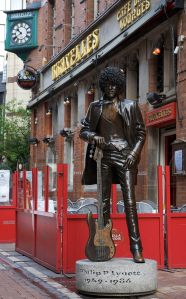
phil-lynott-statue

In 1984, Lynott forms a new band, Grand Slam, with Doish Nagle, Laurence Archer, Robbie Brennan, and Mark Stanway. The band tours various clubs but suffers from being labeled a poor version of Thin Lizzy due to the inclusion of two lead guitarists. Grand Slam disbands at the end of the year due to a lack of money and Lynott’s increasing addiction to heroin.

Lynott’s last years are dogged by drug and alcohol dependency leading to his collapse on December 25, 1985, at his home in Kew. He is taken to Salisbury Infirmary where he is diagnosed as suffering from septicemia. His condition worsens by the start of the new year, and he is put on a respirator. He dies of pneumonia and heart failure due to septicemia in the hospital’s intensive care unit on January 4, 1986, at the age of 36.

Lynott’s funeral is held at St. Elizabeth of Portugal Church, Richmond, London, on January 9, 1986, with most of Thin Lizzy’s ex-members in attendance, followed by a second service at Church of the Assumption, Howth, on January 11. He is buried in St. Fintan’s Cemetery, Sutton, Dublin.