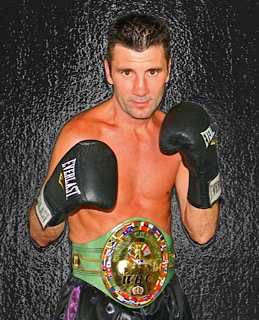
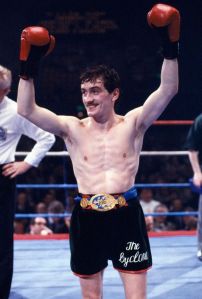
McCullough turns professional in 1993, moving to Las Vegas, Nevada, to train under legendary coach Eddie Futch. Less than 2½ years after his debut, he captures the WBC bantamweight title on July 30, 1995, by defeating Yasuei Yakushiji in Japan, becoming the first Irish or UK boxer to win a world title there. He successfully defends the WBC belt twice before moving up in weight. He challenges for championships in super bantamweight and featherweight, including notable bouts against Daniel Zaragoza, Naseem Hamed, Erik Morales, and Oscar Larios. He is renowned for his relentless attacking style and exceptional durability, never being knocked down in his professional career.
McCullough’s career record consists of 34 professional bouts with 27 wins (18 by knockout) and 7 losses. He retires after a bout against Juan Ruiz in June 2008 due to injury, ending a career spanning 15 years.
McCullough marries Cheryl Rennie in 1993, and they have a daughter, Wynona, pursuing a career in entertainment. During his career, he faces mental health challenges, including depression and suicidal thoughts, which he overcomes with the support of his family and faith. He becomes a United States citizen in 2005.
After retiring, McCullough becomes a trainer for amateur and professional fighters and works to promote goodwill in sports as WBC World Ambassador for Peace. He is also involved in mixed martial artspublic relations and founds his charity initiative, IHOW. He publishes his autobiography, Pocket Rocket: Don’t Quit, in 2005. In 2019, he is inducted into the Nevada Boxing Hall of Fame for his contributions to the sport.
McCullough’s courage, low knockdown susceptibility, and international successes have cemented him as a revered figure in boxing, both in Ireland and globally. His story is one of triumph, resilience, and overcoming personal and professional adversity.
Cooney is encouraged to become a professional fighter by his father. His brother, Tommy Cooney, is also a boxer and reaches the finals of the New York Golden Gloves Sub-Novice Heavyweight division. His grandparents lived in Placentia, Newfoundland, in Canada.
Fighting as an amateur, Cooney wins international tournaments in England, Wales, and Scotland, as well as the New York Golden Gloves titles. He wins two New York Golden Gloves Championships, defeating Larry Derrick to win the 1973 160-lb Sub-Novice Championship and Earlous Tripp to win the 1976 Heavyweight Open Championship. In 1975 he reaches the finals of the 175-lb Open division, but is defeated by Johnny Davis. He trains at the Huntington Athletic Club in Long Island, New York, where his trainer is John Capobianco. His amateur record consists of 55 wins and 3 losses.
When Cooney turns professional, he signs with co-managers Mike Jones and Dennis Rappaport. He is trained by Victor Valle. Known for his big left-hook and his imposing size, he has his first paid fight on February 15, 1977, beating Billy Jackson by a knockout in one round. Nine wins follow and he gains attention as a future contender, although his opponents are carefully chosen. He moves up a weight class and fights future world cruiserweight champion S. T. Gordon in Las Vegas, winning by a fourth round disqualification. He has eleven more wins, spanning 1978 and 1979. Among those he defeats are Charlie Polite, former U.S. heavyweight champion Eddie Lopez, and Tom Prater. These are not rated contenders, however.
By 1980, Cooney is being featured on national television. Stepping up, he beats one-time title challengers Jimmy Young and Ron Lyle, both by knockout. The Young fight is stopped because of cuts sustained by Young. By then Cooney is ranked number 1 by the World Boxing Council (WBC) and eager for a match with champion Larry Holmes.
In 1981, Cooney defeats former world heavyweight champion Ken Norton by knockout just 54 seconds into the first round with a blisteringly powerful attack. This ties the record set in 1948 by Lee Savold for the quickest knockout in a main event in Madison Square Garden. Since his management team is unwilling to risk losing a big future pay day with Holmes by having him face another viable fighter, Cooney does not fight for 13 months after defeating Norton.
The following year, Holmes agrees to fight Cooney with the fight held on June 11, 1982. With a purse of ten million dollars for the challenger, it is the richest fight in boxing history to that time. The promotion of the fight takes on racial overtones that are exaggerated by the promoters, something Cooney does not agree with. He believes that skill, not race, should determine if a boxer is good. However, if he wins, he would become the first Caucasian world heavyweight champion since SwedeIngemar Johansson defeated Floyd Patterson 23 years earlier. Don King calls Cooney “The Great White Hope.” The bout draws attention worldwide, and Larry Holmes vs. Gerry Cooney is one of the biggest closed-circuit/pay-per-view productions in history, broadcast to over 150 countries.
Cooney fights bravely after he is knocked down briefly in the second round. He is fined three points for repeated low blows. After 12 rounds, the more skillful and experienced Holmes finally wears him down. In round 13, his trainer, Victor Valle, steps into the ring, forcing the referee to stop the fight. Two of the three judges would have had Cooney ahead after the 12th round if it were not for the point deductions. He and Holmes become friends after the fight, a relationship that endures for them. On December 14, 1982, he fights Harold Rice, the heavyweight champion of Connecticut, in a four-round bout. No winner is declared, so he tells the crowd following the bout, “This is only an exhibition. I’m sorry if I disappointed anybody. I’m trying to work myself back in shape so I can knock out Larry Holmes. Everything is OK. I felt a little rusty, but that is normal. It has been a while. I felt good in front of the people.”
After a long layoff, Cooney fights in September 1984, beating Phillip Brown by a 4th-round knockout in Anchorage, Alaska. He fights once more that year and wins, but personal problems keep him out of the ring.
Although Cooney fights only three official bouts in five years following his loss to Holmes, in 1987 he challenges former world heavyweight and world light heavyweight champion Michael Spinks in a title bout. He appears past his prime and Spinks, boxing carefully with constant sharp counters, knocks him out in the fifth round. His last fight is in 1990. He is knocked out in a match-up of power-punching veterans in two rounds by former world champion George Foreman. He does stagger Foreman in the first round, but he is over-matched, and Foreman knocks him out two minutes into the second round.
The losses to Holmes, Spinks, and Foreman exposes Cooney’s Achilles’ heel: his inability to clinch and tie up his opponent when hurt. In the Foreman fight, he rises from a second-round knockdown and stands in the center of the ring as Foreman delivers the coup de grâce.
Cooney compiles a professional record of 28 wins and 3 losses, with 24 knockouts. Not a single one of his fights ever goes the distance in a 12 or 15-round match. He is ranked number 53 on The Ring‘s list of “100 Greatest Punchers of All Time.”
Cooney founds the Fighters’ Initiative for Support and Training, an organization which helps retired boxers find jobs. He is deeply involved in J.A.B., the first union for boxers. He becomes a boxing promoter for title bouts featuring Roberto Durán, Héctor Camacho, and George Foreman. He is a supporter of the “hands are not for hitting” program, which tries to prevent domestic violence. He guides young fighters in the gym. In June 2010, he becomes the co-host of “Friday Night at the Fights” on Sirius XM radio.
Cooney resides in Fanwood, New Jersey, with his wife Jennifer and two of their three children, Jackson and Sarah. His son Chris resides in New York. He has been inducted into the Hall of Fame at Walt Whitman High School (New York), where he graduated.
After a successful juvenile boxing career, McGuigan begins his professional boxing career on May 10, 1981, beating Selwyn Bell by knockout in two rounds in Dublin. He wins four out of five additional bouts in 1981. In 1982, McGuigan wins eight fights, seven by knockout, although one of these almost destroys his career and his life. Opposed by Young Ali, on June 14, 1982, McGuigan wins by a knockout in six rounds. Ali falls into a coma and dies five months later.
In 1985, McGuigan meets former world featherweight champion Juan Laporte and wins a 10-round decision. Following one more win, he finally gets his world title attempt when the long reigning WBA featherweight champion, Eusebio Pedroza of Panama, comes to London to put his title on the line at Loftus Road soccer stadium. McGuigan becomes the champion by dropping Pedroza in the seventh round and winning a unanimous fifteen-round decision in a fight refereed by hall of fame referee Stanley Christodoulou. McGuigan and his wife are feted in a public reception through the streets of Belfast that attracts several hundred thousand spectators. Later that year, he is named BBC Sports Personality of the Year, becoming the first person not born in the United Kingdom to win the award.
McGuigan twice successfully defends his title, first against American Bernard Taylor, who is stopped in nine rounds, and then against Dominican Danilo Cabrera in a controversial knock out in fourteen rounds. The fight is stopped after Cabrera bends over to pick up his mouthpiece after losing it, a practice that is allowed in many countries but not in Ireland. Cabrera is not aware of this, and the fight is stopped.
McGuigan’s next defence takes place in Las Vegas in June 1986, where he faces the relatively unknown Steve Cruz of Texas, in a gruelling 15-round title bout under a blazing sun. McGuigan holds a lead halfway through, but suffers dehydration due to the extreme heat and wilts near the end, being dropped in the tenth and fifteenth rounds. He eventually loses the world title, which he never reclaims, in a close decision. After the fight McGuigan requires hospitalisation because of his dehydrated state.
McGuigan retires after the fight but returns to the ring between 1988 and 1989, beating former world title challengers Nicky Perez and Francisco Tomas da Cruz, as well as contender Julio César Miranda, before losing to former EBU featherweight champ and future WBC and WBA super featherweight challenger Jim McDonnell by a technical knockout. After the McDonnell fight he permanently retires from boxing. His record is 32 wins and 3 losses, with 28 knockouts. In January 2005, McGuigan is elected into the International Boxing Hall of Fame.
McGuigan founds and is the current President of the Professional Boxing Association (PBA). He is also the CEO and founder of Cyclone Promotions.