
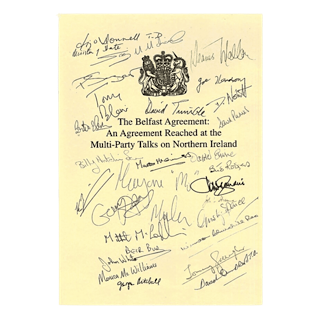
On October 30, 2000, the Good Friday Agreement (GFA) — the 1998 peace settlement that establishes a power sharing Executive in Northern Ireland — is at a critical juncture. The Government of the United Kingdom seeks to determine whether David Trimble, First Minister of Northern Ireland, can ban Sinn Féin ministers from attending cross‑border committee meetings between the Northern Ireland Assembly and the Republic of Ireland’s Oireachtas.
This move comes amid deep political tensions over decommissioning and Sinn Féin’s role in the peace process. The GFA requires both the UK and Irish governments to ratify the agreement, and the Northern Ireland Assembly to function under a power sharing Executive. However, progress on decommissioning — the disarmament of paramilitary groups — has stalled, and Sinn Féin’s participation in cross‑border talks is seen by some Unionists as a political liability.
The dispute reflects broader disagreements over:
- Sinn Féin’s political legitimacy in the peace process.
- Unionist concerns about the Irish Republican Army’s (IRA) continued armed activities.
- Irish government and nationalist demands for full political inclusion.
The UK Government’s attempt to restrict Sinn Féin’s cross‑border participation is a direct challenge to the GFA’s principle of inclusive political engagement. It underscores the fragility of the peace process, as even the most carefully negotiated agreements can be undermined by procedural disputes and mistrust between parties.
This episode is part of a wider period of implementation challenges after the GFA’s signing, where political disagreements over disarmament, decommissioning, and cross‑border cooperation often threaten to paralyse the Assembly.


