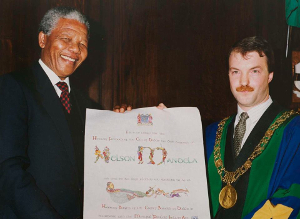
Nelson Rolihlahla Mandela, the first president of South Africa to be elected in a fully representative democratic election, is awarded the Freedom of the City of Dublin on his 70th birthday, July 18, 1988. Mandela is not available to receive his award on the date it is conferred, however, as he is a prisoner in South Africa at the time. On July 1, 1990, after his release from prison, Mandela finally receives the Freedom of the City of Dublin at a ceremony in the Mansion House Dublin.
The Freedom of the City of Dublin is awarded by Dublin City Council after approving a person nominated by the Lord Mayor of Dublin. Eighty people have been honoured under the current process introduced in 1876. Most honourees have made a contribution to the life of the city or of Ireland in general, including politicians, public servants, humanitarians, artists, and entertainers. Others have been distinguished members of the Irish diaspora and foreign leaders, honoured visiting Dublin. Honourees sign the roll of freedmen in a ceremony at City Hall or the Mansion House and are presented with an illuminated scroll by the Lord Mayor.
Mandela is honoured with the Freedom of Dublin city for his contribution to society and commitment to the study and promotion of Human Rights and also his work in the area of development and social inclusion, which has enhanced the lives of local communities in Ireland and fostered global links with institutions and organisations.
Holders of this award have some ancient privileges and duties such as the right to bring goods into Dublin through the city gates without paying customs duties, the right to pasture sheep on common ground within the city boundaries including College Green and St. Stephen’s Green (this right is exercised as a publicity stunt by U2 members the day after their 2000 conferring), and the right to vote in municipal and parliamentary elections. Some of the ancient duties are that freemen/women must be ready to defend the city of Dublin from attack and, at short notice, can be called up to join a city militia. Also a law which was passed in 1454 states that freemen/women must own a bow, a coat of mail, a helmet, and a sword.
At the age of 18, Sr. Stan, then Treasa Kennedy, decides to become a nun. Following in the footsteps of Mary Aikenhead, founder of the Religious Sisters of Charity, she too is drawn to work on behalf of the poor in the towns and cities of Ireland. For over fifty years she has pioneered, campaigned, explored, and developed a range of inspiring social innovations to benefit thousands of people who have experienced exclusion in its many forms.
In the 1960s, Sr. Stan is missioned to Kilkenny to work alongside Bishop Peter Birch in developing Kilkenny Social Services. For nineteen years Peter Birch is both guide and mentor to Sr. Stan as the Kilkenny social services develop into an innovative, comprehensive model of community care becoming a blue-print for the rest of Ireland.
In 1974, the Irish Government appoints Sr. Stan as the first chair of The National Committee on Pilot Schemes to Combat Poverty, and in 1985 the European Commission appoints her as trans-national coordinator in the European rural anti poverty programme working across Europe.
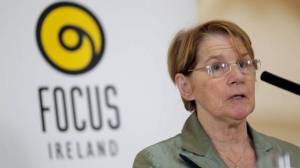
Moving to Dublin in the early 1980s, Sr. Stan tackles one of Ireland’s most neglected social inequalities – homelessness. In 1985, she establishes Focus Point which is now Focus Ireland, the biggest national, voluntary organisation helping people to find, create, and maintain a home.
Sr. Stan founds The Sanctuary in 1998, a meditation/spirituality centre in the heart of Dublin, a place where people can find a quiet space and time for themselves to explore and develop their inner world and wisdom and find stillness.
Sr. Stan establishes two other initiatives in 2001, the Immigrant Council of Ireland (ICI), an independent national organisation working to promote the rights of immigrants through information, advocacy, and legal aid and the Young Social Innovators (YSI), a national showcase providing an opportunity for students to become involved in social issues.
Sr. Stan has also written thousands of articles that have been published in Ireland and elsewhere. She lectures on social issues and policies, is a frequent keynote speaker at many events, and regularly gives talks to many diverse groups in Ireland, Europe, and outside of Europe.
Sheehy is educated at the Dominican Convent on Eccles Street, where she is a prize-winning pupil. She then enrolls at St. Mary’s University College, a third level college for women established by the Dominicans in 1893, to study modern French and German. She sits for examinations at Royal University of Ireland and receives a Bachelor of Arts degree in 1899, and a Master of Arts Degree with first-class honours in 1902. This leads to a career as a teacher in Eccles Street and an examiner in the Intermediate Certificate examination.
Sheehy marries Francis Skeffington in 1903, and they both take the surname Sheehy Skeffington, which they do not hyphenate but use as a double name. In 1908, they found the Irish Women’s Franchise League, a group aiming for women’s voting rights.
Sheehy-Skeffington gets into numerous scuffles with the law. She is jailed in 1912 for breaking windows of government buildings in support of suffrage as part of an IWFL campaign. That same year she also throws a hatchet at visiting British Prime Minister Herbert Asquith. She loses her teaching job in 1913 when she is arrested and imprisoned for three months after throwing stones at Dublin Castle and assaulting a police officer in a feminist action. While in jail she goes on hunger strike and is released under the Prisoner’s Temporary Discharge of Ill Health Act but is soon rearrested.
Being free from her teaching job enables Sheehy-Skeffington to devote more time to the fight for suffrage. She is influenced by James Connolly and during the 1913 lock-out works with other suffragists in Liberty Hall, providing food for the families of the strikers.
She strongly opposes participation in World War I which breaks out in August 1914 and is prevented by the British government from attending the International Congress of Women held in The Hague in April 1915. The following June her husband is imprisoned for anti-recruiting activities. He is later shot dead during the 1916 Easter Rising after having been arrested by British soldiers.
Sheehy-Skeffington refuses compensation for her husband’s death, which is offered on condition of her ceasing to speak and write about the murder. Rather, she travels to the United States to publicise the political situation in Ireland. In October 1917, she is the sole Irish representative to League for Small and Subject Nationalities where, along with several other contributors, she is accused of pro-German sympathies. She publishes British Militarism as I Have Known It, which is banned in the United Kingdom until after the World War I. Upon her return to Britain she is once again imprisoned, this time in Holloway prison. After release, Sheehy-Skeffington attends the 1918 Irish Race Convention in New York City and later supports the anti-Treaty Irish Republican Army (IRA) during the Irish Civil War.
In 1926, Sheehy-Skeffington becomes a founding member of Fianna Fáil and is elected to the party’s Ard Comhairle. During the 1930s, she is assistant editor of An Phoblacht. In January 1933, she is arrested in Newry for breaching an exclusion order banning her from Northern Ireland. At her trial she says, “I recognize no partition. I recognize it as no crime to be in my own country. I would be ashamed of my own name and my murdered husband’s name if I did…Long live the Republic!” She is sentenced to a month’s imprisonment.


 seamus dubhghaill