seamus dubhghaill

Promoting Irish Culture and History from Little Rock, Arkansas, USA


1 Comment

Birth of Musician Gary Moore in Belfast

gary-moore

Robert William Gary Moore, Northern Irish musician, most widely recognised as a singer, songwriter, and virtuoso rock and blues guitarist, is born in Belfast on April 4, 1952.

In a career dating back to the 1960s, Moore plays with musicians including Phil Lynott and Brian Downey during his teenage years, leading him to memberships of the Irish bands Skid Row and Thin Lizzy, and British band Colosseum II. Moore shares the stage with such blues and rock musicians as B.B. King, Albert King, Jack Bruce, Albert Collins, George Harrison, and Greg Lake, as well as having a successful solo career. He guests on a number of albums recorded by high-profile musicians.

Moore starts performing at a young age, having picked up a battered acoustic guitar at the age of eight. He gets his first quality guitar at the age of 14, learning to play the right-handed instrument in the standard way despite being left-handed.

At the age of 16, aiming to become a musician, he moves to Dublin. Moore’s greatest influence in the early days is guitarist Peter Green of Fleetwood Mac who is a mentor to Moore when performing in Dublin. Other early musical influences are artists such as Albert King, Elvis Presley, The Shadows, and The Beatles. Later, having seen Jimi Hendrix and John Mayall’s Bluesbreakers in his hometown of Belfast, his own style is developing into a blues-rock sound that becomes the dominant form of his career in music.

In Dublin, Moore joins the group Skid Row with Noel Bridgeman and Brendan “Brush” Shiels. It is with this group that he earns a reputation in the music industry, and his association with Phil Lynott begins.

Moore moves to England in 1970 and in 1973, under the name “The Gary Moore Band,” he releases his first solo album, Grinding Stone. Grinding Stone receives “Album of the Year” accolades on KTAC-FM/Seattle-Tacoma, Washington, in 1974.

In 1974 he joins Thin Lizzy after the departure of founding member Eric Bell. From 1975 to August 1978, he is a member of Colosseum II. In 1977, Moore rejoins Thin Lizzy, first as a temporary replacement for Brian Robertson, and on a permanent basis a year later.

In July 1979, he leaves the band permanently to focus on his solo career, again with help from Phil Lynott. After a series of rock records, Moore returns to blues music with Still Got the Blues (1990), with contributions from Albert King, Albert Collins, and George Harrison. Other collaborations during his solo years include a broad range of artists including Trilok Gurtu, Dr. Strangely Strange, Jimmy Nail, Mo Foster, Ginger Baker, Jack Bruce, Jim Capaldi, B.B. King, Vicki Brown, Cozy Powell, Rod Argent, The Beach Boys, Paul Rodgers, Keith Emerson, Roger Daltrey, and Otis Taylor.

Gary Moore dies of a heart attack in his sleep at the age of 58 during the early hours of February 6, 2011. At the time, he is on holiday with a girlfriend at the Kempinski Hotel in Estepona, Spain. Moore is laid to rest in St. Margaret’s Churchyard, Rottingdean, East Sussex, England, in a private ceremony with only family and close friends in attendance.


Leave a comment

Birth of Scientific Writer Dionysius Lardner in Dublin

dionysius-lardner

Dionysius Lardner, scientific writer who popularised science and technology and edited the 133-volume Cabinet Cyclopædia, is born in Dublin on April 3, 1793.

Lardner’s father was a solicitor in Dublin, who wishes his son to follow the same calling. After some years of uncongenial desk work, Lardner enters Trinity College, Dublin in 1812, obtains a B.A. in 1817 and an M.A. in 1819, winning many prizes. While in Dublin, Lardner begins to write and lecture on scientific and mathematical matters, and to contribute articles for publication by the Irish Academy.

In 1828, Lardner is elected professor of natural philosophy and astronomy at University College, London, a position he holds until he resigns his professorship in 1831. He is the author of numerous mathematical and physical treatises on such subjects as algebraic geometry, differential and integral calculus, and the steam engine. He also writes handbooks on various departments of natural philosophy, but it is as the editor of Lardner’s Cabinet Cyclopædia that he is best remembered.

The Cabinet Cyclopædia eventually comprises 133 volumes with many of the ablest savants of the day contributing to it, including Sir Walter Scott, Thomas Moore, Connop Thirlwall, and Robert Southey. Lardner himself is the author of the treatises on arithmetic, geometry, heat, hydrostatics and pneumatics, mechanics, and electricity. The Cabinet Library and the Museum of Science and Art are his other chief undertakings.

In 1840, Lardner’s career receives a major setback as a result of his involvement with Mary Spicer Heaviside, the wife of Captain Richard Heaviside, of the Dragoon Guards. Lardner runs off to Paris with Mrs. Heaviside and is pursued by her husband. When he catches up with them, Heaviside subjects Lardner to a flogging but is unable to persuade his wife to return with him. Later that year Heaviside successfully sues Lardner for “criminal conversation” (adultery) and receives a judgment of £8,000. The Heavisides are divorced in 1845 and Lardner marries Mary Heaviside in 1846. The scandal effectively ends his career in England, so Lardner and his wife remained in Paris until shortly before his death in 1859. He is able to maintain his career by lecturing in the United States between 1841 and 1844, which proves financially rewarding.

Lardner dies in Naples, Italy, on April 29, 1859, and is buried in the Cimitero degli Inglesi there.


Leave a comment

The Founding of Cumann na mBan

cumann-na-mban

Cumann na mBan, an Irish republican women’s paramilitary organisation, is formed in Dublin on April 2, 1914.

In 1913, a number of women decide to hold a meeting in Wynn’s Hotel, Dublin, for the purpose of discussing the possibility of forming an organisation for women who would work in conjunction with the recently formed Irish Volunteers. A meeting led by Kathleen Lane-O’Kelly on April 2, 1914, marks the foundation of Cumann na mBan. Branches, which pledge to the Constitution of the organisation, are formed throughout the country and are directed by the Provisional Committee.

The primary aims of Cumann na mBan, as stated in its constitution, are to “advance the cause of Irish liberty and to organize Irishwomen in the furtherance of this object,” to “assist in arming and equipping a body of Irish men for the defence of Ireland” and to “form a fund for these purposes, to be called ‘The Defence of Ireland Fund.'”

Recruits come from diverse backgrounds, mainly white-collar workers and professional women, but with a significant proportion also from the working class. In September 1914, the Irish Volunteers split over John Redmond‘s appeal for its members to enlist in the British Army. The majority of Cumann na mBan members support the 10,000 to 14,000 volunteers who rejected this call and who retain the original name, the Irish Volunteers.

On April 23, 1916, when the Military Council of the Irish Republican Brotherhood finalises arrangements for the Easter Rising, it integrates Cumann na mBan, along with the Irish Volunteers and Irish Citizen Army, into the “Army of the Irish Republic.”

On the day of the Rising, Cumann na mBan members arrive armed with both a Webley revolver and a typewriter, entering the General Post Office (GPO) on O’Connell Street in Dublin with their male counterparts. By nightfall, women insurgents are established in all the major rebel strongholds throughout the city. The majority of the women work as Red Cross workers, are couriers, or procure rations for the men. Members also gather intelligence on scouting expeditions, carry despatches, and transfer arms from dumps across the city to insurgent strongholds. A number of Cumann na mBan members die during the Rising.

At the Four Courts, they help to organise the evacuation of buildings at the time of surrender and destroy incriminating papers. On April 29, the leaders at the GPO decide to negotiate surrender. Patrick Pearse, the overall Commandant-General, asks Cumann na mBan member Elizabeth O’Farrell to act as a go-between. Under British military supervision she brings Pearse’s surrender order to the rebel units still fighting in Dublin. Over 70 women, including many of the leading figures in Cumann na mBan, are arrested after the insurrection, and many of the women who are captured fighting are imprisoned in Kilmainham Gaol. All but twelve are released by May 8, 1916.

Revitalized after the Rising and led by Countess Markievicz, Cumann na mBan takes a leading role in popularising the memory of the 1916 leaders, organising prisoner relief agencies, opposing conscription, and canvassing for Sinn Féin in the 1918 general election, in which Markievicz is elected Teachta Dála.

Cumann na mBan supports the Provisional wing in the 1969-1970 split in the Irish Republican Army (IRA) and Sinn Féin. In Northern Ireland, Cumann na mBan is integrated into the mainstream IRA during the conflict, although they continue to exist as a separate organisation in the Republic of Ireland. In 1986, Cumann na mBan opposes the decision by the IRA and Sinn Féin to drop the policy of abstentionism and aligns itself with Republican Sinn Féin and the Continuity IRA.

In 2014, Cumann na mBan celebrates the Centenary of its foundation in Wynn’s Hotel, Dublin, the site of their founding in 1914. The U.K. Home Office in March 2015 lists Cumann na mBan as a group linked to Northern Ireland related terrorism. However, it is not so listed in 2008 by the U.S. State Department.


Leave a comment

Éamon de Valera Elected President of Dáil Éireann

eamon-de-valera

Éamon de Valera is elected President of Dáil Éireann (Príomh Aire) at the third meeting of the First Dáil on April 1, 1919.

The Declaration of Independence asserts that the Dáil is the parliament of a sovereign state called the “Irish Republic,” and so the Dáil establishes a cabinet called the Ministry or “Aireacht,” and an elected prime minister known both as the “Príomh Aire” and the “President of Dáil Éireann.”

When the First Dáil meets in the Round Room of the Mansion House in Dublin on January 21, 1919, de Valera is the president of Sinn Féin and thus the natural choice for leadership. However, he is imprisoned in England so, at the second meeting of the Dáil on January 22, Cathal Brugha is elected as the first Príomh Aire on a temporary basis. De Valera escapes Lincoln Gaol in February and is then elected to replace Brugha at the Dáil’s third meeting.

As leader, de Valera visits the United States from June 1919 to December 1920. His aim is to gain both popular and official recognition for the Republic and to obtain a loan to finance Dáil Éireann and the War of Independence. By the time of his return, de Valera has won public but not official support for the Republic and has raised a loan of $6 million.

After the election of the Second Dáil in 1921, de Valera resigns on August 26 and is immediately re-elected under the new title of President of the Republic. He then remains in office until January 1922 when, against his wishes, the Dáil votes to ratify the Anglo-Irish Treaty. De Valera resigns and submits his name for re-election but is rejected by the house, which instead elects Arthur Griffith, who supports the Treaty, by a vote of 60-58.

On January 16, 1922, the British government implements the Treaty and appoints a new Irish administration called the Provisional Government. The Dáil decides that the new administration will operate in parallel with the existing institutions of the Irish Republic, which the British do not recognise. Therefore, as the Irish Civil War begins the country has two leaders, Arthur Griffith as President of Dáil Éireann and Michael Collins as Chairman of the Provisional Government. Collins is also Minister for Finance in Griffith’s cabinet. This anomalous situation continues until Griffith and Collins both died suddenly in August 1922, Collins being assassinated by anti-Treaty irregulars and Griffith dying of natural causes. W.T. Cosgrave becomes Chairman of the Provisional Government on August 25 and, when he is also elected as President of Dáil Éireann in September, the two administrations are merged.

On December 6, both the Irish Republic and the Provisional Government come to an end as the new Constitution of the Irish Free State comes into force. The new Irish Free State has three leaders, the King as head of state, the Governor-General as the King’s representative, and the President of the Executive Council as head of government. W.T. Cosgrave is appointed as the first President of the Executive Council on the same day.


Leave a comment

Birth of Father Ted, Dermot John Morgan

dermot-john-morgan

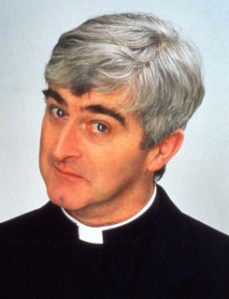
Dermot John Morgan, Irish comedian and actor who achieves international renown for his role as Father Ted Crilly in the Channel 4 sitcom Father Ted, is born in Dublin on March 31, 1952.

Educated at Oatlands College, Stillorgan, and University College, Dublin (UCD), Morgan comes to prominence as part of the team behind the highly successful RTÉ television show The Live Mike. Morgan makes his debut in the media on the Morning Ireland radio show produced by Gene Martin. Between 1979 and 1982 Morgan, who has been a teacher at St. Michael’s College, Ailesbury Road, plays a range of comic characters who appear between segments of the show, including Father Trendy, an unctuous trying-to-be-cool Catholic priest given to drawing ludicrous parallels with non-religious life in two-minute ‘chats’ to camera.

Morgan’s success as Father Trendy and other characters leads him to leave teaching and become a full-time comedian.

Morgan’s biggest Irish broadcasting success occurs in the late 1980s on the Saturday morning radio comedy show Scrap Saturday, which mocks Ireland’s political, business, and media establishment. The show’s treatment of the relationship between the ever-controversial Taoiseach Charles Haughey and his press secretary P.J. Mara prove particularly popular. When RTÉ axes the show in the early 1990s a national outcry ensues. Morgan lashes the decision, calling it “a shameless act of broadcasting cowardice and political subservience.”

Already a celebrity in Ireland, Morgan’s big break comes in Channel 4‘s Irish sitcom Father Ted, which runs for three series from April 21, 1995 until May 1, 1998. Writers Graham Linehan and Arthur Mathews audition many actors for the title role, but Morgan’s enthusiasm wins him the part.

Father Ted centres on three disparate characters. Father Ted Crilly, played by Morgan, lives a frustrated life trapped on the fictional Craggy Island. Irish TV comedy actor Frank Kelly plays Father Jack Hackett, a foul-mouthed and apparently brain-damaged alcoholic, while child-minded Father Dougal McGuire is played by comedian Ardal O’Hanlon. The three priests are looked after by their housekeeper, Mrs. Doyle, played by Pauline McLynn, with whom Morgan had worked on Scrap Saturday. Father Ted enjoys widespread popularity and critical acclaim. In 1998, the show wins a BAFTA award for the best comedy, Morgan wins a BAFTA for best actor, and McLynn is named best actress.

On February 28, 1998, one day after recording the last episode of Father Ted, Morgan has a heart attack while hosting a dinner party at his home in southwest London. He is rushed to hospital but dies soon afterwards. Morgan’s Requiem Mass in St. Therese’s Church in Mount Merrion, south Dublin, is attended by the President of Ireland Mary McAleese, her predecessor, Mary Robinson, and by political and church leaders, many of whom had been the targets of his humour in Scrap Saturday. He is cremated at Glasnevin Cemetery and his ashes are buried in the family plot in Deansgrange Cemetery.


Leave a comment

Assassination of MP for Abingdon, Airey Neave

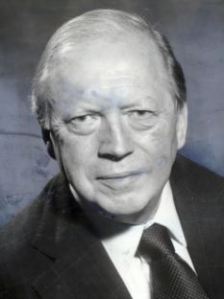
airey-neaveAirey Middleton Sheffield Neave, British army officer, barrister, and politician, is killed in a car-bomb attack at the House of Commons on March 30, 1979. During World War II, Neave is the first British officer to successfully escape from the German prisoner-of-war camp Oflag IV-C at Colditz Castle. He later becomes Conservative Member of Parliament (MP) for Abingdon.

Neave is killed when a magnetic car-bomb fitted with a ball bearing tilt switch explodes under his Vauxhall Cavalier just before 3:00 PM as he drives out of the Palace of Westminster car park. He loses his right leg below the knee and his left is hanging on by a flap of skin. Neave dies without regaining consciousness at the hospital an hour after being freed from the wreckage. The Irish National Liberation Army (INLA), an illegal Irish republican paramilitary group, claims responsibility for the killing.

Conservative leader Margaret Thatcher leads tributes, saying, “He was one of freedom’s warriors. No one knew of the great man he was, except those nearest to him. He was staunch, brave, true, strong; but he was very gentle and kind and loyal. It’s a rare combination of qualities. There’s no one else who can quite fill them. I, and so many other people, owe so much to him and now we must carry on for the things he fought for and not let the people who got him triumph.”

Labour Prime Minister James Callaghan says, “No effort will be spared to bring the murderers to justice and to rid the United Kingdom of the scourge of terrorism.”

The INLA issues a statement regarding the killing in the August 1979 edition of The Starry Plough, “In March, retired terrorist and supporter of capital punishment, Airey Neave, got a taste of his own medicine when an INLA unit pulled off the operation of the decade and blew him to bits inside the ‘impregnable’ Palace of Westminster. The nauseous Margaret Thatcher snivelled on television that he was an ‘incalculable loss’ — and so he was — to the British ruling class.”

Neave’s death comes just two days after the vote of no confidence which brings down Callaghan’s government and a few weeks before the 1979 general election, which brings about a Conservative victory and sees Thatcher come to power as Prime Minister. Neave’s wife Diana is subsequently elevated to the House of Lords as Baroness Airey of Abingdon.

Neave’s biographer Paul Routledge meets a member of the Irish Republican Socialist Party, the political wing of INLA, who was involved in the killing of Neave and who tells Routledge that Neave “would have been very successful at that job [Northern Ireland Secretary]. He would have brought the armed struggle to its knees.”


Leave a comment

Birth of Singer Ruby Florence Murray

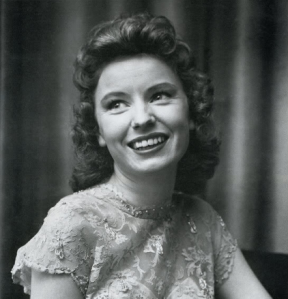
ruby-florence-murrayRuby Florence Murray, one of the most popular singers in the United Kingdom and Ireland in the 1950s, is born on the Donegal Road in south Belfast on March 29, 1935. In 1955 alone, she secures seven Top 10 UK hit singles.

The distinctive sound of Murray’s voice is partly the result of a throat operation in early childhood. She tours as a child singer and first appears on television at the age of 12, however, laws governing children performing, Murray has to delay her start in the entertainment industry. She returns to Belfast and full-time education until she reaches 14 years of age.

Spotted by producer Richard Afton, Murray is signed to Columbia and her first single, Heartbeat, reaches No. 3 in the UK Singles Chart in December 1954. Afton offers her the position of resident singer on the BBC‘s Quite Contrary television show, replacing Joan Regan. Softly, Softly, her second single, reaches number one in early 1955. That same year Murray sets a pop-chart record by having five hits in the Top Twenty in one week, a feat unmatched until the emergence of Madonna in the 1980s.

The 1950s is a busy period for Murray, during which she has her own television show, stars at the London Palladium with Norman Wisdom, appears in a Royal Command Performance, and tours the world. During a 52-week period, starting in 1955, Murray constantly has at least one single in the UK charts, this being at a time when only a Top 20 is listed.

Murray appears with Frankie Howerd and Dennis Price in her only film role, as Ruby in a 1956 farce, A Touch of the Sun. A couple of hits follow later in the decade. Goodbye Jimmy, Goodbye, a No. 10 hit in 1959, is her final appearance in the charts. EMI puts together a compilation album of her hits on CD in 1989, including songs that are regularly featured in her act, Mr. Wonderful, Scarlet Ribbons, and It’s the Irish in Me. They update this with the release of EMI Presents The Magic Of Ruby Murray in 1997 and a triple album, Anthology — The Golden Anniversary Collection, in 2005, the 50th anniversary of her peak successes on the charts.

A play about Murray’s life, Ruby, written by the Belfast playwright Marie Jones, opens at the Group Theatre in Belfast in April 2000.

Although her days as a major star gradually diminish, Murray continues performing until close to the end of her life. She spends her last couple of years in Asprey’s Nursing Home, often delighting her carers with a song. She dies of liver cancer, at the age of 61, on December 17, 1996 in Torquay after a long struggle with alcoholism.


Leave a comment

Birth of War Reporter William Howard Russell

william-howard-russell

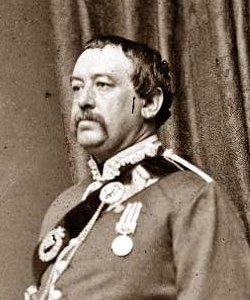
Sir William Howard Russell, reporter with The Times and considered to be one of the first modern war correspondents, is born at Lily Vale, Tallaght, County Dublin, on March 28, 1820.

As a young reporter, Russell reports on a brief military conflict between Prussian and Danish troops in Denmark in 1850. Sent by editor John Delane to Malta in 1854 to cover British support for the Ottoman Empire against Russia, Russell despises the term “war correspondent” but his coverage of the conflict brings him international renown. Florence Nightingale later credits her entry into wartime nursing to his reports. The Crimean medical care, shelter, and protection of all ranks by Mary Seacole is also publicised by Russell and by other contemporary journalists, rescuing her from bankruptcy.

Russell is described by one of the soldiers on the frontlines as “a vulgar low Irishman, who sings a good song, drinks anyone’s brandy and water, and smokes as many cigars as a Jolly Good Fellow. He is just the sort of chap to get information, particularly out of youngsters.” This reputation leads to Russell being blacklisted from some circles, including British commander Lord Raglan who advises his officers to refuse to speak with the reporter.

His dispatches are hugely significant. For the first time the public is able to read about the reality of warfare. Shocked and outraged, the public’s backlash from his reports leads the Government to re-evaluate the treatment of troops and lead to Florence Nightingale’s involvement in revolutionising battlefield treatment.

On September 20, 1854, Russell covers the battle above the Alma River. The story, written in the form of a letter to Delane, is supportive of the British troops though pays particular attention to the battlefield surgeons’ “humane barbarity” and the lack of ambulance care for wounded troops. He later covers the Siege of Sevastopol.

Following Russell’s reports of the appalling conditions suffered by the Allied troops conducting the siege, including an outbreak of cholera, Samuel Morton Peto and his partners build the Grand Crimean Central Railway, which is a major factor leading to the success of the siege. Russell leaves Crimea in December 1855.

In 1856, Russell is sent to Moscow to describe the coronation of Tsar Alexander II and in the following year is sent to India where he witnesses the final re-capture of Lucknow.

In 1861, Russell goes to Washington, returning to England in 1863. In July 1865, he sails on the SS Great Eastern to document the laying of the Transatlantic Telegraph Cable and writes a book about the voyage with color illustrations by Robert Dudley. He publishes diaries of his time in India, the American Civil War, and the Franco-Prussian War, where he describes the warm welcome given him by English-speaking Prussian generals such as Leonhard Graf von Blumenthal.

He is awarded the title of Commander of the Royal Victorian Order by King Edward VII. Russell later accuses fellow war correspondent Nicholas Woods of the Morning Herald of lying in his articles about the war to try to improve his stories.

In the 1868 General Election, Russell runs unsuccessfully as a Conservative candidate for the borough of Chelsea. He retires as a battlefield correspondent in 1882 and founds the Army and Navy Gazette. He is knighted in May 1895.

Russell dies on February 11, 1907, and is buried in Brompton Cemetery, London.


Leave a comment

The Bloody Sunday Inquiry Convenes

bloody-sunday-inquiry-1

The Bloody Sunday Inquiry, the biggest public inquiry in British history, opens properly on March 27, 2000, when formal public hearings begin at the Guildhall in Derry. The Inquiry holds public hearings on 116 days over the year, clocking up more than 600 hours of evidence. The vast majority of the evidence is from eyewitnesses.

The Bloody Sunday Inquiry, also known as the Saville Inquiry or the Saville Report after its chairman, Lord Saville of Newdigate, is established in 1998 by British Prime Minister Tony Blair after campaigns for a second inquiry by families of those killed and injured in Derry on Bloody Sunday during the peak of ethno-political violence known as The Troubles. The inquiry is set up to establish a definitive version of the events of Sunday, January 30, 1972, superseding the tribunal set up under Lord Widgery in April 1972, and to resolve the accusations of a whitewash that had surrounded it.

The inquiry takes the form of a tribunal established under the Tribunals of Inquiry (Evidence) Act 1921, and consists of Lord Saville, the former Chief Justice of New Brunswick William L. Hoyt, and John L. Toohey, a former Justice of the High Court of Australia. The judges retire on November 23, 2004, and reconvene once again on December 16 to listen to testimony from another key witness, known only as Witness X.

The results are published on June 15, 2010. The report states, “The firing by soldiers of 1 PARA on Bloody Sunday caused the deaths of 13 people and injury to a similar number, none of whom was posing a threat of causing death or serious injury.” It also says, “The immediate responsibility for the deaths and injuries on Bloody Sunday lies with those members of Support Company whose unjustifiable firing was the cause of those deaths and injuries.”

Saville states that British paratroopers “lost control”, fatally shooting fleeing civilians and those who tried to aid the civilians who had been shot by the British soldiers and that the civilians had not been warned by the British soldiers that they intended to shoot. Saville also says British soldiers should not have been ordered to enter the Bogside area as “Colonel Wilford either deliberately disobeyed Brigadier MacLellan’s order or failed for no good reason to appreciate the clear limits on what he had been authorised to do.”

The report states five British soldiers aimed shots at civilians they knew did not pose a threat and two other British soldiers shot at civilians “in the belief that they might have identified gunmen, but without being certain that this was the case.” It also states that British soldiers had concocted lies in their attempt to hide their acts and, contrary to the previously established belief, that none of the soldiers fired in response to attacks by petrol bombers or stone throwers, and that the civilians were not posing any threat. The report finds that Martin McGuinness, “did not engage in any activity that provided any of the soldiers with any justification for opening fire.”

bloody-sunday-inquiry-2

On the morning that the report is published, thousands of people walk the path that the civil rights marchers had taken on Bloody Sunday, holding photos of those who had been shot. The families of the victims receive advance copies of the report inside the Guildhall. British Prime Minister David Cameron addresses the House of Commons that afternoon where he acknowledges, among other things, that the paratroopers had fired the first shot, had fired on fleeing unarmed civilians, and shot and killed one man who was already wounded. He then apologises on behalf of the British Government.


Leave a comment

Death of Politician & Journalist Timothy Michael Healy

Timothy Michael “Tim” Healy, Irish nationalist politician, journalist, author, barrister, and one of the most controversial Irish Members of Parliament (MPs) in the House of Commons of the United Kingdom of Great Britain and Ireland, dies in Chapelizod, County Dublin, on March 26, 1931.

Healy is born in Bantry, County Cork, the second son of Maurice Healy, clerk of the Bantry Poor Law Union, and Eliza Healy (née Sullivan). His father is transferred in 1862 to a similar position in Lismore, County Waterford. Timothy is educated at the Christian Brothers school in Fermoy, and is otherwise largely self-educated, in 1869, at the age of fourteen, he goes to live with his uncle Timothy Daniel Sullivan in Dublin.

Healy then moves to England in 1871, working first as a railway clerk and then from 1878 in London as parliamentary correspondent of The Nation, writing numerous articles in support of Charles Stewart Parnell, the newly emergent and more militant home rule leader, and his policy of parliamentary obstructionism. Healy takes part in Irish politics and becomes associated with Parnell and the Irish Parliamentary Party. After being arrested for intimidation in connection with the Irish National Land League, he is promptly elected as member of Parliament for Wexford Borough in 1880.

In Parliament, Healy becomes an authority on the Irish land question. The “Healy Clause” of the Land Act of 1881, which protects tenant farmers’ agrarian improvements from rent increases imposed by landlords, not only makes him popular throughout nationalist Ireland but also wins his cause seats in Protestant Ulster. He breaks with Parnell in 1886 and generally remains at odds with subsequent leaders of the Irish Parliamentary Party, though he is a strong supporter of proposals for Irish Home Rule. Meanwhile, he is called to the Irish bar in 1884 and becomes a queen’s counsel in 1899.

Dissatisfied with both the Liberals and the Irish Nationalists after the Easter Rising in 1916, Healy supports Sinn Féin after 1917. He returns to considerable prominence in 1922 when, on the urging of the soon-to-be Irish Free State’s Provisional Government of W.T. Cosgrave, the British government recommends to King George V that Healy be appointed the first “Governor-General of the Irish Free State,” a new office of representative of the Crown created in the 1921 Anglo-Irish Treaty and introduced by a combination of the Irish Free State Constitution and Letters Patent from the King.

Healy believes that he has been awarded the Governor-Generalship for life. However, the Executive Council of the Irish Free State decides in 1927 that the term of office of Governors-General will be five years. As a result, he retires from the office and public life in January 1928 and publishes his extensive two volume memoirs later in that year. Throughout his life he is formidable because he is ferociously quick-witted, because he is unworried by social or political convention, and because he knows no party discipline. Towards the end of his life, he becomes more mellowed and otherwise more diplomatic.

Healy dies on March 26, 1931, at the age of 75, in Chapelizod, County Dublin. He is buried in Glasnevin Cemetery in Dublin.