seamus dubhghaill

Promoting Irish Culture and History from Little Rock, Arkansas, USA


Leave a comment

Death of John William Nixon, Politician & N.I. Police Leader

John William NixonMBE, a unionist politician and police leader in Northern Ireland, dies on May 11, 1949, at his home in Woodvale House, Ballygomartin Road, Belfast. He is allegedly responsible for several sectarian atrocities, including the McMahon killings and the Arnon Street killings. Eyewitnesses to the Arnon street killings claim they can identify the police involved and allege that their leader is District Inspector Nixon. It is widely believed that Nixon’s “murder gang” within the Royal Irish Constabulary (RIC) hunted down and murdered Catholics as reprisals for the killing of police.

Nixon is born on June 1, 1877, in Graddum, a townland located between the village of Kilnaleck and the hamlet of Crosskeys in County Cavan. He becomes a district inspector in the RIC, and transfers to its successor in the newly created region of Northern Ireland, the Royal Ulster Constabulary (RUC). By 1922, he is responsible for controlling access to the Roman Catholic Ardoyne and Marrowbone areas of Belfast, and works closely with the Ulster Special Constabulary (USC).

Irish nationalist writer and activist Michael Farrell alleges that during this period Nixon leads the Cromwell Club, an unofficial organisation of security officials responsible for killing several Catholic civilians. These allegations are not independently confirmed and during his lifetime Nixon successfully sues the Derry Journal and a book publisher for libel. He is appointed a Member of the Order of the British Empire (MBE) in 1923 “… for services rendered by him during the troubled period.”

In 1924, Nixon, long a member of the Orange Order, makes a political speech at an Orange lodge. This contravenes RUC regulations, and he is dismissed on the orders of Sir James Craig, the first Prime Minister of Northern Ireland.

Nixon is elected to Belfast Corporation as an Independent Unionist, but at the 1925 Northern Ireland general election, he stands unsuccessfully as an Ulster Unionist Party (UUP) candidate in Belfast North. At the 1929 Northern Ireland general election, running once again as an Independent Unionist, he is narrowly elected as the MP for Belfast Woodvale. From September 1932 until the 1933 Northern Ireland general election, he is the only opposition MP attending the Parliament of Northern Ireland. He is founder in 1931 of the Ulster Protestant League (UPL), whose object is to safeguard Protestant jobs, and is also connected with the Ulster Protestant Association (UPA), which includes a hard core of loyalist gunmen who carried out assassinations on Catholics during the mid-1930s. Until the end of his life, fearful that the Irish Republican Army (IRA) would catch up with him, he carries a revolver in the glove compartment of his car.

Nixon holds his seat until his death on May 11, 1949, at home in Woodvale House, Ballygomartin Road, Belfast. He denies the murder allegations against him until the end of his life.

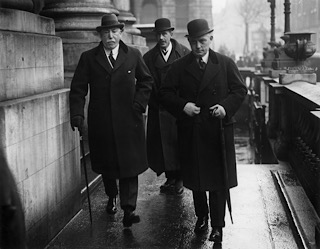
(Pictured: Captain John William Nixon (right) with Northern Ireland Prime Minister James Craig and Colonel Spencer, attending a conference with Michael Collins at City Hall, Dublin in February 1922)


Leave a comment

Proportional Representation Used in Ireland for the First Time

Proportional Representation (PR), specifically the Single Transferable Vote (STV), is used in Ireland for the first time in the local elections on January 15, 1920.

The STV, sometimes known as Proportional Ranked Choice Voting (P-RCV), is a multi-winner electoral system in which each voter casts a single vote in the form of a ranked-choice ballot. Voters have the option to rank candidates, and their vote may be transferred according to alternate preferences if their preferred candidate is eliminated or elected with surplus votes, so that their vote is used to elect someone they prefer over others in the running. STV aims to approach Proportional Representation based on votes cast in the district where it is used, so that each vote is worth about the same as another. Formally, STV satisfies a fairness criterion known as proportionality for solid coalitions.

Under STV, no one party or voting bloc can take all the seats in a district unless the number of seats in the district is very small or almost all the votes cast are cast for one party’s candidates, which is seldom the case. This makes it different from other district voting systems. In majoritarian or plurality systems – such as first-past-the-post (FPTP), instant-runoff voting (IRV; also known as the alternative vote), block voting, and ranked-vote block voting – one party or voting bloc can take all the seats in a district.

The key to STV’s approximation of proportionality is that each voter effectively only casts a single vote in a district contest electing multiple winners, while the ranked ballots (and sufficiently large districts) allow the results to approach proportionality. The use of a quota means that, for the most part, each successful candidate is elected with the same number of votes. This equality produces fairness – a party taking twice the votes than another party will take twice the seats compared to that other party.

Under STV, multiple winners are selected for a constituency (a multi-member district). Every sizeable group within the district wins at least one seat: the more seats the district has, the smaller the size of the group needed to elect a member. In this way, STV provides approximately proportional representation, ensuring that substantial minority factions have some representation.

STV is distinguished from plurality voting systems, like FPTP, plurality block voting and the single non-transferable vote (SNTV) by the fact that votes are transferable under STV but are not under the other systems. STV reduces the number of “wasted” votes, votes which are cast for unsuccessful candidates by electing multiple representatives for a district. Additionally, surplus votes collected by successful candidates are transferred to aid other candidates, preventing waste caused by successful candidates receiving votes over and above those actually needed to secure the seat.

An important characteristic of STV is that it enables votes to be cast for individual candidates rather than for parties. Party lists are therefore not needed, as opposed to many other proportional electoral systems). It is the voters who create their own ordered list of candidates. The ranked voting also allows voters to form consensus behind the most popular candidates.

In the 1921 Northern Ireland general elections, when PR is used, every seat is contested. However, after Northern Ireland reverts to the first-past-the-post (FPTP) system, numerous seats go uncontested by nationalists who know they have no chance of winning seats. In the 1933 Northern Ireland general election, fought under the British first-past-the-post system, only 19 of 52 seats are contested. Gerrymandered voting districts plus first-past-the-post see Unionists gain 36 of 52 seats in the election. This can be contrasted with the 1920 Irish local elections when Sinn Féin wins control of 10 of 12 urban councils.